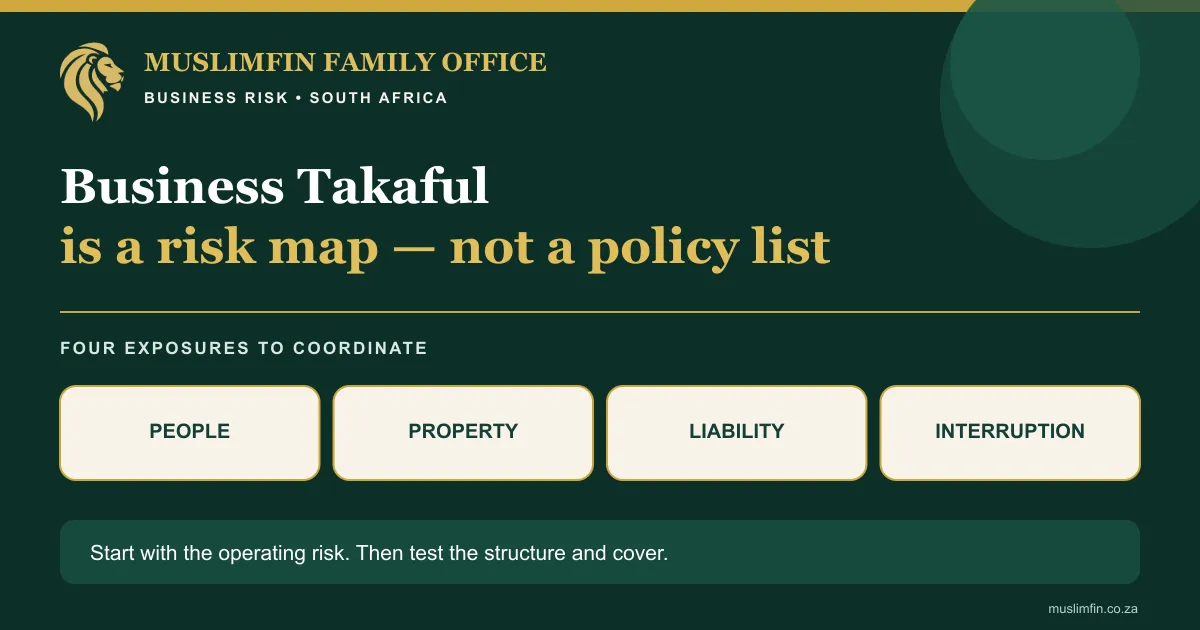
Cyber Takaful and Business Risk in South Africa
Cyber Takaful in South Africa should combine prevention, incident response, financial resilience and product-level Shariah due diligence. It should not be treated as a promise that every cyber loss will be paid. A policy responds only when the event, insured party, system, time period, notification, control warranties, exclusions, sublimits and evidence satisfy the wording.
Cyber losses can affect much more than computers. A compromised Microsoft 365 account can redirect supplier payments. Ransomware can stop orders and production. Stolen client information can trigger legal, forensic and notification costs. A cloud outage can interrupt revenue even though no equipment at the insured premises was damaged. A fraudulent instruction can create a disputed loss that falls between crime and cyber sections.
For a Muslim business, the product structure also matters. The review should examine whether a genuine participant risk fund exists, how the operator is paid, how funds are invested, how deficits and surplus are handled, whether retakaful is used, what conventional reinsurance remains and which qualified Shariah authority supervises the arrangement. Where no suitable Takaful capacity is available, the business should document the market search and obtain case-specific Shariah guidance on necessity and the least-problematic alternative.
This guide is general education, not a cybersecurity assessment, insurance recommendation, legal opinion, breach notification, forensic instruction or fatwa. Activate an appropriately qualified incident-response team when a real event occurs.
The direct answer
Cyber cover does not replace security
Insurers increasingly ask about multifactor authentication, backups, endpoint protection, patching, privileged access, email controls, employee training and incident plans. Incorrect answers or a failure to maintain warranted controls can damage a claim. Security also reduces harm that insurance cannot reverse, including client distrust and stolen confidential information.
A POPIA breach can require notification
The Information Regulator's security-compromise fact sheet states that POPIA does not provide a low-risk threshold that allows a responsible party to avoid notification. The responsible party should use its Information Officer or Deputy Information Officer to notify the Regulator and affected data subjects as required. An operator should notify the responsible party.
Cybercrime and privacy are separate legal workstreams
The Cybercrimes Act 19 of 2020 creates offences and investigation and reporting mechanisms. POPIA governs personal-information processing and security-compromise obligations. Contract, employment, banking and sector rules can add more duties. Reporting one issue does not automatically satisfy every other obligation.
Verify insurer and intermediary authority
Use the FSCA entity search to confirm the insurer, intermediary, FSP and relevant authorisations. Ask who underwrites the risk, handles claims, performs binder functions and receives each fee.
Map the cyber exposure before buying cover
Identify critical services
List email, banking, accounting, payroll, CRM, e-commerce, cloud storage, production systems, telephony, point-of-sale, access control, backups and supplier portals. Record the owner, administrator, hosting location, recovery target and maximum tolerable outage for each service.
Map information
Classify client, employee, supplier, financial, health, identity, payment and confidential business data. Record where it is collected, stored, copied, transmitted, backed up and deleted. Include laptops, phones, paper-to-digital scans, messaging platforms and external processors.
Map money movement
Identify who can create, approve and release payments; change supplier details; reset banking credentials; issue refunds; load payroll; and alter beneficiary accounts. Cyber fraud often exploits business processes rather than technical access alone.
Map dependent providers
Cloud hosts, IT support firms, payment gateways, accountants, payroll bureaus, logistics systems and software vendors can interrupt the business. Record contracts, security evidence, notification duties, limits of liability and alternative arrangements.
Quantify the loss
Estimate restoration, forensic, legal, notification, public-relations, extortion-response, lost-profit, increased-cost, fraud, liability and regulatory costs. Separate cash expense from revenue interruption and long-term client loss.
Understand the main cyber-cover sections
Incident response
Check whether the policy provides or reimburses breach counsel, forensic specialists, notification vendors, public relations and call centres. Confirm whether the insured must use panel providers and obtain prior consent. A twenty-four-hour hotline is useful only if authorised staff can find and use it.
Data and system restoration
Review definitions of data, software, hardware and restoration. Determine whether the policy pays to recreate data, remove malware, restore backups, improve systems or only return them to the pre-event state. Old unsupported systems can create disputes.
Cyber business interruption
Check the trigger, waiting period, indemnity period, insured measure, system failure, malicious event, human error and dependent-provider extensions. Revenue lost during a twelve-hour outage may be excluded by a waiting period even when the event is otherwise covered.
Privacy and network liability
This section can address third-party claims arising from disclosure, privacy breaches, malware transmission or failure of network security. Check defence costs, damages, regulatory investigations, contractual liability, territorial scope and exclusions.
Social engineering and funds transfer
Business-email compromise can lead an employee to authorise a genuine bank transfer to a criminal. Some wordings treat this as voluntary payment and exclude it unless a social-engineering extension applies. Compare cyber, fidelity, crime and banking protections; do not assume one policy fills every gap.
Cyber extortion
Review the definition, consent process, legal restrictions, sanctions screening, negotiator, cryptocurrency handling and whether payment is discretionary. Paying a demand does not guarantee data recovery or prevent publication. The response team should prioritise safety, law and restoration.
Regulatory and notification costs
Identify covered investigations, legal representation, notification, credit monitoring and fines where legally insurable. Do not assume that every administrative penalty can lawfully or contractually be transferred.
Apply Takaful due diligence
Confirm the contractual model
Request the participant agreement, policy wording, operator terms and fund structure. Determine whether risk contributions are treated through Tabarru and how claims are paid from the fund. MuslimFin's Tabarru guide explains the evidence a participant should obtain.
Understand operator remuneration
If a Wakala model is used, record the agency fee, performance incentives, expenses and conflicts. If a Mudarabah or mixed model applies, understand the profit allocation. The Wakala in Takaful guide provides a fuller operator review.
Review investments
Ask how contribution, reserve and claims funds are held and invested. Review prohibited activities, financial ratios, interest-bearing accounts, Sukuk, equities, money-market exposure, purification and breach handling.
Review retakaful and reinsurance
Cyber aggregation can create severe correlated loss across many participants. Ask what retakaful capacity exists, where conventional reinsurance is used, why it is used and how the Shariah authority treats the arrangement.
Review governance currency
A certificate without scope and date is weak evidence. Record the Shariah board or adviser, methodology, approval date, audited period, exceptions, unresolved matters and next review.
Document unavailable capacity
If the required limit, territory, industry or cyber extension is unavailable under Takaful, keep quotations and declinations. Obtain qualified guidance on necessity and proportionality, choose only the required cover and repeat the market search at renewal.
Build minimum cybersecurity controls
Multifactor authentication
Apply MFA to email, remote access, cloud administration, banking and critical systems. Prefer phishing-resistant methods where feasible. Remove inactive accounts and prohibit shared administrator credentials.
Backups
Keep multiple copies, including an offline or immutable copy. Test restoration rather than trusting a successful backup notification. Record recovery point, recovery time, encryption, administrator separation and test results.
Patch and vulnerability management
Maintain an asset inventory, supported software list, critical-patch deadline, external scanning and exception process. Internet-facing systems require special urgency.
Endpoint and email protection
Use centrally managed endpoint detection, malware protection, spam filtering, domain controls and attachment safeguards. Monitor alerts and define who responds outside business hours.
Payment verification
Verify bank-detail changes using a trusted, independent channel. Use maker-checker approvals, payment limits, beneficiary cooling periods and exception reporting. Never verify a payment through the same compromised email thread.
Access control
Grant the least privilege needed, review access regularly and remove it immediately after role changes or termination. Separate backup, security and production administration where possible.
Staff training
Use short recurring simulations and role-specific training for finance, executives, IT and client-facing employees. Measure reporting behaviour, not merely course completion.
Incident exercises
Run realistic tabletop exercises involving ransomware, data theft, payment fraud and cloud outage. Include directors, IT, legal, privacy, finance, communications, insurer and broker contacts.
POPIA incident-response controls
Establish responsible-party and operator roles
For each system, identify who determines the purpose and means of processing and which providers act as operators. Contracts should require timely incident notification, cooperation, evidence preservation and security controls.
Route the event to the Information Officer
The Information Officer or Deputy Information Officer should assess the compromise with legal and technical support. Keep the detection time, containment actions, affected data, people, systems and decisions in an incident log.
Notify through the current process
The Regulator's current fact sheet says all security compromises require reporting rather than a discretionary low-risk exemption. Determine the permitted timing, content, channels and any law-enforcement delay. Do not issue an improvised public statement without legal and factual review.
Notify affected data subjects appropriately
The notice should be clear, accurate and actionable. Explain what occurred, information affected, measures taken, protective steps and contact route without speculating or exposing additional personal data.
Preserve evidence
Maintain forensic images, logs, emails, authentication records, malware indicators, payment instructions and a defensible chain of custody. Coordinate preservation with restoration so that emergency cleanup does not erase the cause.
A practical incident sequence
First hour
Protect people, disconnect affected systems where appropriate, preserve volatile evidence, activate the response lead, notify the insurer or broker through the approved channel and stop suspicious payments. Do not wipe devices or negotiate independently.
First day
Engage approved forensic and legal support, define the incident boundary, secure privileged accounts, check backups, notify banking partners for payment fraud, assess privacy duties and create an executive decision log.
First week
Complete required notifications, monitor affected identities, restore through controlled stages, reconcile transactions, communicate with stakeholders, quantify interruption and preserve claim evidence.
Recovery period
Validate system integrity, rotate credentials, close control failures, calculate loss, submit claim schedules and update the risk register. Track customer and regulatory commitments to completion.
Claims evidence and common disputes
Proposal accuracy
Keep the completed proposal, control questionnaire, supporting screenshots and renewal changes. If the business stated that MFA covered all remote access, it should be able to prove the scope and maintenance of that control.
Date of discovery
Claims-made and notification provisions can depend on when the event or circumstance was discovered and reported. Record alerts, internal escalation and insurer notification precisely.
Waiting periods and loss measurement
Reconcile system outage, operational downtime and revenue loss. The policy may apply a time waiting period and a specific definition of insured loss. Preserve sales, orders, production, payroll and mitigation costs.
Crime versus cyber
A manipulated payment can be excluded from cyber but covered under a crime extension, or vice versa. Notify every potentially responsive policy without double recovery and let the wordings determine allocation.
Unauthorised providers
Emergency specialists can be costly, but a policy may require prior consent or panel providers. Store the incident hotline and authority matrix before the event.
Complaint escalation
Request a written coverage decision referencing the clause, facts and calculation. Respond with evidence and use the insurer's complaint process. Where within jurisdiction, the National Financial Ombud may provide an external route for participating non-life insurers.
MuslimFin's Takaful claims guide provides a structured claim register and escalation process.
Cyber interruption calculation example
Simplified facts
Assume a covered cyber event stops a business for five complete days. The policy has a twelve-hour waiting period. Verified insured gross profit lost after trend and mitigation adjustments is R120,000 per day. In addition, the business incurs R80,000 of reasonable approved increased costs to limit the loss.
Illustration
Five days equals 120 hours. After a twelve-hour waiting period, 108 hours remain, or 4.5 days. The simple interruption amount is 4.5 × R120,000 = R540,000. Adding the approved R80,000 increased cost produces R620,000 before the excess, sublimits, savings, indemnity wording and other adjustments.
What the example does not prove
It does not prove coverage or payment. The event, system, insured measure, waiting-period method, mitigation and evidence must satisfy the actual wording.
Twelve-step cyber-Takaful process
1. Map systems and data
List critical services, information, administrators, dependencies and recovery targets.
2. Quantify loss scenarios
Model ransomware, data breach, payment fraud, cloud outage and supplier compromise.
3. Correct control weaknesses
Prioritise MFA, backups, patching, access, payment verification and exercises.
4. Identify legal and contractual duties
Map POPIA, Cybercrimes Act, sector, client, banking and notification obligations.
5. Search Takaful capacity
Record available limits, classes, territories, exclusions and Shariah documents.
6. Obtain qualified Shariah review
Address the structure, reinsurance and unavailable-capacity questions.
7. Verify providers
Confirm insurer, intermediary, FSP authority, claims operator and fees.
8. Compare wordings
Test cyber, crime, fidelity, professional and interruption overlaps and gaps.
9. Align response providers
Record insurer panels, privacy counsel, forensic teams, communications and banking contacts.
10. Store evidence securely
Keep policies, proposals, controls and incident contacts offline and off-site.
11. Exercise the plan
Test after-hours escalation, decision authority, restoration and notification.
12. Review continuously
Update after system, vendor, data, turnover, control, incident or regulatory changes.
Frequently asked questions
Is cyber insurance halal?
It requires product and necessity analysis. Review available Takaful structures and obtain case-specific guidance where conventional cover is considered.
Does cyber cover pay ransomware demands?
Not automatically. Consent, legality, sanctions, wording and response decisions matter, and payment does not guarantee recovery.
Does POPIA have a low-risk reporting exemption?
The Information Regulator's current fact sheet says all security compromises must be reported by the responsible party, irrespective of the deemed risk level.
Is business-email compromise covered?
Only if the wording or relevant extension responds. Cyber, crime and fidelity policies often define the event differently.
Is cloud downtime covered?
It may require a dependent-system or non-damage interruption extension. Check the provider, trigger, waiting period and sublimit.
Can an insurer reject a claim if MFA was absent?
The answer depends on the proposal, warranty, causation, law and wording. Give accurate answers and retain evidence of control scope.
Who should lead a cyber incident?
Use a named incident leader supported by technical, legal, privacy, finance and communications roles. Insurer approval requirements should already be documented.
Can MuslimFin perform digital forensics?
MuslimFin coordinates the risk, policy, family-office and professional workstreams. Qualified forensic, legal, security and regulated insurance providers retain their specialised roles.
How often should cyber cover be reviewed?
At least annually and after material changes in systems, revenue, data, vendors, acquisitions, controls or incidents.
Final checklist
Before treating the cyber-Takaful plan as ready, verify:
critical systems, data and providers are inventoried;
maximum outage and loss scenarios are quantified;
MFA, backups, patching and access controls are evidenced;
payment-change verification is independent;
POPIA and Cybercrimes Act workstreams are mapped;
insurer and intermediary authority is verified;
Takaful structure, investments and Shariah oversight are documented;
unavailable capacity and necessity analysis are recorded;
cyber, crime, fidelity and interruption gaps are compared;
waiting periods, sublimits and panel requirements are understood;
the incident plan names decision owners and external providers;
policies and contact details remain available offline;
a tabletop exercise has tested the plan; and
renewal and event-driven reviews are scheduled.
Cyber resilience is not one product. It is a controlled system connecting prevention, lawful response, financial protection, Shariah due diligence and verifiable evidence before the attack occurs.
Discuss your business-risk priorities
Contact MuslimFin to discuss a coordinated business-risk review and the evidence needed to assess available cover. This is not an emergency incident-response service. During an active breach, use your agreed incident-response channels and obtain specialist assistance without waiting for an insurance review. Do not send passwords, access keys or exposed personal information through a general enquiry form.


