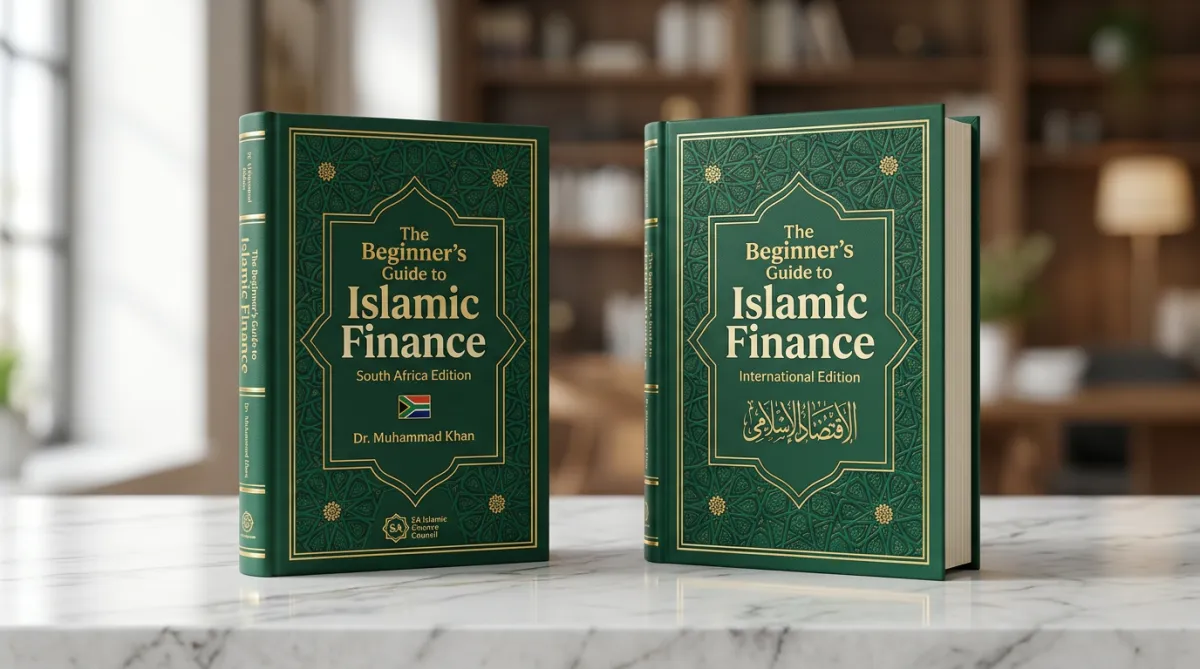
Beginner's Guide to Islamic Finance South Africa
Direct answer: The Beginner's Guide to Islamic Finance South Africa by Mogamat Ali Salie is a practical starting point for readers who want to connect Islamic financial principles with real South African decisions. It explains the language of Islamic banking, investing, Takaful, Zakah, Waqf and estate planning, then helps readers identify the questions and evidence they need before choosing a product or acting on personal circumstances.
Islamic finance can feel unnecessarily difficult when every explanation begins with Arabic terminology or a product brochure. A beginner needs a map before needing a product. The useful first questions are simple: What do I own and owe? Which contracts govern my money? What makes a transaction different from an interest-bearing loan? How are investments screened? What protection is available? How should giving and inheritance fit into one plan?
This page explains what the book is designed to do, how to use it and where MuslimFin's specialist services may fit after the learning stage. It is not a substitute for personalised financial, tax, legal or Shariah advice. Product suitability and religious conclusions depend on the actual facts and documents.
Who the book is for
The book is written for South African readers who want an accessible foundation without pretending that one guide can decide every case.
Muslims beginning their financial journey
A student, graduate, newly married couple or first-time investor may need a vocabulary for banking, saving, investment risk, home finance and protection. The book helps the reader move from isolated questions to a connected financial picture.
Families reviewing conventional arrangements
Many families already have home loans, retirement funds, policies, investments and business obligations. Learning about Islamic finance does not mean cancelling everything immediately. Existing agreements should be inventoried, read and assessed before action. MuslimFin's Islamic family-office guide explains how a coordinated review can bring those workstreams together.
Professionals and business owners
Business finance involves more than replacing one price label with another. Ownership, asset risk, agency, guarantees, late-payment terms, working capital and exit rights all matter. The book provides a foundation for better questions while accountants, lawyers, authorised advisers and qualified Shariah specialists retain their own professional roles.
Non-Muslim readers and professional partners
Islamic finance is also relevant to lawyers, accountants, property professionals, trustees, insurers and advisers who serve Muslim clients. A plain-language overview can reduce misunderstandings and help a professional identify when specialist review is needed.
What the guide helps you understand
The central benefit is not memorising terms. It is learning to test a financial decision from several angles.
The difference between a label and a structure
Murabaha, Ijarah, Musharakah, Mudarabah and Wakala describe different contractual relationships. A name alone does not prove that a transaction has been implemented correctly. The parties, asset, price, ownership, risk, sequence of agreements and remedies must be understood together.
How Shariah screening fits into investing
An investment review commonly considers both the underlying business activity and financial ratios or instruments. Screening does not remove market risk, guarantee performance or prove that an investment is suitable for a household's goals. The MuslimFin portfolio-building guide shows how screening sits alongside diversification, fees, tax, liquidity and governance.
Why Takaful is more than an insurance synonym
Takaful is generally described through participant contribution, risk pooling, operator roles and Shariah governance. Availability and implementation vary. A South African family should verify the legal insurer, intermediary authority, policy wording, exclusions, claims process and Shariah evidence. Use the short-term protection guide for a practical comparison process.
How giving and legacy connect to wealth
Zakah, voluntary charity, Waqf, lifetime gifts and testamentary transfers are different. They have different timing, ownership and South African legal or tax consequences. A calculator can assist education, but it cannot verify an estate, family tree or religious ruling. MuslimFin's inheritance calculator should therefore be used as a planning aid rather than a final distribution instruction.
South African implementation also needs current source checking. The Department of Justice's wills guidance explains the legal role and execution of a will; Islamic inheritance intentions must be coordinated with those requirements rather than treated as a parallel informal document.
A seven-step reading method
Reading becomes more useful when each chapter produces evidence and a next action.
1. Build a personal glossary
Write each unfamiliar term in plain English. Add the role of each party, who owns the asset, who bears risk and what payment is being made. Do not assume two products are identical because both use the same Arabic word.
2. Create a financial inventory
List bank accounts, debts, retirement funds, investments, policies, property, companies, trusts, wills and beneficiary nominations. Record the legal owner, provider, balance, payment, fees, maturity, beneficiaries and where the governing documents are stored.
3. Separate urgent issues from important issues
Food, housing, healthcare, work transport and required contractual payments come first. A possible Shariah concern should be investigated promptly, but a rushed cancellation may create penalties, tax or loss of essential protection.
4. Mark every claim that needs verification
The book provides education. Current tax rates, laws, provider status, product terms and scholarly interpretations must be checked at the decision date. For a regulated service, verify the provider or representative through the FSCA's regulated people and entities portal.
5. Turn principles into questions
Ask the provider to explain the contract sequence, ownership, fees, early settlement, default, late-payment treatment, guarantees and Shariah oversight. Ask an investment provider for the screening methodology, review frequency, purification treatment, custody and total cost.
6. Identify the correct specialist
A Shariah scholar evaluates religious questions. An authorised financial adviser addresses regulated product advice. A lawyer addresses legal validity and drafting. A tax practitioner addresses tax. A mortgage originator compares appropriate application routes but does not create approval. A family office can coordinate the evidence without replacing these specialists.
7. Write a ninety-day action plan
Choose a small number of actions: complete the inventory, close a document gap, establish an emergency reserve, review one high-cost debt, verify one investment methodology, update beneficiaries and arrange a will review. Assign an owner and date to each action.
What the book does not promise
Islamic finance does not eliminate risk, cost, disagreement or commercial loss. Shariah-conscious investing can fall in value. A Takaful claim can be declined under its wording. A home-finance application can fail affordability or credit checks. A trust can be badly governed. A will can be invalidly executed.
The book also does not turn general education into personal advice. The National Credit Regulator's current consumer borrowing guidance reinforces the importance of budgeting and understanding repayment capacity. Those disciplines remain relevant regardless of the product label.
How the book connects to MuslimFin services
Some readers need education only. Others discover that several decisions interact and need coordination.
Shariah-conscious investment planning
MuslimFin can help organise goals, current holdings, screening evidence, fees, liquidity, tax information and specialist questions into a reviewable investment brief. This does not guarantee a particular security's continuing Shariah status or investment return.
Family risk and Takaful coordination
A protection review maps dependants, income, debts, property, business obligations and existing benefits before comparing cover. The objective is to identify gaps and overlaps, not to sell the largest policy.
Property and home-finance preparation
Households can coordinate affordability evidence, acquisition costs, ownership questions and the application path. Crescent Capital's mortgage-origination role and Solace Realty's property-services role remain distinct from MuslimFin's family planning role.
Trust, estate and legacy planning
MuslimFin can help assemble ownership, family, liquidity, tax, will, trust and Shariah information for the appropriate specialists. The South African Islamic estate-planning guide is a useful next resource.
Frequently asked questions
Is this book only for people who already understand finance?
No. It is designed as a starting point, but experienced readers can also use its framework to identify gaps between products, documents and family objectives.
Does reading the book make a product Shariah-compliant?
No. The actual contract, implementation and relevant scholarly methodology must be reviewed.
Should I cancel an existing product after reading a concern?
Not without understanding the consequences and alternatives. Obtain the contract, quantify costs and risks, and seek the appropriate advice.
Can MuslimFin provide a coordinated next step?
Yes. MuslimFin Family Office can help organise a household or family-business review and route regulated, legal, tax or Shariah questions to the appropriate professionals. Start from the MuslimFin services page.
A useful outcome from the first reading
The best result is not a shelf of terminology. It is a one-page control sheet showing what the family owns and owes, which decisions are urgent, which claims require verification, which specialist owns each question and what must happen next. That is how introductory knowledge becomes responsible action.


