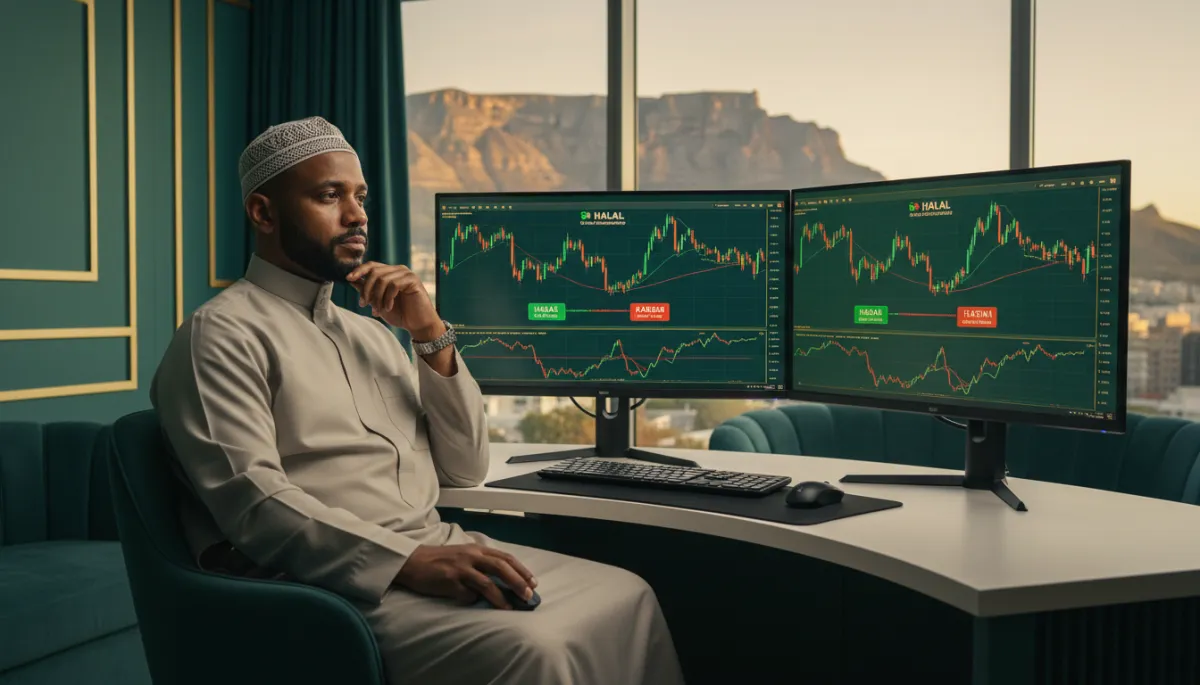
Forex, CFDs and Leverage: Shariah Risks for South African Traders
Direct answer
Whether a foreign-exchange transaction is permissible depends on the contract, ownership, settlement and charges—not on the word “forex” alone. Many retail platforms offer leveraged contracts for difference rather than actual currency ownership. Leverage, overnight financing, delayed exchange, speculation and ambiguous broker terms can create serious Shariah concerns. South African traders should identify the legal instrument and obtain qualified guidance before funding an account.
Key takeaways
Currency exchange and retail “forex trading” are not necessarily the same transaction.
Many retail products are CFDs: cash-settled bets on price movement without ownership of currency.
A “swap-free” label does not resolve every Shariah issue.
Leverage can magnify losses and may introduce interest or loan-related conditions.
Broker regulation helps with conduct and recourse but does not establish Shariah compliance.
Long-term ownership of screened productive assets is structurally different from leveraged short-term speculation.
First identify what you are actually buying
The central question is contractual: what legal and economic rights does the trader receive?
In a genuine currency exchange, one currency is exchanged for another with the parties assuming ownership and the required form of possession or settlement. In a typical retail CFD, the customer does not take delivery of the currency pair. Instead, the customer and provider settle the difference between opening and closing prices, subject to the provider’s terms, margin rules and charges.
The platform interface can make both arrangements look similar. A “buy EUR/USD” button does not prove ownership of euros or delivery of dollars. Read the product disclosure statement, client agreement, execution policy and fee schedule.
The main Shariah questions
Is there real ownership and possession?
Currency exchange has particular Shariah rules because both sides of the transaction are monetary counter-values. The structure, timing of exchange and recognised possession matter. Ask whether currency is actually credited to an account under the customer’s control and whether it can be withdrawn, transferred or used independently.
If the contract only pays a price difference, the analysis moves away from ordinary exchange. Do not assume a price-linked instrument is equivalent to owning the referenced asset.
Is interest charged or received?
Retail positions held overnight may attract financing, rollover or swap charges. Renaming a charge does not determine its substance. A “swap-free” account may replace overnight interest with administration fees, wider spreads, time limits or other conditions. Review how each charge is calculated and what service, if any, it pays for.
An account can avoid one interest charge while retaining other problems involving ownership, excessive uncertainty or the contractual nature of the CFD.
How does leverage work?
Leverage allows a customer to control a larger exposure using a smaller margin deposit. A small market movement can therefore produce a large percentage gain or loss. The arrangement may involve financing, a loan, conditional benefit to the provider or forced close-out rights.
From a risk perspective, leverage can cause rapid losses and liquidation. From a Shariah perspective, the source, benefit and contractual conditions of the financing require scrutiny. Ask the broker to explain the legal relationship in writing.
Does the activity resemble informed trade or pure speculation?
Risk exists in ordinary commerce, but a contract dominated by wagering on short-term price movements, without ownership or productive economic activity, raises different concerns. High turnover, extreme leverage and binary win/lose payoffs can intensify gharar and maysir concerns.
The trader’s skill or charting system does not by itself cure a problematic contract. Analyse both the instrument and the conduct.
Forex versus CFDs versus currency conversion
Feature | Currency conversion | Retail forex CFD | Offshore currency account |
|---|---|---|---|
Purpose | Exchange one currency for another | Speculate or hedge using price difference | Hold and transact in a foreign currency |
Ownership | Currency should be received/controlled | Commonly no ownership of referenced currency | Customer may have a claim to or control of currency, depending on terms |
Leverage | Usually none in normal conversion | Common | Usually none unless separately arranged |
Overnight charge | Not inherent to spot conversion, though service fees may apply | Common or replaced by another fee | Account/custody charges may apply |
Shariah review | Exchange and possession rules | Contract, ownership, leverage, uncertainty and fees | Custody, account and transaction terms |
This table is a starting point, not a ruling on a named provider. Product documents determine the real structure.
South African regulatory checks
Before dealing with any provider, verify its claimed authorisation and the exact entity named in the customer agreement. The Financial Sector Conduct Authority maintains official information on authorised financial services providers and warns the public about impersonation and unauthorised operations.
Regulation does not remove trading risk or prove Shariah compliance. It does, however, help establish which legal entity is responsible, what category of service it may provide and where complaints can be directed. Be cautious when:
a salesperson contacts you through an unsolicited messaging group;
profits are guaranteed or losses dismissed;
payment is requested to a personal or unrelated bank account;
a “mentor” controls the account or asks for remote-device access;
withdrawal requires a new tax, insurance or release payment;
the website’s company name differs from the agreement; or
the provider claims that “regulated” means “risk-free”.
Use the official regulator’s site rather than a link supplied by the promoter.
The “Islamic account” checklist
Do not stop at the product label. Ask the provider:
Is this an actual currency purchase or a CFD?
What asset or contractual right does the customer own?
When and how does settlement or possession occur?
Can the currency be withdrawn or transferred?
Who is the contractual counterparty?
How is leverage provided and what does the provider receive?
Are there swaps, rollover charges, administration fees or wider spreads?
How do fees change with holding period?
What happens during volatility, negative balances or forced liquidation?
Which independent Shariah authority reviewed the exact current agreement?
Is the Shariah opinion publicly available and product-specific?
Which South African entity is authorised, and for what service?
If the provider cannot answer plainly, pause. Marketing copy is not a substitute for the executed contract.
Risk example: why leverage changes the outcome
Assume a trader places R10,000 as margin to obtain R200,000 of market exposure. A 2% adverse move represents R4,000 before spreads, slippage and charges—40% of the original margin. A 5% move can consume the full margin before costs, although close-out rules may act earlier or execution may occur later during fast markets.
The precise result depends on the contract. The example shows why “small currency moves” can still create large losses. It is not a forecast and excludes taxes and provider-specific protections.
A more durable wealth-building comparison
Retail leveraged trading is often promoted as a shortcut to income. A financial plan asks a different question: which combination of emergency reserves, debt management, protection, screened long-term assets and disciplined contributions best serves the household’s goals?
Diversified ownership of Shariah-screened productive assets is not risk-free, but it is structurally different from a leveraged contract settled on short-term price movement. Investors can explore the Shariah-compliant investing hub, learn how to screen JSE shares and compare Shariah-compliant ETFs.
If you already have an account
Download the signed agreement, transaction history and fee statements.
Identify open positions, leverage, margin and close-out terms.
Do not add money solely to recover prior losses.
Verify the legal entity and regulatory details independently.
Ask a qualified Shariah scholar to review the actual contract, not a screenshot.
Obtain tax guidance for completed trades and foreign accounts where relevant.
If you suspect fraud, preserve records and contact the appropriate regulator, bank or law-enforcement channel promptly.
Avoid making rushed decisions based on shame, pressure or a promised recovery service. Recovery scams often target people who have already lost money.
Frequently asked questions
Is all forex trading haram?
A genuine currency exchange and a leveraged retail CFD are different contracts. Permissibility depends on exchange, ownership, possession, settlement, fees and purpose. Obtain qualified guidance on the actual arrangement.
Does a swap-free account make forex halal?
Not automatically. It may remove or replace an overnight charge, but ownership, CFD structure, leverage, uncertainty and other fees still require review.
Is a regulated forex broker Shariah-compliant?
Not necessarily. Regulatory authorisation and Shariah compliance answer different questions. Verify both independently.
Can I lose more than my deposit?
That depends on the provider, legal protections and contract. Leverage can create rapid losses, slippage and forced close-outs. Read the current negative-balance and margin terms.
Is copying a trader safer?
Copying does not remove instrument, leverage, fraud or suitability risk. It can add reliance on a person whose record, incentives or risk level is unclear.
Next step
If your real objective is long-term wealth rather than leveraged speculation, review MuslimFin managed portfolios. The process should start with goals, capacity for loss, liquidity and a documented Shariah approach—not a promise of quick returns.
Important: This educational article is not a fatwa, trading recommendation, legal opinion or personal financial advice. Product terms and laws change. Retail leveraged products can cause substantial loss. Verify the exact agreement, regulator records and current professional guidance before acting.


