Islamic Finance for Gig Entrepreneurs in South Africa
Direct answer: A South African Muslim earning through freelance work, consulting, delivery, ride-hailing, online platforms or short contracts needs a financial system built for irregular income. Separate business and household money, calculate usable income after platform fees and tax, fund essential expenses from a conservative baseline, build a larger cash reserve, avoid interest-bearing cash-flow fixes where reasonably possible, document every contract, protect earning capacity and invest only surplus money through verified Shariah-screened assets. A high-revenue month is not a salary, and an app's payout screen is not a complete set of business records.
The gig economy can provide flexibility and access to customers, but it transfers risks that an employer often carries. Work may disappear without notice. A platform can change commissions, suspend an account or hold a payout. Fuel, data, equipment, insurance, medical costs, downtime and tax are paid before the entrepreneur knows what is truly available for the household.
Islamic financial planning adds contract and ethical questions. Is the service itself permissible? Who owns the asset being rented or sold? Are the price, deliverable and cancellation terms clear? Does a cash advance contain interest or a disguised fixed increase? Is a customer deposit trust money, income or security? A halal service can still become financially unstable when records, pricing or obligations are unclear.
This guide is general education, not personal financial, tax, credit, legal, employment or Shariah advice. A qualified Shariah scholar must assess a specific contract or activity. An authorised adviser handles regulated product advice, a tax practitioner advises on tax, and legal or labour professionals determine legal status and obligations. MuslimFin Family Office can coordinate the entrepreneur's household, business, risk, investment and succession plan so that each specialist works from the same evidence.
Identify the actual business model
“Gig worker” is not one legal, tax or financial category. A driver using an owned vehicle, a designer selling services abroad, a tutor paid in cash and a consultant working mainly for one company have different costs and risks.
Write the value exchange in one sentence
State:
- who the customer is;
- what is delivered;
- who sets the price;
- when acceptance occurs;
- who bears refunds, damage and non-payment;
- whether the platform is principal, agent or marketplace; and
- how and when the entrepreneur is paid.
If this cannot be explained clearly, the contract probably needs review. The Arabic label on a funding arrangement does not solve uncertainty in the underlying service.
Test the activity and contract separately
First assess whether the product or service is permissible. Then assess the contract for price, ownership, deliverability, timing, responsibility, cancellation and excessive uncertainty. The Qur'anic distinction between trade and riba appears in Al-Baqarah 2:275–280. MuslimFin's Gharar guide for South African contracts explains how material uncertainty can arise even when the business activity itself is acceptable.
Determine working status with evidence
A platform's use of the word “partner” or “independent contractor” does not necessarily settle legal or tax status. Keep the signed terms, work controls, payment statements, customer relationship, equipment ownership and ability to work for others. Obtain labour or legal advice where the facts resemble employment or where a status decision affects benefits and protection.
Calculate real income, not app revenue
Gross receipts create optimism; net distributable income pays the household. The entrepreneur needs a monthly income statement even when no company is registered.
Reconcile every source
Record gross customer value, platform commission, payment fees, refunds, tips, incentives, withholding, foreign-currency conversion, cash receipts and the amount deposited. Match each platform or client statement to the bank account.
Do not record only the net payout. The gap can contain deductible costs, taxes, customer refunds or unexplained leakage. Keep original electronic statements because platforms can limit historic downloads.
Separate direct and shared costs
Direct costs may include fuel, delivery charges, subcontractors, marketplace commission and materials. Shared costs may include data, software, accounting, equipment, workspace, vehicle expenses and professional fees. Classify private and business use honestly; the tax treatment of a cost depends on facts and evidence.
Use a conservative baseline
Take at least six to twelve months of net operating income where available. Remove exceptional once-off work and identify the weakest normal months. Build essential household commitments around a conservative baseline rather than the best month.
If net business income was R31,000, R18,000, R42,000, R24,000, R27,000 and R20,000 over six months, the average is R27,000. That does not make R27,000 a safe fixed draw. A prudent starting draw may be closer to the lower recurring months while the excess strengthens tax, equipment and emergency reserves.
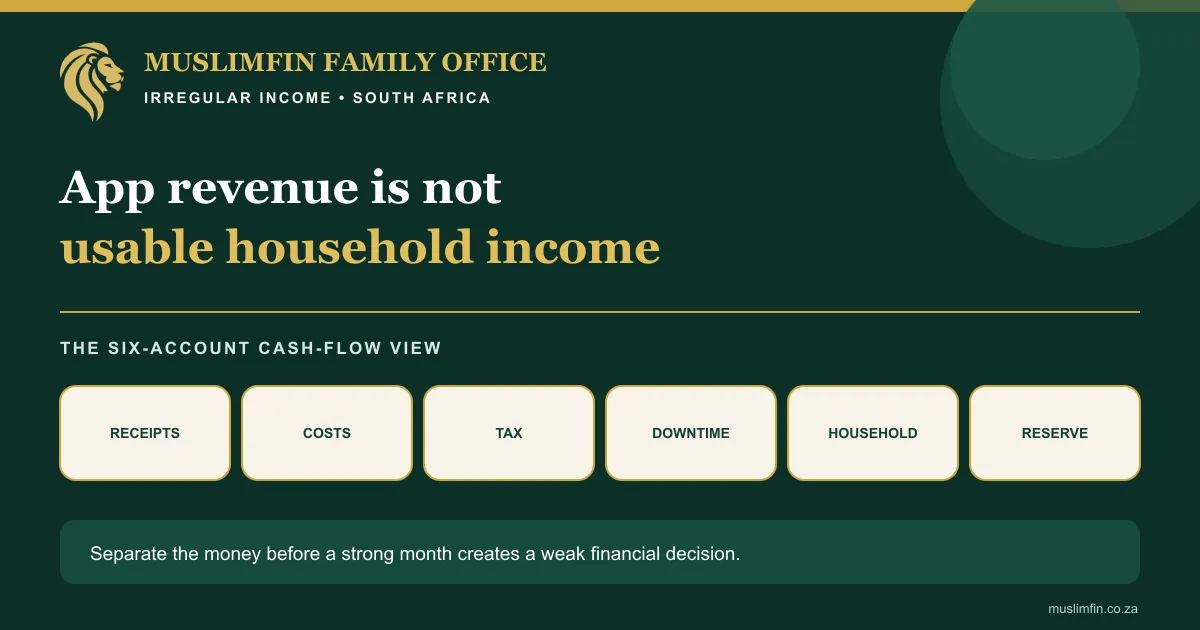
Build a six-account cash-flow system
Separate purpose accounts or clearly controlled sub-accounts make irregular income easier to manage. Check fees, account structure and access before opening multiple products.
Account 1: business receipts
All platform and client receipts arrive here. Do not pay household shopping directly from it. Reconcile deposits to invoices or platform statements.
Account 2: operating costs
Transfer the amount needed for fuel, software, stock, data, subcontractors and other verified business costs. Review unit economics before increasing marketing or accepting low-margin work.
Account 3: tax and statutory obligations
Move a provisional percentage of receipts or profit into a separate reserve. Refine it with a tax practitioner. VAT collected by a registered vendor is not household income.
Account 4: equipment and downtime
Reserve monthly amounts for tyres, repairs, devices, licences, professional subscriptions and replacement assets. A predictable annual cost is not an emergency.
Account 5: household draw
Pay a planned amount to the household on a fixed date. The draw should be supported by conservative net income, not by the balance visible after a strong week.
Account 6: business and household resilience
Maintain separate emergency layers for business continuity and essential household expenses. A driver may need a vehicle repair reserve as well as rent and food reserves. MuslimFin's emergency-fund guide provides a staged approach.
Price each job for sustainability and fairness
Low headline prices can hide an unprofitable business. Fair dealing includes clarity for the customer and a price that can support delivery.
Calculate contribution per job
For a delivery or service, subtract platform commission, payment cost, direct labour, fuel or materials, refund allowance and other job-specific costs from revenue. The remainder must contribute to equipment, tax, downtime, administration and household income.
Suppose a job produces R500 before costs. Platform and payment charges total R90, materials R80, transport R55 and a refund or rework allowance R25. The contribution is R250, not R500. If the job takes five hours including travel and administration, the contribution is R50 an hour before tax and fixed costs.
Quote complete terms
State scope, deliverables, price, deposit, payment date, revision limits, expenses, cancellation, ownership of work, confidentiality and dispute steps. Avoid hidden charges and do not promise delivery capacity that does not exist.
Treat tips and incentives carefully
Tips and platform incentives can fluctuate or depend on rules that change. Record them as income where applicable, but do not use them to support fixed debt commitments. Review incentive structures for prohibited conditions or deception when uncertain.
Put South African tax on a calendar
Gig and freelance receipts can create tax obligations even when the platform does not issue a payslip. Good records begin with the first invoice.
Determine provisional-tax status
SARS explains that a person earning income beyond ordinary PAYE remuneration—such as business, freelance, rental or investment income—may be a provisional taxpayer. Its current provisional-tax guide describes two compulsory estimate-and-payment periods and an optional additional payment. The exact obligation and estimate need the taxpayer's full facts.
Create reminders well before the deadlines. Estimate annual taxable income from reconciled revenue and defensible expenses, not from the latest platform payout. Keep working papers supporting the estimate.
Monitor VAT on a rolling basis
SARS's current VAT registration guidance states that compulsory registration applies when taxable supplies exceed, or under a written obligation will exceed, R2.3 million in a consecutive twelve-month period from 1 April 2026. Voluntary registration has separate requirements. Thresholds and rules can change, so monitor rolling taxable supplies monthly.
Do not wait for the calendar year to end. A growing freelancer can cross the threshold in any rolling twelve-month period. Obtain advice on exported services, electronic services, exempt supplies and platform arrangements.
Compare normal tax and turnover tax properly
Turnover tax is a simplified system for qualifying micro businesses, not automatically the cheapest choice. It taxes qualifying turnover under its rules rather than simply taxing accounting profit. Eligibility, entity type, connected persons, investment income and other exclusions matter.
Use SARS's turnover-tax guidance and a tax practitioner to compare scenarios. Do not register based only on a social-media table.
Preserve the evidence
Keep invoices, platform statements, bank statements, mileage or travel logs, contracts, receipts, equipment registers, foreign-payment records and tax submissions. Separate personal costs from business costs. An expense is not deductible merely because it was paid from a business account.
Avoid debt that masks a broken business model
Irregular income makes revolving credit tempting. An overdraft or cash advance can hide underpricing, delayed invoices and personal overspending until the balance becomes permanent.
Diagnose the reason for the shortfall
Classify the need as:
- timing gap on confirmed receivables;
- seasonal low demand;
- equipment replacement;
- growth investment with evidence;
- customer non-payment;
- underpricing; or
- household spending above sustainable draw.
Funding is not the first solution to a structurally unprofitable service. Change price, costs, scope, collection terms or client mix before financing repeated losses.
Read every funding contract
Identify whether the arrangement is a loan, sale, lease, partnership, invoice transfer or service advance. Record capital, total repayment, fees, ownership, security, personal surety, late charges, early settlement and recourse. A fixed fee can still require Shariah review when it is economically tied to a loan.
For existing debt, keep required obligations stable while obtaining qualified advice. The debt-exit plan for Muslim families explains settlement evidence, priority and South African debt-review controls.
Use customer deposits with discipline
A deposit may fund materials or secure a booking, but the contract must say what it is for and when it becomes earned. Keep enough liquidity to honour lawful refunds. Spending every deposit before delivering creates both operational and ethical risk.
Consider Shariah-compliant business funding structures
The right structure follows the actual asset or venture. It should not be chosen merely because its Arabic name appears attractive.
Qard for a short and genuine loan
An interest-free loan may help bridge a temporary gap. Document the capital, repayment dates, hardship process and whether any security is provided. A benefit demanded because of the loan can create a Shariah issue; obtain guidance on any fee or linked favour.
Murabaha for an identified asset purchase
In a genuine Murabaha, the financier buys an identified asset and sells it at a disclosed price and profit under agreed terms. Verify ownership sequence, asset risk, delivery, price, security, default and early settlement. A cash loan should not be relabelled as a sale without the required transaction.
Ijarah for usable equipment
Leasing may be appropriate for a vehicle, device or equipment when ownership, maintenance, use, rent, damage and end-of-term rights are clear. Compare total cash flow with buying and ensure the asset remains fit for the intended service.
Musharakah or Mudarabah for a real venture
Partnership finance requires genuine profit participation and defined loss rules, governance, information rights and exit terms. A fixed repayment irrespective of actual profit may contradict the claimed structure. Partners should agree how labour, capital, intellectual property, customers and platform accounts are valued.
Protect earning capacity and operating assets
For a gig entrepreneur, the ability to work is often the largest asset. A damaged vehicle, stolen laptop, illness or suspended account can stop income immediately.
Map the interruption risks
List the events that could stop revenue for one day, one week, one month and six months. Include illness, disability, family care, theft, accident, device failure, platform suspension, licence expiry, cyber fraud and a key client's departure.
For each event, record prevention, reserve, backup, contractual remedy and protection. A second device or documented client list can be as important as an insurance product.
Review Takaful and other protection by contract
Assess vehicle, household, equipment, liability, disability, severe-illness, funeral and life risks. For Takaful or insurance, inspect contributions or premiums, risk-pool and investment arrangements, operator fees, exclusions, waiting periods, excesses, claims and Shariah governance.
When no suitable Takaful option is available, a qualified scholar can assess necessity, alternatives and the risk. Do not cancel finance-required or essential cover before a replacement is active. MuslimFin's short-term Takaful guide explains the evidence to compare.
Verify financial providers
Use the FSCA's regulated-entity resources to confirm the exact legal entity and authorisation. Regulatory status, Shariah status and product suitability are separate tests. Verify contact details independently because scammers can copy an authentic FSP number.
Build retirement without an employer payroll
Irregular earners do not receive automatic retirement contributions unless they create the process. Waiting for a future permanent job can lose years.
Use a percentage with a minimum floor
Set a contribution percentage of conservative net income and a minimum monthly amount. During strong months, fund the percentage after tax and operating reserves. During weak months, preserve the minimum only if essential cash flow remains safe.
The contribution should go to an asset and wrapper that pass separate Shariah, fee, liquidity, tax and suitability tests. A retirement annuity's tax rules do not automatically screen its portfolio.
Avoid locking away the emergency reserve
Retirement money serves a long horizon and may have access restrictions. Keep business downtime and household emergency cash outside volatile or inaccessible long-term assets. The entrepreneur should not need expensive debt to repair a vehicle while retirement contributions are locked away.
Preserve old employment benefits
A person moving from employment to gig work should obtain statements, fund rules and benefit details before withdrawing or transferring. Review tax, fees, investment choices, Shariah screening and protection lost when employment ends.
Invest only after the business and household can breathe
A profitable gig business can fund long-term ownership, but frequent cash shortages and speculative investing are a dangerous combination.
Use an investment readiness gate
Before investing, confirm that:
- tax and statutory reserves are funded;
- essential business costs are current;
- a basic household and downtime buffer exists;
- harmful revolving debt is controlled;
- money will not be needed for near-term equipment replacement; and
- the goal and time horizon are documented.
Screen the underlying assets
Ask which Shariah standard or methodology applies, who screens holdings, when the review occurred, how prohibited business activities and financial ratios are treated, and how purification is calculated. Review custody, fees, liquidity, concentration and fraud risk as well.
MuslimFin's Shariah-compliant portfolio guide provides a full due-diligence checklist.
Use a TFSA deliberately
A tax-free savings account is a tax wrapper, not a Shariah certificate. SARS's tax-free investment guidance states that from 1 March 2026 the annual contribution limit is R46,000 and the lifetime limit is R500,000, with tax on excess contributions. Withdrawals do not restore contribution room.
Do not treat the TFSA as a business cash account. Select the underlying investment for a long-term goal and keep operational reserves accessible elsewhere.
Diversify clients, platforms and access
Income concentration can be as dangerous as investment concentration. A freelancer with ten invoices but one payer has one economic client.
Measure concentration monthly
Calculate the percentage of revenue from the largest client, platform and service. Record payment time and cancellation rights. Create a target for reducing excessive dependence without breaching exclusivity or confidentiality.
Own the permitted business records
Within platform and privacy rules, maintain invoices, customer permissions, portfolio evidence, supplier records, service procedures and a backup communication plan. Do not scrape or export personal data unlawfully. The goal is operational continuity, not taking data that belongs to a platform or customer.
Prepare a platform-suspension file
Keep verification documents, vehicle or professional licences, payout statements, support references, customer evidence and appeal routes. Maintain an emergency reserve and alternative lead source so that a temporary review does not immediately create debt.
Keep family and business boundaries clear
The household needs predictable information without gaining uncontrolled access to business cash.
Agree on the household draw
Set the amount, payment date and review rule. Explain which expenses belong to the business and how strong months will be allocated. Family support should be intentional rather than repeatedly funded by credit.
Document family money
When relatives provide money, record whether it is a gift, Qard, asset sale, partnership capital or payment for work. State repayment, profit rights, loss exposure, management authority and exit. Relationships do not remove the need for evidence.
Protect marital and ownership clarity
Record who owns the vehicle, device, intellectual property, shares, platform account and customer receivables. The civil marital regime, suretyships and business form affect risk. Obtain legal advice before moving assets into a spouse's name or a trust.
Choose a business structure for a reason
A sole proprietorship is simple but does not create legal separation between owner and business. A company can provide continuity and governance but brings administration, tax and compliance duties. A trust has a distinct purpose and should not be used as a fashionable invoice account.
Compare the practical factors
Consider liability, customer requirements, co-owners, tax, payroll, funding, intellectual property, succession, compliance cost and ability to keep records. Registering a company does not repair weak margins or eliminate personal surety.
Keep authority visible
If using a company or partnership, document bank authority, contract signing, expenditure limits, owner drawings, disputes and what happens during illness. Keep business money separate from personal money and reconcile shareholder or partner loan accounts.
Create continuity and an estate trail
Gig income can stop when the owner cannot log in, drive, deliver or invoice. Dependants need records and lawful authority, not passwords left in a message.
Build a continuity pack
Include client and platform names, contract locations, invoice status, suppliers, critical devices, backup procedures, insurance or Takaful schedules, tax status, debts, equipment ownership and the person authorised to act where law permits. Store credentials securely rather than writing them in the pack.
Align the will and business facts
Record business assets, receivables, intellectual property, company interests, family loans and platform balances. A South African estate professional and qualified scholar should coordinate civil execution and Islamic succession objectives. Update nominations and documents after marriage, divorce, a birth, incorporation or a new partner.
A twelve-month implementation plan
Month 1: establish truth
Map services, platforms, clients, income, costs, debt, assets, policies and household commitments. Separate accounts and reconcile the previous three months.
Months 2–3: stabilise cash flow
Set a conservative household draw. Create tax, equipment and emergency reserves. Stop using new revolving debt to fund normal shortfalls. Repair pricing on unprofitable work.
Months 4–6: formalise
Standardise quotations, invoices and contracts. Confirm tax status, VAT monitoring, licences, provider records and protection needs. Document family funding and ownership.
Months 7–9: strengthen resilience
Reduce client concentration, build alternative lead sources, test backups and expand the reserve. Review Takaful or insurance, disability exposure and business continuity.
Months 10–12: build long-term ownership
Start or refine Shariah-screened retirement and investment contributions after readiness gates pass. Align the business, will, nominations and succession plan. Review the full system before the next tax year.
How MuslimFin Family Office can help
The gig entrepreneur's personal and business finances are often inseparable in practice but must remain distinguishable in the records. MuslimFin can coordinate both without replacing regulated specialists.
Consolidated income and risk map
Build a dated view of platforms, clients, net income, tax, debt, equipment, household draw, reserves, protection and long-term goals. Stress-test weak months, suspension, disability and asset failure.
Shariah and contract evidence register
Collect platform terms, funding agreements, banking structures, investment screening and Takaful evidence. Assign unresolved issues to a qualified scholar and preserve the decision basis.
Family-office coordination
Connect tax, debt exit, Shariah-screened investing, retirement, Takaful, business structure, property, trusts, succession and estate planning. Each professional remains accountable for advice within their mandate; MuslimFin maintains the integrated roadmap and follow-through.
Frequently asked questions
Is freelance or gig income halal?
It depends on the service, customer, contract and conduct. A permissible skill can be delivered under unclear or deceptive terms, while a well-drafted contract cannot make a prohibited activity permissible. Obtain contract-specific Shariah guidance where uncertainty is material.
Is platform commission permissible?
A platform may charge for access, agency, payment or other services, but the ruling depends on the agreement and what is delivered. Check the amount, calculation, disclosure, cancellation, incentives and whether charges are tied to a loan.
Must a freelancer register a company?
Not automatically. Compare liability, clients, co-owners, tax, administration and succession. A sole proprietor can trade without a company but remains personally exposed. Obtain legal and tax advice for the facts.
How much should I reserve for tax?
There is no universal percentage. Estimate taxable income from reconciled revenue and allowable expenses, include other household income and refine the reserve with current tax advice. Move the provisional amount before paying the household draw.
Does earning below the VAT threshold mean I can ignore VAT records?
No. Monitor taxable supplies over a rolling twelve-month period and keep evidence. Voluntary registration, exported services and other rules may also matter. Thresholds should be checked on the decision date.
Can I use a credit card to bridge slow months?
Repeated revolving credit usually signals an unstable draw, insufficient reserves, delayed collection or weak pricing. Review the contract for riba, fees and consequences and address the underlying gap. Existing debt needs an orderly exit rather than denial.
Is a fixed-fee cash advance halal?
The name “fee” does not determine the substance. Identify whether money is advanced as a loan, sale of receivables or another contract; how repayment is calculated; and who bears risk. Ask a qualified scholar to review the complete agreement.
Should I invest in my business or a portfolio first?
Compare the business investment's expected cash flow, concentration and risk with household reserves, debt and long-term goals. Do not place all wealth in one untested business, but do not invest externally while predictable equipment failure threatens income.
What protection does a gig worker need?
Start with the events that would stop earnings or create large liabilities: illness, disability, vehicle or equipment loss, public liability, death and dependent support. Calculate the shortfall, review available Takaful or other options and inspect each contract.
How should I save for retirement with irregular income?
Use a percentage of conservative net income plus a manageable minimum, after tax and emergency reserves. Verify the underlying assets, fees, access rules, tax wrapper and Shariah methodology rather than choosing by product name alone.
Can family members invest in my gig business?
Yes, but define whether the money is a gift, loan or partnership capital. Document ownership, profit, loss, labour, information rights, decisions and exit. A promised fixed return can conflict with a genuine equity partnership.
What happens if a platform closes my account?
Keep evidence, know the appeal process, preserve lawful business records, maintain alternative lead sources and fund a suspension reserve. Do not violate platform rules by taking customer data or creating deceptive replacement accounts.
Can I deduct my vehicle, phone or home-office costs?
Tax deductibility depends on use, legal requirements and evidence. Separate private and business portions, keep logs and receipts, and obtain current tax advice. Payment from a business account is not sufficient proof.
What records should I keep?
Keep contracts, invoices, statements, payout reports, expense evidence, tax returns, equipment registers, mileage records, funding agreements, protection schedules, client deposits, licences and Shariah decisions. Back them up securely and define retention periods with professional advice.
Practical conclusion
Islamic finance for gig entrepreneurs in South Africa begins with real unit economics and clear contracts. Reconcile gross revenue to cash, reserve tax before household spending, price work to cover all costs, build separate business and family buffers, and stop debt from disguising a weak model. Protect the assets and health that produce income, then invest long-term surplus through verified Shariah-screened structures.
The strongest system makes volatile income boring: money arrives through documented channels, is allocated by rule, and supports obligations before lifestyle expands. That discipline allows a Muslim freelancer or platform worker to turn flexible work into durable household security and long-term ownership.
Last reviewed: 8 September 2026. Tax thresholds, platform terms, provider status, product availability and legislation can change. Verify current facts and obtain contract-specific professional and Shariah guidance before acting.


