Islamic Finance for Muslim Women Entrepreneurs
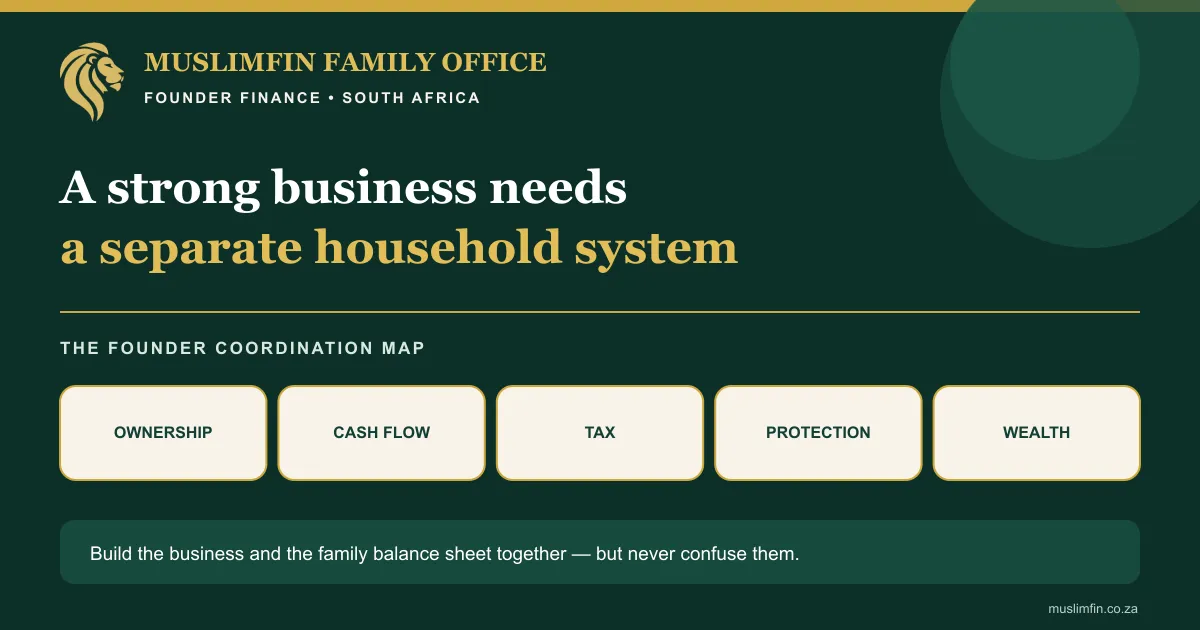
Direct answer: A Muslim woman entrepreneur in South Africa needs two connected but distinct financial systems: a viable business and a resilient personal estate. She should document what she owns, separate business and household money, price for every real cost, reserve tax before drawing profit, use funding whose legal and Shariah substance is understood, protect the people and assets that keep the enterprise operating, and move long-term wealth out of excessive founder concentration. Marriage, family support or an Islamic label does not replace contracts, company records, regulatory checks or product-level Shariah review.
Entrepreneurship can give a woman greater control over her work, income and assets. It can also concentrate her family's cash flow, retirement capital, sureties, intellectual property and future inheritance in one venture. A profitable-looking business can still fail because customers pay late, the founder draws too much, tax was never reserved, a relative's contribution was not classified, or nobody else can operate the business during illness.
Islamic finance adds a further evidence layer. The activity, contract, funding, investment of surplus cash and treatment of default must each be assessed. A permissible product does not repair weak economics. A registered company is not automatically Shariah-compliant. A family loan does not become a gift merely because repayment is uncomfortable.
This guide is general education, not personal financial, tax, accounting, legal, credit, insurance or Shariah advice. A qualified Shariah scholar must assess a specific contract or business activity. An authorised adviser handles regulated product advice, a tax practitioner handles tax, an attorney handles legal agreements and a company secretarial professional assists with corporate records. MuslimFin Family Office can coordinate those workstreams around one founder and family evidence file.
Build the founder map before choosing products
The first task is not selecting finance or an investment. It is establishing who owns, controls, owes and benefits from each part of the enterprise.
Record the operating form
State whether the activity is conducted as a sole proprietorship, partnership, private company, co-operative, trust-owned company or another structure. The trading name on an invoice is not enough. Record the legal person that contracts with customers, employs staff, rents premises, owns stock and incurs tax.
The Companies Act governs company incorporation, management and the relationships among companies, shareholders and directors. A founder may be a shareholder, director, employee, creditor and surety at the same time, but each role has different rights and risks.
Prove shareholding and control
Keep the incorporation documents, memorandum of incorporation, securities register, share certificates, subscription agreements, shareholder agreements, director resolutions and beneficial-ownership filings together. Reconcile them rather than assuming that a verbal family understanding controls the company.
CIPC's beneficial-ownership guidance says corporate entities must submit beneficial-ownership information and keep it current, including with annual-return filings. A beneficial owner is the natural person who ultimately owns or controls the entity. This is not necessarily identical to the person whose name appears on the website or bank card.
Identify founder-created intellectual property
List trademarks, domain names, social accounts, customer lists, designs, recipes, software, courses, photographs and proprietary methods. For each item, record who created it, who paid for it, whether copyright or another right was assigned, and which entity may license or sell it. A company cannot reliably be valued or transferred when its key intellectual property sits informally in the founder's personal accounts.
Map personal support given to the business
Record cash injections, equipment contributed, expenses paid personally, home-office use, unpaid salary, guarantees and shareholder loans. Label each transaction when it happens. “I put money into the business” could mean equity, a repayable loan, a gift or reimbursement. These produce different tax, control, inheritance and Shariah consequences.
Separate business money from household money
A separate bank account does not create profitability, but it makes the truth easier to see.
Reconcile revenue to cash
Start with invoices or sales records, then deduct refunds, discounts, platform fees, payment charges and amounts not yet collected. Revenue is not the balance in the account. Cash collected is not profit. Profit is not automatically available for a household draw.
For every month, reconcile:
- sales issued;
- cash received;
- debtors still outstanding;
- direct costs;
- operating overheads;
- tax and statutory liabilities;
- debt or funding payments;
- capital expenditure;
- owner remuneration and drawings; and
- closing cash.
Use a defined owner-pay policy
A sole proprietor may take drawings, while a company may pay salary, reimbursement, dividends, loan repayments or other amounts depending on the facts and rules. Do not move money with the generic description “owner payment.” Establish what the payment is, who authorised it, whether the business can afford it and how it will be recorded.
A conservative policy can combine a stable base amount with a periodic distribution after tax, working-capital and reserve tests. This makes household planning less dependent on the founder's mood or a single strong sales month.
Create three cash reserves
Keep separate targets for:
- Operating reserve: unavoidable business costs during a sales interruption.
- Tax and statutory reserve: amounts collected or expected to be payable to SARS and other authorities.
- Household emergency reserve: essential family costs when the owner's draw stops.
One pool should not silently perform all three jobs. Money collected as VAT, customer deposits or staff deductions is not founder wealth.
Price for sustainability, not only sales
Underpricing can create demand while destroying the founder's time and capital.
Calculate contribution per sale
For each product or service, subtract direct materials, packaging, payment fees, platform commission, delivery, subcontractors, returns and variable labour from the selling price. The balance must contribute to rent, software, administration, tax, founder pay, protection, growth and profit.
Price the founder's time
Unpaid founder labour can make a business look profitable. Record delivery time, sales time, administration, travel, rework and after-sales service. Compare the resulting hourly contribution with the income the founder needs and the capacity actually available after caregiving and personal obligations.
Test payment timing
A R100,000 order paid after 90 days may be less useful than smaller orders paid upfront. Measure debtor days, supplier terms, stock days and customer-deposit obligations. Negotiate deposits, milestones or retainers where the commercial and Shariah terms are clear, rather than financing customers without recognising it.
Stop cross-subsidising weak offers
Build a product-level view. If one offer consumes staff time, refunds and inventory while another generates the cash, decide whether to reprice, redesign or discontinue the weak offer. Growth in turnover is not a substitute for economic value.
Plan South African tax before spending profit
Tax should be calculated from records, not estimated from the current bank balance.
Provisional tax is an advance payment
SARS explains that provisional tax is a method of paying income tax during the year based on estimated taxable income. There are two compulsory periods and an optional top-up. Companies are provisional taxpayers, and an individual earning business income may also fall within the system. The final liability is determined on assessment, with provisional payments credited against it.
Maintain a rolling taxable-income estimate and update it when sales, margins, capital gains or other income change. A reserve percentage applied blindly to revenue can be materially wrong when margins fluctuate.
Monitor the VAT rolling period
From 1 April 2026, the SARS VAT registration page states that the compulsory registration threshold is R2.3 million and the voluntary threshold is R120,000, subject to the governing conditions and exceptions. Monitor taxable supplies over the applicable period and obtain advice before the business crosses a threshold, signs a large contract or changes its offering.
VAT registration affects pricing, invoices, cash flow, input-tax evidence and returns. VAT collected is not sales profit. Voluntary registration is a commercial and compliance decision, not automatically a saving.
Compare turnover tax with ordinary tax
Turnover tax is optional for qualifying micro businesses with annual turnover of R2.3 million or less under the current 2026/27 rules. Its calculation is based on taxable turnover rather than accounting profit, and eligibility restrictions apply. The 0% band to R600,000 does not mean every qualifying business owes no other amount or that turnover tax is always better.
Compare both regimes using the founder's entity, margins, remuneration, investment income, growth plan and record quality. A low-margin business may reach a different conclusion from a high-margin consultancy at the same turnover.
Keep evidence that survives review
Retain source documents, invoices, statements, payroll records, mileage or travel evidence, asset registers, loan agreements, stock records and tax calculations for the legally required periods. Payment from the business account alone does not prove deductibility or business purpose.
Choose Shariah funding by economic substance
Funding must match what the business needs: an asset, inventory, working capital, expertise or permanent risk capital.
Qard for a genuine loan
A Qard is a loan where the principal is repayable without a contractually required increase for the lender. Document the amount, payment path, term, events of default and whether any security is provided. A voluntary gift cannot be pre-agreed as the lender's return. Inflation, administration, tax and legal questions still require appropriate advice.
Murabaha for identified assets or stock
Murabaha is a disclosed-cost sale with an agreed profit. The financier or seller must acquire the relevant asset and sell it under the actual contractual sequence; relabelling a cash loan is not sufficient. Specify the asset, cost, selling price, delivery, defects, security, late-payment treatment and early-settlement position.
The detailed MuslimFin Murabaha guide explains why ownership, possession, price certainty and separate agency evidence matter.
Ijarah for use of an asset
Ijarah can fund the use of equipment, vehicles or premises without an immediate purchase. Establish who owns the asset, who bears ownership-related risk and major maintenance, who pays operating costs, what happens if the asset cannot be used, and whether any eventual transfer is documented separately.
Musharakah for shared capital and risk
In a Musharakah, partners contribute capital and share profit under an agreed method, while ordinary loss is linked to capital contribution. Management authority, access to information, reserved matters, additional funding, valuation and exit must be documented. A fixed return that ignores actual venture performance requires careful Shariah and legal review.
The IFSB risk-management standard emphasises partner due diligence, financial reporting, recordkeeping and continuous monitoring for Musharakah and Mudarabah investments. Shared risk does not mean unmanaged risk.
Mudarabah for capital plus entrepreneurship
In a Mudarabah, one party provides capital and the manager contributes effort and expertise, with profit shared under an agreed ratio. Define the permitted activity, expenses, reporting, conflicts, negligence or misconduct, reserves, withdrawal and termination. The capital provider should not confuse a forecast with a debt-like entitlement.
Match term to cash generation
Do not use short repayment periods for assets that produce value over many years. Do not sell permanent equity merely to fund a temporary debtor gap without comparing alternatives. Model a base case, downside and severe case with exact payment dates.
Treat family capital as real capital
Family support can be patient and values-aligned, but ambiguity can damage both the business and the relationship.
Classify each contribution before transfer
Use a written term sheet stating whether money is:
- a gift;
- Qard or another loan;
- payment for shares;
- a Musharakah contribution;
- Mudarabah capital;
- an advance for an asset purchase; or
- reimbursement of an expense.
Record who may decide, how information is supplied, whether the contributor has security, what happens on death or divorce, and how disputes will be handled.
Do not confuse mahr with business capital
Mahr belongs to the woman when validly due and received, but investing it into a venture is a separate decision. Record whether the founder contributed it as equity or lent it to the business. Protect her liquidity before concentrating personal assets in a risky enterprise.
Define relatives' work and authority
A spouse, sibling or parent helping informally may later believe that effort created ownership. Use employment, contractor, profit-share or equity documents as appropriate. Access to the bank account, shop keys or social-media password is not proof of shareholding.
Use independent valuation for major transactions
When a relative buys shares, exits, contributes property or receives business assets, obtain a defensible valuation and tax advice. A nominal price can transfer value, create tax consequences and distort inheritance expectations.
Understand marriage, consent and surety exposure
Islamic ownership principles and South African matrimonial-property consequences must both be mapped; one does not erase the other.
Verify the actual matrimonial regime
The Matrimonial Property Act forms part of the South African legal framework governing matrimonial property. Obtain the marriage certificate, antenuptial contract and any court order. Do not rely on recollection of what spouses intended years earlier.
Record whether spouse consent is required
The answer can depend on the matrimonial regime, asset and transaction. Obtain legal advice before disposing of major assets, pledging investments, granting security or binding a joint estate. A spouse's practical support is not a substitute for legally required consent, and unnecessary co-signing can create avoidable exposure.
Read every surety as a personal-risk decision
A company loan may become a household risk when the founder, spouse or relative signs unlimited surety. Record the creditor, covered obligations, cap, term, security, cancellation process and whether the surety continues after ownership changes. Test the household outcome if the business fails and the creditor enforces.
Check credit providers and affordability
Where the National Credit Act applies, it promotes responsible credit granting, consumer information and regulation of credit providers. Application depends on the parties, agreement and thresholds; “business finance” is not a complete exemption analysis. Verify relevant registrations and obtain contract-specific advice.
Protect the founder, operations and family
Risk planning should preserve the economic function, not merely buy policies.
Quantify founder-dependency
List tasks only the founder can perform: sales, approvals, recipes, supplier negotiation, client delivery, payments or regulatory sign-off. Measure revenue and cash flow lost if she is unavailable for 30, 90 or 180 days. Then reduce dependency through documentation, delegated limits, access controls and cross-training.
Build a maternity, health and caregiving plan
Plan for reduced capacity rather than assuming a precise date or duration. Fund personal medical costs, household essentials, replacement staff, temporary management and working capital. Define which services pause, who communicates with customers and what authority a delegate receives.
Consider income and disability protection
Assess the founder's personal income gap and the business cost of replacing her. Takaful or other insurance availability and terms must be checked in the current South African market. Review waiting periods, benefit definitions, exclusions, escalation, tax treatment and claim evidence. A policy name is not proof that the structure satisfies a chosen Shariah standard.
Protect business assets and liabilities
Map buildings, vehicles, equipment, stock, cyber risk, public liability, professional liability, employer obligations and business interruption. The right excess and insured amount depend on the balance sheet and the firm's capacity to absorb loss. Underinsurance can leave the founder funding a shortfall personally.
Verify regulated providers
Use the FSCA regulated-entities search to check relevant financial-services authorisation, and check other regulators where the product requires it. Regulatory status and Shariah approval answer different questions; obtain both sets of evidence.
Keep customer and company information under control
An entrepreneur's customer list can be both an asset and a legal responsibility.
Define the responsible party and purpose
The Protection of Personal Information Act establishes conditions for lawful processing, including accountability, purpose specification, information quality, openness, security safeguards and data-subject participation. Identify which person or entity determines why and how information is processed.
Collect less, know where it goes
Map forms, websites, messaging apps, cloud drives, payment providers, accountants, contractors and marketing systems. Record the lawful purpose, access, retention, deletion and cross-border path. Do not copy client data to a personal device merely because it is convenient.
Prepare for access loss and incidents
Use role-based access, multi-factor authentication, password management, backups and a documented offboarding process. Keep a response path for loss, unauthorised access or disclosure. The Information Regulator's eServices portal provides Information Officer and compliance services, but portal registration is not the whole privacy programme.
Build personal wealth outside the business
The founder's company may be her largest asset and her main income source. That is a concentration, not diversification.
Set a surplus-extraction rule
After tax, working capital, debt terms and approved growth capital are covered, decide how much surplus stays in the business and how much moves to the founder's personal plan. Document whether extraction occurs through salary, dividends, loan repayment or another lawful route.
Keep emergency money liquid
Do not count stock, equipment, shareholder loans or an optimistic business valuation as household emergency cash. Set separate liquidity for the business and family. If cash is held through an Islamic banking product, verify the contract, access terms, bank status and deposit-protection position.
Use tax wrappers carefully
For the 2027 year of assessment, SARS states that the tax-free investment contribution limit is R46,000 a year and R500,000 over a lifetime, aggregated across qualifying accounts. Excess contributions attract tax at 40%. A tax-free wrapper is not automatically Shariah-compliant; screen the underlying funds and mandate.
Diversify by risk, not by product count
Multiple funds holding similar companies do not necessarily diversify the founder. Map exposure to the business, sector, rand, property, customers, key suppliers and a spouse's income. Set long-term allocations from goals and risk capacity, then use a documented Shariah-screening process for securities and funds.
Preserve retirement continuity
An entrepreneur does not receive an employer retirement contribution unless she creates the system. Compare retirement funds, tax-free investments and discretionary portfolios by liquidity, tax, costs, underlying holdings, beneficiary treatment and Shariah governance. Automate a sustainable contribution rather than waiting for the perfect month.
Plan business continuity and succession early
Succession is an operating process, not only a clause in a will.
Create an emergency authority map
Identify who can access premises, approve payroll, pay SARS, contact staff, fulfil orders, restore systems and communicate with key customers if the founder is incapacitated. Grant only appropriate legal authority and technical access; sharing a password is not governance.
Separate death, incapacity and voluntary exit
These events require different mechanisms. A will operates after death and must comply with the Wills Act. It does not appoint someone to manage the founder's personal affairs during incapacity, rewrite a shareholder agreement, transfer an asset the founder did not own or decide every retirement benefit.
Reconcile the will with company documents
List shares, shareholder loans, director roles, key-person cover, buy-and-sell agreements, trusts and beneficiary nominations. Make sure the ownership evidence and estate plan do not issue contradictory instructions. Consider executor liquidity, valuation, tax and whether heirs can or should operate the business.
Build a successor bench
Document processes, management reporting, customer relationships, supplier terms, regulatory duties and decision limits. Test whether the business can complete a monthly cycle without the founder. The MuslimFin business-succession guide provides a deeper continuity framework.
Review inheritance and Shariah directions together
Map what enters the estate, what may pass through another mechanism, debts, matrimonial consequences, claims, tax and liquidity before calculating a proposed Islamic distribution. Obtain coordinated legal and Shariah advice. A generic online fraction cannot resolve uncertain ownership.
Worked example: turn growth into resilient wealth
Consider a founder-owned private company with annual sales of R2.1 million. It appears successful, but the founder's records reveal R210,000 of unpaid invoices, R160,000 of VAT and tax reserves needed, a R300,000 shareholder loan from her, and an unlimited personal surety for equipment finance. Her household relies on irregular transfers from the company, while the customer database and domain are registered in her personal name.
Step 1: establish ownership and liabilities
The founder reconciles the securities register, beneficial-ownership filing, shareholder loan, surety and intellectual-property ownership. She does not transfer assets until legal and tax consequences are reviewed.
Step 2: rebuild cash flow
The business introduces deposits and milestone billing, assigns responsibility for collections, calculates contribution by service and fixes a monthly owner-pay policy. The tax reserve moves to a separate account and is reconciled monthly.
Step 3: choose funding for the actual need
Instead of seeking generic “halal business finance,” the founder identifies a specific equipment need, a seasonal stock need and a permanent working-capital gap. Each can then be assessed against Murabaha, Ijarah, partnership capital or internally generated cash with comparable total costs and downside outcomes.
Step 4: reduce household concentration
Once liquidity tests are met, a defined portion of surplus is extracted lawfully into personal emergency savings, retirement funding and a diversified Shariah-screened portfolio. The business remains important, but it is no longer the household's only asset and retirement plan.
Step 5: protect continuity
The founder documents operations, trains a deputy, limits payment authority, reviews protection and aligns the will, shareholder agreement and business-continuity file. The outcome is not merely higher sales; it is a business and family system that can survive disruption.
A twelve-month implementation plan
Month 1: ownership and entity evidence
Collect formation documents, registers, contracts, licences, IP records, bank mandates, spouse-related documents, funding agreements and sureties. Resolve contradictions.
Month 2: accounting and cash conversion
Reconcile revenue to collections, age debtors, count stock, calculate product contribution and introduce a thirteen-week cash-flow forecast.
Month 3: tax control
Confirm registrations and filing dates, update taxable-income estimates, assess VAT exposure, compare turnover tax where eligible and create a tax-reserve policy.
Month 4: household resilience
Set the owner-pay rule, build household and business reserve targets, eliminate harmful borrowing patterns and document family contributions.
Month 5: funding architecture
Match each asset or capital need to an appropriate structure, obtain legal and Shariah review, compare total cost and model downside cash flow.
Month 6: business risk
Review key-person dependency, asset protection, liability, cyber controls, staff duties, service continuity and policy evidence.
Month 7: founder protection
Review medical funding, income interruption, disability, death, maternity and caregiving scenarios. Test waiting periods and cash gaps.
Month 8: personal investing
Map concentration, establish long-term goals, verify Shariah screening, review costs and automate a sustainable contribution.
Month 9: customer-data governance
Map data, access, vendors, purposes, retention and security. Register or update required responsible persons and close uncontrolled access paths.
Month 10: management and delegation
Create monthly reporting, decision limits, process notes and a deputy plan. Test a founder-absence week.
Month 11: succession and estate
Align the will, shareholder agreement, shareholder loans, buy-and-sell position, trusts, nominations, tax and Islamic distribution objectives.
Month 12: independent review
Reconcile open issues, retest the severe cash-flow case, confirm current provider status and update the next twelve-month priorities.
Common mistakes Muslim women entrepreneurs should avoid
Treating sales as spendable income
Sales may include VAT, unpaid invoices, refunds and costs still to be paid. Draw from verified available cash, not headline turnover.
Giving equity for temporary help
Equity is a lasting ownership decision. Price the contribution, document rights and compare a salary, contractor fee or loan before issuing shares.
Signing unlimited surety without a household stress test
The business may have limited liability while the founder does not. Read the actual surety and model enforcement.
Keeping every rand in the business
Reinvestment can support growth, but permanent personal concentration leaves the household exposed to the same customers, sector and founder health.
Using relatives instead of governance
Trust matters, but it does not define access, authority, remuneration, ownership or succession. Put important arrangements in writing.
Assuming a Shariah label answers every question
Review the actual contract, asset, payment sequence, ownership risk, late-payment terms, security, fees and Shariah governance. Marketing language is not the evidence file.
Ignoring data and digital ownership
A lost domain, locked advertising account or copied customer list can stop sales. Record ownership and recovery paths before a crisis.
Waiting for growth before planning succession
Small firms can be most founder-dependent. Continuity work improves current operations even if the founder never exits.
Frequently asked questions
Can a Muslim woman own and run a business in South Africa?
Yes, subject to the same applicable company, tax, licensing and other legal requirements. Her specific activity and contracts should also be assessed for Shariah compliance. Ownership and management authority must be evidenced rather than assumed.
Does my husband automatically own part of my company?
Do not answer from the share certificate alone. Review company ownership, matrimonial regime, funding, contracts and the facts with a legal professional. Islamic personal ownership and South African matrimonial consequences both require evidence.
Should my spouse be a director?
Only when the role, competence, duties, authority and liability make sense. Marriage is not a governance qualification, and shareholding is not the same as directorship.
Is family funding automatically halal?
No. The contract and activity matter. Define whether the transfer is a gift, loan, sale, lease, Musharakah or Mudarabah investment and obtain Shariah review where needed.
Can an investor receive a fixed percentage every month?
A payment forecast is not the same as a permissible profit share. The answer depends on the structure, actual profit, risk and contractual terms. Obtain qualified Shariah and legal review before promising a return.
Is turnover tax always better for a small business?
No. Eligibility and the better outcome depend on margins, entity, remuneration, activities, investment income, growth and other rules. Compare the regimes using current numbers.
When must I register for VAT?
Current SARS guidance sets the compulsory threshold at R2.3 million from 1 April 2026 and a R120,000 voluntary threshold, subject to conditions and exceptions. Monitor taxable supplies and obtain current advice rather than waiting for year-end.
Should I pay myself a salary or dividend?
The appropriate mix depends on legal form, payroll, profits, solvency and liquidity, tax and household needs. Label and authorise each payment correctly with professional advice.
Can my business pay my household expenses?
Only with correct classification, authority and accounting. Mixing personal costs into business expenses can hide profitability and create tax or governance problems.
Do I need Takaful or insurance?
First quantify the loss the family and business cannot absorb. Then compare available structures, wording, limits, exclusions, insurer status and Shariah evidence. Self-funding small losses and transferring severe risks can form part of the same plan.
Is a tax-free investment automatically halal?
No. Tax status concerns the wrapper. Shariah compliance depends on the underlying holdings, mandate and governance.
What happens to my company shares when I die?
The answer depends on ownership, matrimonial consequences, the will, shareholder agreement, trusts, tax, debts and estate administration. Align these before death; do not assume a beneficiary nomination transfers company shares.
Should I put the company in a trust?
Not by default. A trust changes legal ownership, governance, cost, tax and succession. It should solve a defined problem and be administered according to its deed and the Trust Property Control Act, with legal, tax and Shariah advice.
How can MuslimFin Family Office help?
MuslimFin can coordinate the founder's ownership map, cash-flow and tax evidence, Shariah funding questions, regulated-provider checks, protection needs, investment diversification and succession work. It does not replace the licensed, legal, tax or scholarly professionals required for a specific decision.
Final founder-control checklist
Before the next major funding, investment or growth decision, confirm that:
- legal ownership, beneficial ownership and control agree;
- the company owns or licenses essential intellectual property;
- business and household cash are separate;
- owner pay is classified and affordable;
- debtors, stock and tax reserves are current;
- VAT and provisional-tax exposure are monitored;
- family money has a written classification;
- funding matches the asset or capital need;
- no return, approval or Shariah outcome is being promised without evidence;
- sureties and spouse-consent questions have been reviewed;
- founder illness, caregiving and maternity disruptions are funded;
- business and personal protection gaps are quantified;
- customer data and digital access are controlled;
- personal investments reduce rather than repeat business concentration;
- the will, shareholder agreement and succession file agree; and
- every unresolved point has an owner, professional and due date.
Islamic finance for Muslim women entrepreneurs in South Africa is strongest when the founder's agency is supported by evidence. Clear ownership, disciplined cash flow, fair contracts, current tax control, proportionate protection, diversified personal wealth and executable succession allow the enterprise to serve the family without becoming its single point of failure.
Last reviewed: 8 September 2026. Tax thresholds, laws, provider status, product availability and Shariah opinions can change. Verify current facts and obtain contract-specific professional and Shariah guidance before acting.


