Unlocking the Horizon: Islamic Finance, Global Trade & South Africa's Strategic Role

“Unlocking the Horizon: Islamic Finance, Global Trade & South Africa’s Strategic Role" by Mogamat Ali Salie
The shifting currents of global commerce, where supply chains stretch across continents and capital seeks smart alignment, South Africa finds itself at a pivotal juncture. More than just a point on a map, the country stands as a bridge between Africa, Asia (notably China) and the broader world. At the same time, the rise of Sharia-compliant finance is reshaping how trade is conceived, funded and governed. For executives and high-net-worth individuals engaged in import, export or investment, this is not merely a niche financial discussion; it is a strategic vantage point.
This article offers a broad, holistic lens on why this matters, and how South African players might position themselves intentionally in this evolving matrix.
1. The Big Picture: Trade, Capital & Values
Trade isn’t simply goods moving from A to B; it’s ideas, capital, networks and influence flowing across borders. As global trade volumes rebound and recalibrate, the orchestration of finance, regulation and relationships becomes critical.
Simultaneously, Shariah-compliant finance, once seen as a specialist branch of banking, is quietly becoming part of the mainstream conversation. Its emphasis on ethical frameworks, asset-backing, risk sharing, and clear structures resonates in a world where trust and transparency matter ever more.
Seen this way, South Africa isn’t just an exporter or importer; it can be an architect of its trade-finance identity.
2. Why South Africa Especially Matters
South Africa’s strategic geography, diversified economy and links to both global and African markets make it uniquely positioned. Think of it as a crossroads:
On one side, the African continent has its emerging markets and resources.
On the other hand, Asia and China have manufacturing, technology and major trade flows.
And globally, the pathways of capital, logistics, regulation and values.
In this context, the adoption of more holistic trade-finance frameworks, including Islamic-finance options, offers South African high-net-worth operators a chance to stand out. It’s not only about exporting more or importing smarter; it’s about structuring that activity with foresight, values and alignment.
3. China & the Trade Compass
China remains a dominant node in global manufacturing, shipping and logistics. But more than that, it is part of a broader narrative of global connectivity, trade-corridor development and capital-flows alignment.
For South Africa, aligning with China isn’t purely transactional; it’s strategic: sourcing key components, engaging in joint value-chains, participating in infrastructure or logistics, and leveraging the capital flows that accompany them.
When Islamic-finance frameworks are added into the mix, they offer alternative channels, which may appeal to investors and counterparties in the Middle East, Asia and Africa — enabling South African players to access new networks. Viewed holistically, the message is: be part of the map, not just a peripheral point.
4. Leadership Mindset: Trade Finance as Strategic Enabler
For high-net-worth individuals and ultra-high-net-worth operators, the framing needs to shift. Instead of: “How do I get finance for a shipment?” think:
How does my trade-finance framework reflect values, networks and strategy?
Am I participating in corridors that offer more than logistics — that embed relationships, capital, reputation and footprint?
How can South Africa be the base, hub or launch point — not merely the origin or destination?
In practical terms: embed trade-finance decisions inside the broader corporate, investment or family office strategy. Ask not only how much you export or import, but how that trade is anchored in networks, credibility and thematic positioning.
5. A Holistic Map of Opportunity
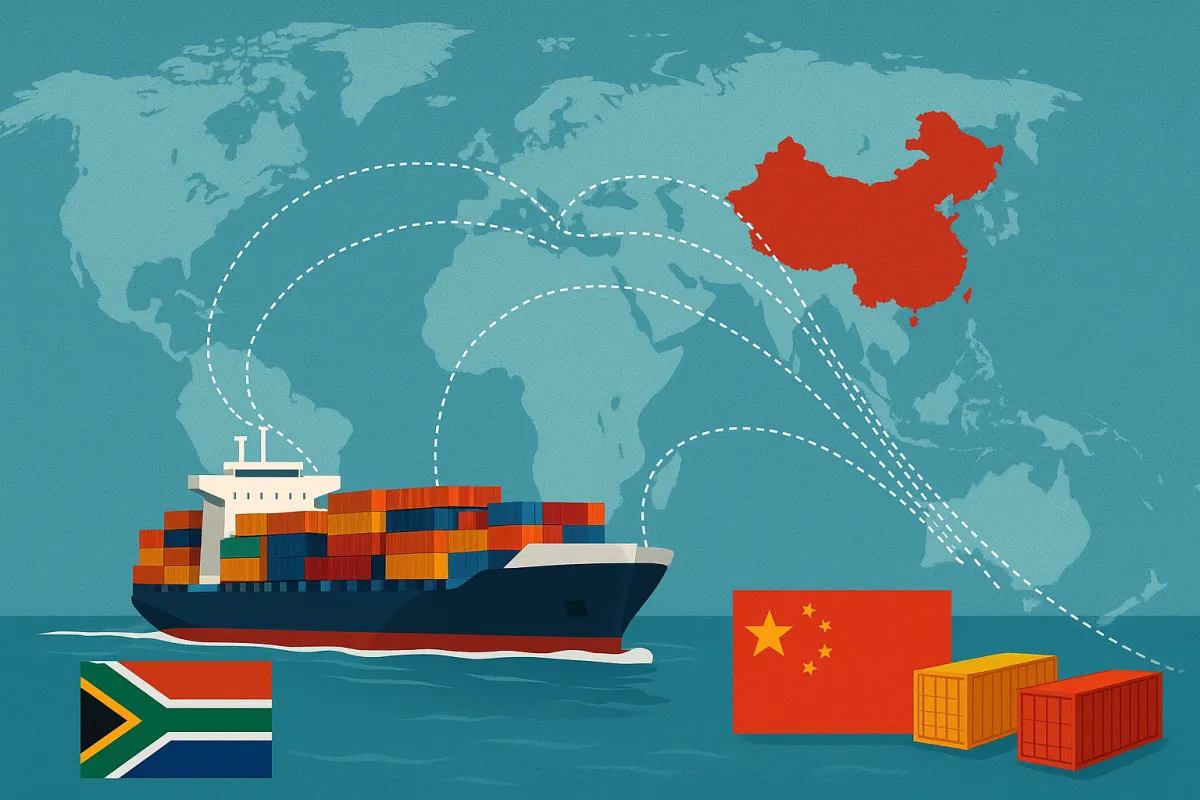
Imagine a cargo vessel leaving Cape Town, bound for a Chinese manufacturing hub, then transiting via the Indian Ocean to Middle East distribution, all backed by a trade-finance architecture that respects global ethical norms, Islamic-finance principles and collaborative capital.
Now scale that picture: it becomes less about a single deal and more about your trade-map, your positioning. South Africa isn’t merely an exporter of goods; it becomes a partner, convener and intersection point for global trade-finance-capital flows.
In this map, Islamic-finance options aren’t a niche add-on; they are strategic levers.
6. What Now? The Leadership Agenda
Here are stepping-stones for those who wish to lead, not just participate:
Clarify your role: Are you a commodity exporter? A value-adder? A manufacturing partner? Map where you sit and where you could sit in the global corridors.
Think networks, not just transactions: Engage counterparties, financiers and partners who share your global vision, not only your immediate deal.
Embed finance inside strategy: Don’t treat trade-finance as a cost-centre, treat it as a strategic lever that shapes positioning, reputation and opportunity.
Monitor and adapt: As global trade routes shift (logistics, regulation, supply-chain resilience), the smart operator watches the map, not only the ledger.
Lead with values: In a world increasingly attentive to ethics, transparency and sustainability, frameworks like Sharia-compliant finance offer both alignment and differentiation.
Conclusion
In an era where goods, capital and ideas move with greater speed and complexity, the advantage lies with those who see beyond the immediate transaction. For South Africa’s high and ultra-high-net-worth professionals, the message is clear: trade isn’t simply about exporting or importing — it’s about architecture, networks and strategic positioning.
By integrating frameworks like Shariah-compliant finance into this architecture, you elevate from being a participant to being a designer of trade-flows, capital-flows and reputational flows.
Your horizon isn’t just a map of routes, it’s a map of possibilities. And in that map, South Africa has an opportunity to lead, to innovate the intersection of trade, finance and global connectivity.


