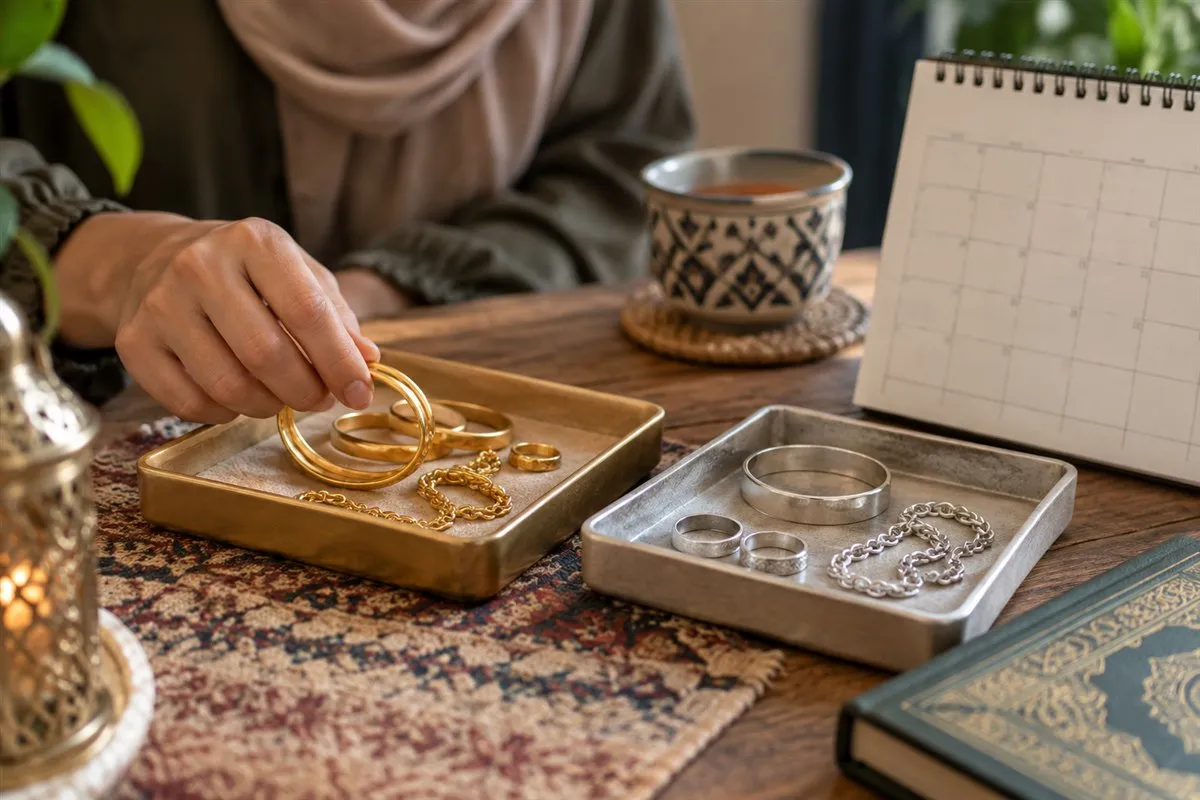
South African Nisab 2026: Gold vs Silver Threshold and Zakah Calendar
Direct answer
The South African Nisab for 2026 is not one fixed rand amount. It changes with the market value of the relevant weight of gold or silver and the rand exchange rate. Choose the scholarly method you follow, obtain a current rand price on your Zakah date, calculate net Zakatable wealth consistently, and retain a dated record of the inputs.
Key takeaways
Nisab is a threshold, not the amount on which Zakah is charged only above the threshold.
Gold and silver produce different rand thresholds because their relative market values differ.
Precious-metal prices and exchange rates move, so an undated rand figure quickly becomes stale.
Use one recurring Islamic-lunar date or another method approved by the scholar you follow.
Cash, trade stock, accessible investments and qualifying receivables may be Zakatable; personal-use assets usually require different treatment.
Complex portfolios, retirement products, debt, trusts and business interests need case-specific scholarly and professional guidance.
Why there is no permanent “2026 Nisab” in rand
Nisab is traditionally linked to a specified weight of gold or silver. The rand equivalent is therefore a calculation:
Nisab in rand = chosen metal weight × current rand price per gram
South African Zakah organisations may publish a live or regularly updated value. SANZAF provides daily Nisaab information and a Zakah calculator, while Islamic Relief South Africa publishes a Zakat calculator with current gold and silver inputs. Check the displayed date, metal weight, purity, price source and whether VAT is included before using a figure.
This article deliberately does not hard-code a current rand threshold. A number copied in January could be materially wrong by Ramadan or year-end. For a calculation that may be reviewed later, save a PDF, screenshot or dated statement of the rate you used.
Gold versus silver Nisab
The gold method
The gold Nisab is calculated from the gold weight accepted by the relevant scholarly methodology. Contemporary calculators may display slightly different gram weights because of the traditional measures and conversion conventions they apply. Do not silently combine the weight from one authority with the metal price convention from another.
Because gold is much more valuable per gram than silver, the gold method usually produces a higher rand threshold. A person with net Zakatable wealth below that threshold would not be liable under that calculation, subject to the rest of the rules followed.
The silver method
The silver Nisab uses the corresponding traditional silver weight. Its rand threshold is commonly lower than the gold threshold. Some scholars and organisations prefer silver because it brings more wealth holders into the Zakah net and may benefit more recipients. Others consider gold more appropriate in particular contemporary circumstances.
This is a legitimate jurisprudential question, not a price-comparison trick. Choose a method with a qualified scholar or the established guidance you trust, and apply it consistently. If a material amount turns on the choice, document the view followed.
A five-step Nisab calculation
Step 1: fix the calculation date
Use the same date and time zone for the metal price, exchange rate and asset values. South African residents should record the local date. If using an Islamic date, note its Gregorian equivalent because local moon-sighting calendars can differ.
Step 2: choose gold or silver guidance
Record the authority or scholar, the specified weight and the purity convention. A jewellery quote for a lower carat is not automatically the correct input for a pure-metal Nisab calculation.
Step 3: obtain a current rand price per gram
Use a reputable, time-stamped source. The London Bullion Market Association publishes benchmark information for precious metals, but a South African calculation still requires a valid rand conversion and clarity about price type. A local Zakah calculator can be simpler if its methodology and update date are transparent.
Step 4: multiply and preserve the evidence
Multiply the accepted metal weight by the rand price per gram. Keep the source URL, timestamp, screenshot and arithmetic. Do not use an ounce price without converting the unit correctly.
Step 5: compare the threshold with net Zakatable wealth
Add the assets included under your methodology, subtract only liabilities that the methodology permits, and compare the result with the Nisab. If the threshold is met and the other conditions apply, Zakah is normally calculated on the relevant net Zakatable amount—not merely the excess above Nisab.
What belongs in net Zakatable wealth?
The answer varies by asset and scholarly view, but a household working paper normally separates these categories.
Cash and near-cash
List bank balances, cash, foreign currency and amounts in payment wallets. Convert foreign currency at a supportable rate on the valuation date. Do not omit a dormant account simply because it is used infrequently.
Gold and silver
Record weight, purity, purpose and valuation source. Scholarly views can differ on jewellery held for personal use. A jeweller's retail replacement value, scrap value and pure-metal content are not interchangeable; follow the valuation basis specified by your guidance.
Investments
Shares, unit trusts, ETFs, managed portfolios and private-company interests require more analysis than a bank balance. Approaches may differ according to trading intention, underlying Zakatable assets and access restrictions. Avoid assuming that a Shariah-compliant investment is exempt from Zakah. Shariah compliance concerns the permissibility of the investment; Zakah concerns the holder's obligation.
For portfolio planning, use our Shariah-compliant investing hub. For a calculation involving listed securities, obtain a current portfolio statement and specific scholarly guidance.
Business assets
Cash, trade receivables expected to be collected and stock held for sale are common Zakah work-paper items. Fixed assets used to operate the business—such as machinery, office furniture or a delivery vehicle—are generally distinguished from trading stock, but the facts matter. Property held for resale is not the same as property used as business premises or held for rental.
Use reliable stock counts, debtor-age analyses and consistent values. Do not reduce the figure for doubtful debt without a supportable basis.
Money owed to you
Separate amounts likely to be recovered from disputed, doubtful or irrecoverable debts. Scholars differ on when Zakah is recognised for each category and whether it is caught up on collection. Preserve agreements and repayment histories, then seek guidance where the amount is material.
Which liabilities can be deducted?
It is unsafe to deduct every future instalment on a long-term home or asset-finance agreement. Many approaches focus on liabilities presently due or due within a defined near-term period, while others apply different rules. Record:
the creditor and purpose of the debt;
the amount currently due;
instalments falling due within the relevant period;
whether the liability relates to a Zakatable asset; and
the scholarly method applied.
Accrued tax, supplier balances, credit cards and short-term amounts can also require analysis. A tax estimate is not the same as an assessed and payable liability. Obtain advice rather than using debt to drive the calculation below Nisab without support.
Build a reliable Zakah calendar
Choose an annual anchor date
The Islamic lunar year is shorter than the Gregorian year. Many people choose a memorable Hijri date and calculate all qualifying wealth annually on that date. Others use separate anniversary dates for assets or an approved simplified method. Consistency and documented scholarly guidance matter more than choosing a fashionable day.
Use a four-week process
Four weeks before: gather bank, investment, retirement, business and liability statements. Request missing valuations and identify complex assets.
Two weeks before: reconcile accounts, count stock, review receivables, confirm the scholarly method and list questions.
On the date: capture live Nisab inputs, value assets consistently, calculate liabilities and document the result.
After payment: retain the work paper, proof of payment and recipient or institution details. Create the next year's calendar reminder immediately.
Ramadan does not reset every asset automatically
Ramadan is a convenient time to give, but convenience is not a substitute for the rules governing the completion of a Hawl. If you bring an existing calculation forward, pay in advance, or consolidate multiple dates, ask how adjustments should be treated. Do not let an annual campaign erase your original records.
Worked example without a stale metal price
Assume a person chooses a silver-based method under guidance and, on the Zakah date, records the approved silver weight and a time-stamped rand price per gram from the selected source. Multiplying those two figures produces that day's threshold.
The person then lists:
cash and bank balances;
current portfolio value under the chosen investment method;
eligible gold or silver holdings;
recoverable money owed to them;
business stock and qualifying receivables; less
liabilities deductible under the same guidance.
If the resulting net amount meets the threshold and the other conditions are satisfied, the applicable Zakah rate is applied to the relevant base. Common cash-wealth calculations use 2.5% for a complete lunar year, but asset-specific rules and a solar-year adjustment can differ. The example shows the process, not a ruling for every asset.
Common mistakes to avoid
copying last year's rand Nisab into this year's calculation;
using a gold threshold but a silver weight, or vice versa;
confusing ounces and grams or retail jewellery prices and pure-metal prices;
charging Zakah only on the amount above Nisab without checking the rule followed;
excluding investments because the fund is already Shariah-compliant;
deducting the entire balance of a long-term liability automatically;
ignoring business stock, foreign currency or collectable receivables;
double-counting the same wealth in a business and personal schedule;
using inconsistent valuation dates; and
keeping no record of the method, source or payment.
Frequently asked questions
What is the Nisab in South Africa today?
It depends on the gold or silver method and current rand metal price. Use a dated South African calculator such as SANZAF or Islamic Relief South Africa and record the figure and methodology shown on your calculation date.
Should I use gold or silver Nisab?
Scholarly guidance differs. Silver usually produces a lower threshold, while gold usually produces a higher one. Follow a qualified scholar or established authority and apply the method consistently.
Is Zakah calculated only on wealth above Nisab?
In a common calculation, once net Zakatable wealth meets the threshold, the rate applies to the relevant Zakatable base rather than only the excess. Confirm the treatment for your assets and methodology.
Do I pay Zakah on my home and car?
Personal-use homes and vehicles are generally treated differently from cash or trade stock. A property or vehicle acquired for resale, business stock or another commercial purpose may require a different analysis.
Can MuslimFin calculate my Zakah?
The MuslimFin Zakah calculator can organise a calculation, but unusual assets, debt, trusts, businesses and differences of scholarly opinion require qualified advice.
Next step
Create one dated asset-and-liability schedule and use the MuslimFin Zakah calculator to organise the figures. Cross-check the live threshold with SANZAF or Islamic Relief South Africa, then take unresolved religious questions to a suitably qualified scholar. For related succession planning, use the MuslimFin inheritance calculator as an educational starting point.
Disclaimer
Important: This article is general education, not a religious ruling or personal financial, tax or legal advice. Nisab prices, exchange rates and institutional methodologies change. Zakah treatment varies by asset and scholarly view. Verify current inputs and obtain qualified guidance for your circumstances.


