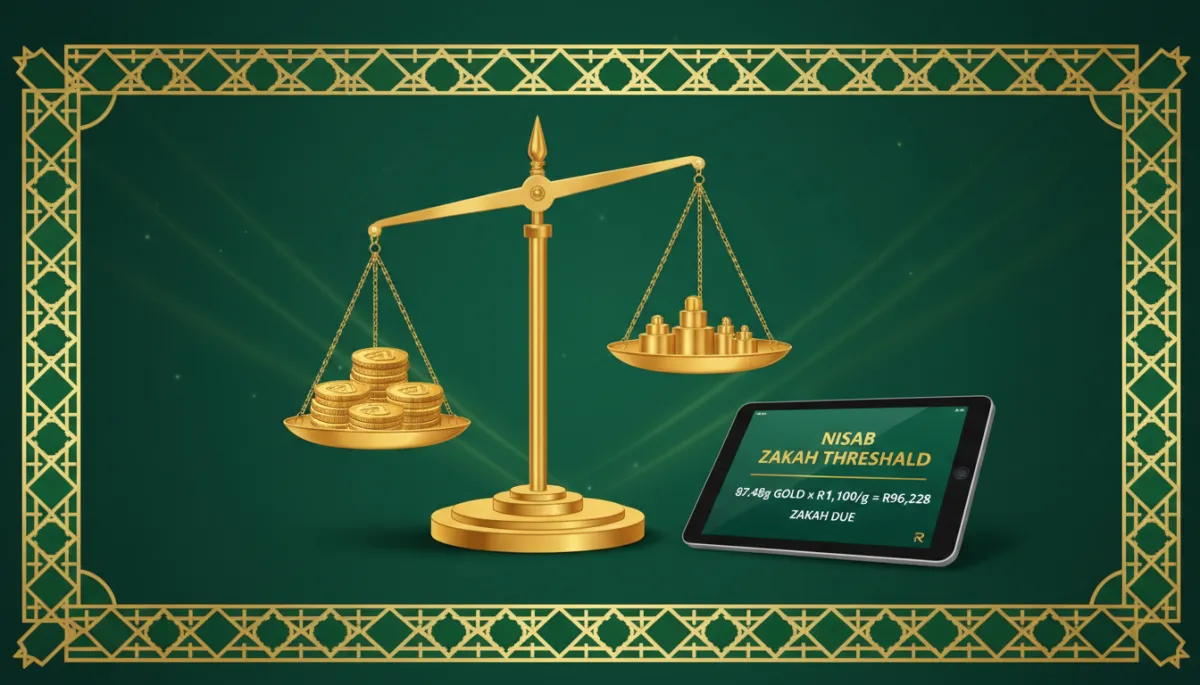
Nisab Threshold South Africa: Complete Zakah Guide
Direct answer: Nisab is the minimum qualifying wealth at which Zakah becomes due, subject to the applicable ownership and lunar-year rules. In South Africa, its rand value changes with the selected gold or silver standard and the metal price on the relevant valuation date. Do not copy a threshold from an old article. Confirm whether your Shariah authority uses a gold or silver basis, its weight convention, the accepted price source and the date and time of valuation. Then compare that threshold with your net zakatable wealth—not your salary, gross assets or net worth alone.
For many families, the arithmetic is easier than the classification. A current account is usually straightforward. A retirement fund, private company, investment property, loan to a relative, jewellery portfolio, trust distribution, foreign account or crypto position can require a separate decision.
This guide is general education as at 8 September 2026. It does not publish a supposedly permanent rand threshold, issue a fatwa or replace personal tax, legal or financial advice. A qualified scholar should confirm the method and any disputed asset.
What does nisab mean?
Nisab is a threshold of qualifying wealth used to determine whether a person enters the Zakah calculation. The classical anchors are expressed in gold and silver units rather than South African rand.
Sunan Abi Dawud 1573 refers to twenty dinars of gold and two hundred dirhams of silver, together with the passage of a year. Sahih al-Bukhari 1447 records the silver threshold as five awaq, explained on the source page as two hundred dirhams. AAOIFI identifies Shari'ah Standard No. 35 on Zakah in its standards framework.
Historic units must be converted under a stated method
Modern publications often express the threshold as a gram weight. You may see approximately 85 grams or 87.48 grams for gold and approximately 595 grams or 612.36 grams for silver. These are not numbers to average together. They reflect different weight conventions and scholarly methodologies.
Record the exact convention adopted by the scholar or institution you follow. Otherwise two people using the same spot price can calculate different rand thresholds without understanding why.
Nisab is not the amount of Zakah payable
Nisab answers whether the qualifying wealth reaches the threshold. The Zakah amount is then calculated on the relevant zakatable base, commonly at one-fortieth or 2.5% for qualifying monetary wealth held through the required lunar year, subject to the adopted method.
Why there is no single permanent rand threshold
The rand value changes because:
- gold and silver prices move;
- the rand exchange rate affects local prices;
- retail and wholesale reference prices may differ;
- gold and silver methods produce very different thresholds;
- gram-weight conventions differ; and
- the valuation date and time can change the result.
A headline such as “the 2026 nisab is R___” becomes stale quickly. A defensible calculation shows the formula and evidence.
Gold nisab or silver nisab?
The choice can determine whether a person is above the threshold. Silver has often produced a materially lower rand threshold than gold in modern markets.
Why some people use silver
Some scholars and organisations use the silver standard for cash and trade assets because it brings more wealth into the Zakah system and can increase support for eligible recipients.
Why some people use gold
Others use the gold standard as a closer measure of meaningful wealth in current economic conditions, particularly where the silver threshold is below a person's ordinary short-term living needs.
Do not choose opportunistically each year
Selecting whichever basis produces the lowest payment without a scholarly method undermines consistency. Equally, selecting the highest threshold solely to avoid Zakah is not a governance policy.
Write down:
- the adopted school or institutional method;
- gold or silver basis;
- weight convention;
- price source;
- valuation date and time; and
- who confirmed the method.
Where a family has followed one method consistently, obtain advice before changing it.
The South African nisab formula
Use this formula after the method is confirmed:
Nisab in rand = adopted metal weight in grams × rand price per gram on the valuation date
Illustrative gold calculation
Assume—only for teaching—that the adopted gold weight is 85 grams and the independently verified price is R1,800 per gram.
85 × R1,800 = R153,000
The illustrative gold nisab would be R153,000. This is not a current market quote.
Illustrative silver calculation
Assume the adopted silver weight is 595 grams and the verified price is R20 per gram.
595 × R20 = R11,900
The illustrative silver nisab would be R11,900. This is not a current threshold or recommendation.
Use like-for-like metal prices
Do not multiply a pure-metal gram weight by a jewellery item's retail price containing labour, VAT, brand margin or stones. Use the price definition approved for the method—such as a stated spot, bid, market or bullion reference—and keep a dated screenshot or statement.
Choose a Zakah valuation date
Many people select one Hijri date each year. This creates a recurring measurement point for wealth subject to a lunar year.
Use a lunar year unless advised otherwise
A Hijri year is shorter than a solar year. Paying 2.5% every Gregorian year without an adjustment can defer payment over time. If your records operate on a Gregorian year, ask the scholar whether to use a different rate or a separate Hijri anniversary.
New wealth can be handled in different ways
Scholarly methods differ on whether every inflow starts its own hawl or whether qualifying monetary wealth is aggregated on one annual Zakah date. A single annual date is operationally easier, but it should be an adopted method rather than an unrecorded convenience.
Record the cut-off
Use a consistent time zone, ideally South African Standard Time, and record whether the calculation is based on closing balances, an exact time or the most recent available statement.
Build the zakatable asset register
Start with legal and beneficial ownership. Do not include another family member's asset because you manage it, and do not omit your asset because another person holds the account.
Cash and bank balances
Include qualifying cash on hand and balances in current, savings, call, foreign-currency and other monetary accounts under the adopted method. Convert foreign currency using a documented rate at the valuation time.
Keep interest or other non-permissible amounts separately identified. Purification and Zakah are different calculations.
Gold and silver
Record bullion, coins and qualifying jewellery with weight, purity and ownership. Treatment of personal-use jewellery differs between schools. Stones and workmanship may be excluded from the metal value, depending on the method.
MuslimFin's halal gold investing guide explains ownership, possession, coins, vaulting and product distinctions.
Listed shares, funds and ETFs
The Zakah treatment can depend on intention and methodology. A trading portfolio may be treated differently from long-term ownership in operating companies. Some methods apply Zakah to market value; others seek the investor's share of zakatable underlying assets for long-term holdings.
First complete the Shariah screen. A non-compliant holding does not become acceptable because Zakah is paid on it. MuslimFin's Shariah stock-screening guide separates compliance, purification, valuation and monitoring.
Retirement funds
Ask whether the member has current ownership and access, a vested but restricted right, or only a contingent future benefit. The treatment of pension, provident, preservation, retirement-annuity, savings-component and living-annuity interests can differ.
Do not include or exclude a retirement balance solely because it appears on an app. Record access restrictions, tax, underlying investments and the adopted ruling.
Business cash and trade inventory
A sole proprietor may need to include qualifying business cash, trade inventory and collectible receivables because they are personally owned. A company is a separate legal entity, so the shareholder's Zakah calculation needs a consistent methodology for the shares or underlying zakatable business assets.
Exclude fixed assets used to operate the business—such as ordinary equipment—where the adopted rule does so. Property or vehicles held for resale can be inventory rather than operating assets.
Receivables and loans made
Classify amounts owed to you by collectability, evidence and expected timing. A strong, acknowledged receivable is different from a disputed or doubtful debt. Record any Zakah deferred on a doubtful amount and what happens if it is later recovered.
Property
A primary home and ordinary personal-use property are generally not valued as trading stock. Rental property is commonly separated into the property itself and accumulated rental cash, but a property bought for resale may be treated as trade inventory.
Intention must be evidenced. A later hope to sell does not necessarily turn every long-term property into stock. MuslimFin's Shariah-compliant property investment guide covers ownership, finance, tax, rent and succession as separate workstreams.
Crypto-assets and digital positions
First determine whether the asset and activity are Shariah-acceptable. Then record beneficial ownership, custody, quantity, market, rand price, liquidity and any restrictions. Stablecoin labels do not prove a one-rand or one-dollar value, and illiquid tokens may need a specialist valuation policy.
Trust interests and distributions
A trust asset does not automatically belong to the founder, trustee or discretionary beneficiary. Review the deed, vesting, distributions, loan accounts and actual rights. A vested amount may be treated differently from a mere expectation.
Which liabilities can reduce the Zakah base?
Debt deductions vary materially between scholars. Some allow qualifying immediate liabilities, while others restrict deductions to protect the Zakah base. A long-term home-finance balance should not automatically be deducted in full.
Build a liability schedule showing:
- legal debtor;
- creditor;
- purpose;
- outstanding balance;
- amount due within the chosen period;
- payment date;
- security;
- whether cash is already reserved; and
- the scholar's treatment.
Avoid double deduction
If an expense has already reduced the bank balance, do not deduct it again as a liability. If a business payable reduces the sole proprietor's business Zakah base, do not also deduct it in the household schedule.
Separate disputed and contingent amounts
A possible future tax bill, guarantee or lawsuit is not the same as a presently enforceable amount. Record the uncertainty and obtain advice.
Net zakatable wealth formula
After classification:
Net zakatable wealth = included zakatable assets − allowed deductible liabilities
Then compare net zakatable wealth with the nisab threshold produced by the adopted method.
If the base is at or above nisab and the other conditions are met:
Zakah = net zakatable wealth × applicable rate
For the common 2.5% rate, divide the qualifying base by 40.
Worked household and business example
Assume a sole proprietor has the following qualifying amounts on the chosen date:
| Item | Treatment in illustration | Rand |
|---|---|---|
| Personal and business cash | Included | R80,000 |
| Collectible customer accounts | Included | R25,000 |
| Trade inventory | Included | R60,000 |
| Screened investment holdings | Included | R45,000 |
| Qualifying gold value | Included | R30,000 |
| Allowed near-term payables | Deducted | (R35,000) |
| Net zakatable wealth | R205,000 |
At an illustrative 2.5%, the amount is:
R205,000 ÷ 40 = R5,125
This calculation is valid only if R205,000 meets the adopted nisab and the included assets, deductions, hawl and rate have been confirmed. It is not a personal ruling.
Business-owner complications
Inventory must be measured consistently
Use the valuation basis approved by the adopted method. Cost, wholesale and expected selling value can produce different answers. Record obsolete, damaged and consignment goods separately.
Receivables need ageing
Split current, overdue, disputed and written-off accounts. A single total from the accounting system hides collectability.
Shareholder loans need two-sided treatment
The company may owe the shareholder, or the shareholder may owe the company. Reconcile both ledgers and avoid counting the same cash in the company and personal schedule.
Companies and owners should not improvise aggregation
Clarify whether the entity pays Zakah, the owners pay, or the entity calculates on their behalf. Record ownership percentages and any tax or legal constraint. Paying from company money can create accounting, company-law and tax consequences even when the religious amount is correct.
MuslimFin's family investment-policy guide shows how family, trust and company portfolios can share governance without losing legal ownership boundaries.
Joint property and family accounts
Marriage does not mean every account should simply be divided 50/50. Determine legal and beneficial ownership, the matrimonial-property regime, contributions, agreements and actual rights.
For a joint account, record:
- who deposited each amount;
- who beneficially owns it;
- whether any amount is held for a child or third party;
- whether a debt is joint or personal; and
- how each spouse's Zakah schedule treats the balance.
Do not omit wealth because “the family pays together” or count it twice because both spouses can transact.
Zakah is not the same as income tax or donations tax
Zakah is a religious obligation calculated under the adopted Shariah method. South African income tax uses statutory definitions, periods and deductions. Paying one does not automatically settle the other.
A Zakah payment is not automatically tax-deductible
SARS explains that a donation can qualify under section 18A only when it is made to an appropriately approved organisation for qualifying activities and supported by a valid section 18A receipt. SARS's PBO guidance distinguishes ordinary PBO status from approval to issue tax-deductible receipts.
Confirm:
- the exact legal recipient;
- current section 18A approval;
- whether the funded activity qualifies;
- the receipt's required details;
- donor identification and tax number requirements; and
- whether the claimed amount matches the receipt.
Do not demand a section 18A receipt from a recipient who is not legally authorised to issue one.
Record tax and Zakah separately
Keep the Zakah calculation, payment proof, recipient evidence and section 18A receipt as related but separate records. A tax deduction does not determine whether the recipient is Zakah-eligible.
Who may receive Zakah?
Qur'an 9:60 identifies categories for obligatory charity. Recipient eligibility is not established merely because an organisation is registered, tax exempt, popular or Muslim-branded.
Ask the collecting organisation:
- which Zakah categories it serves;
- whether Zakah funds are ring-fenced;
- how eligibility is assessed;
- whether administration costs are taken and on what basis;
- when ownership passes to the recipient;
- whether funds are invested before distribution;
- how foreign transfers are controlled; and
- what reporting the donor receives.
Direct payment can require its own checks on dignity, fraud, privacy, ownership and whether the recipient falls within the adopted category.
Common errors in South African Zakah calculations
Copying last Ramadan's rand threshold
Metal prices and dates change. Recompute and retain evidence.
Mixing gold and silver inputs
Do not use a gold weight with a silver price or average two methodologies.
Comparing nisab with gross salary
Salary is a cash inflow, not the Zakah base by itself. Calculate qualifying wealth owned on the relevant date under the hawl method.
Deducting the full home-finance balance
Many methods would not allow every future instalment to erase present zakatable wealth. Use the approved liability rule.
Ignoring business inventory
Stock held for sale can be material even when the bank balance is low.
Counting a primary home as cash wealth
Personal-use property is different from resale inventory and accumulated rental cash.
Treating every retirement statement as immediately zakatable
Ownership, vesting, access, tax and the underlying portfolio need analysis.
Paying without checking the recipient
Good intentions do not replace category, governance and payment evidence.
Forgetting prior-year uncertainty
If an asset was omitted or misclassified, preserve the prior records and obtain a catch-up ruling. Do not silently overwrite history.
A ten-step annual Zakah process
1. Confirm the method
Record school, scholar or institution; metal basis; weight; hawl; liability rule; asset methods and rate.
2. Fix the date and cut-off
Use a repeatable Hijri date and South African time.
3. Capture the metal price
Save the source, price definition, timestamp and calculation.
4. Reconcile all ownership
List personal, joint, business, company, trust, foreign, retirement, property and digital positions.
5. Classify assets
Mark each as included, excluded, disputed or separately calculated, with a reason.
6. Classify liabilities
Apply the approved deduction policy without double counting.
7. Calculate and challenge
Recompute totals, compare with nisab and ask a second reviewer to test large or unusual items.
8. Select recipients
Document category and governance evidence.
9. Pay and retain proof
Record amount, currency, date, recipient, reference and any agency arrangement.
10. Close and review
Keep unresolved items on an exception register and set the next Zakah date.
An Islamic family-office annual review can align the Zakah file with tax, investments, trusts, business accounts and estate planning without merging their legal rules.
Zakah evidence register
Use a table like this:
| Field | Required evidence | Reviewer question |
|---|---|---|
| Method | Written scholarly or institutional reference | Is it current and complete? |
| Nisab | Weight, metal price, timestamp and formula | Can another person reproduce it? |
| Cash | Statements and reconciliation | Are held-for-others amounts excluded? |
| Investments | Holdings and methodology | Were compliance and Zakah treated separately? |
| Business | Trial balance, inventory and receivable ageing | Is ownership and valuation clear? |
| Debts | Agreements and due dates | Is the deduction allowed and not duplicated? |
| Recipients | Category and organisation evidence | Does payment reach an eligible use? |
| Payment | Proof and receipt | Does it match the approved amount? |
| Exceptions | Issue, owner and deadline | Is any uncertainty unresolved? |
Frequently asked questions
What is today's nisab threshold in South Africa?
It depends on today's verified rand gold or silver price, the adopted weight convention and your valuation time. Recalculate rather than relying on a static article value.
Is nisab based on gold or silver?
Both bases are used in contemporary practice. The choice is a Shariah-method decision, not simply a market preference.
Is the gold nisab exactly 85 grams?
Approximately 85 grams is widely used, while other conventions produce figures such as 87.48 grams. Use the exact standard adopted by your scholar or institution and do not switch weights silently.
Is the silver nisab exactly 595 grams?
Approximately 595 grams is widely used, while other conventions produce figures such as 612.36 grams. Record the method applied.
Do I pay Zakah if my assets dip below nisab during the year?
Schools and methods differ on how interim dips affect the hawl. Record the balance and ask the relevant scholar rather than restarting the year automatically.
Can husband and wife combine their Zakah?
They can coordinate payment, but ownership and liability should still be calculated per person unless the adopted ruling provides otherwise.
Is Zakah due on my home?
An ordinary primary residence is generally treated differently from cash wealth or property held for resale. A mixed-use or development property needs classification.
Is Zakah due on rental property?
Many methods exclude the long-term rental asset itself while including accumulated net rental cash, but facts and methods differ. Property held for resale may be treated as inventory.
Is Zakah due on a retirement annuity?
The answer depends on ownership, vesting, access, tax and the adopted scholarly method. Do not infer it from the statement balance alone.
Can I deduct my bond or Islamic home-finance balance?
Do not deduct the entire long-term balance without a ruling. Many methods focus on amounts currently due or use other restrictions.
Can I claim Zakah under section 18A?
Only if the payment also meets section 18A's legal requirements, including an approved organisation, qualifying use and valid receipt. Zakah eligibility and tax deductibility are separate tests.
Must I pay during Ramadan?
Ramadan is a common and convenient review point, but the obligation follows the relevant ownership and hawl rules. Choose a consistent date and do not intentionally delay an amount already due.
Can MuslimFin issue the religious ruling?
MuslimFin can build the ownership schedule, gather evidence, run calculations and prepare disputed questions. A qualified Shariah authority should confirm the adopted method and contested classifications.
How MuslimFin Family Office can help
MuslimFin Family Office can help a South African family:
- establish one repeatable Zakah date and governance policy;
- reconcile personal, joint, business, company, trust and investment ownership;
- capture current metal-price evidence without hard-coding stale thresholds;
- classify cash, gold, investments, property, retirement and digital assets;
- separate Zakah, purification, tax and philanthropy records;
- prepare questions for a qualified scholar;
- test recipient and section 18A evidence;
- retain a reproducible calculation and payment register; and
- connect Zakah decisions to liquidity, investments, trusts, estate planning and family governance.
The goal is not to replace religious authority with a spreadsheet. It is to give the scholar and family a complete, consistent and auditable set of facts.
Final nisab and Zakah checklist
Before payment, confirm that:
- the adopted gold or silver method is recorded;
- the gram-weight convention is explicit;
- the rand metal price and timestamp are evidenced;
- the Zakah date and hawl method are consistent;
- every asset has an owner and classification;
- foreign balances use a documented exchange rate;
- investments are screened separately from the Zakah calculation;
- business inventory and receivables are reconciled;
- liabilities follow the adopted deduction rule;
- joint, company and trust assets are not double counted;
- the arithmetic has been independently recomputed;
- recipients meet the adopted category and governance test;
- tax-deduction claims have separate section 18A evidence;
- payment proof is retained; and
- unresolved items have an owner and deadline.
The South African nisab threshold is not a number to memorise. It is a reproducible calculation built from an adopted Shariah method, a verified metal price and a precise valuation date. The quality of the Zakah result then depends on the harder work: identifying what you truly own, what is zakatable, which liabilities may be deducted and who may lawfully receive the payment.


