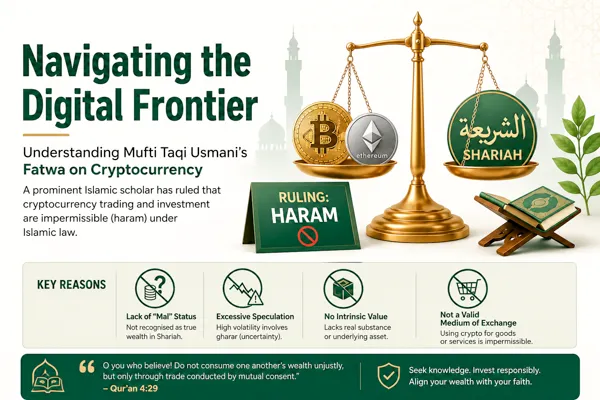
Navigating the Digital Frontier: Understanding Mufti Taqi Usmani's Fatwa on Cryptocurrency
“Navigating the Digital Frontier: Understanding Mufti Taqi Usmani's Fatwa on Cryptocurrency" by Mogamat Ali Salie
As cryptocurrencies continue to reshape global finance, Muslim investors are increasingly asking a fundamental question: Are digital assets compatible with the principles of Shariah? One of the most influential voices in Islamic finance, Mufti Muhammad Taqi Usmani, has addressed this question through a detailed fatwa that concludes cryptocurrency trading and investment are not permissible under Islamic law.
Cryptocurrency and Islamic Finance
Digital currencies such as Bitcoin, Ethereum and thousands of other crypto assets have transformed the global financial landscape, offering decentralised, borderless systems of exchange and investment. Their rapid adoption has generated excitement among investors, while also raising complex legal, ethical and religious questions.
For Muslims, financial decisions extend beyond profitability. Every investment must comply with the principles of Shariah, which promote justice, transparency, genuine economic activity and the protection of wealth. It is within this framework that Mufti Muhammad Taqi Usmani examined cryptocurrencies.
His conclusion, set out in a recent fatwa issued by Darul Uloom Karachi, is clear: based on their current characteristics, cryptocurrencies are not Shariah compliant.
Why Mufti Taqi Usmani's Opinion Matters
Mufti Muhammad Taqi Usmani is widely recognised as one of the world's foremost authorities on Islamic jurisprudence and Islamic finance. A former judge of Pakistan's Federal Shariat Court and an internationally respected scholar in Fiqh, Hadith and Islamic commercial law, he has played a pivotal role in developing modern Islamic banking and finance.
His scholarly opinions are relied upon by Islamic financial institutions, Shariah supervisory boards and Muslims around the world. As such, his views on emerging financial innovations carry significant weight.
The Core Reasons Behind the Fatwa
Mufti Taqi Usmani's ruling is not based on the technology behind blockchain. Rather, it focuses on whether cryptocurrencies satisfy the conditions required by Shariah for wealth, trade and investment.
1. Cryptocurrencies Do Not Qualify as "Māl" in the Shariah Sense
Islam recognises wealth (māl) as property that possesses lawful value, can be owned and transferred, and provides legitimate benefit.
According to Mufti Usmani, cryptocurrencies do not currently fulfil this definition. Unlike tangible assets or recognised currencies backed by sovereign authorities, most cryptocurrencies derive their value almost entirely from market demand and speculation.
Without an underlying asset, productive economic activity or universally accepted legal status, they do not satisfy the traditional Shariah requirements for a valid medium of exchange or store of value.
2. Excessive Speculation (Gharar)
One of the defining principles of Islamic finance is the prohibition of excessive uncertainty (gharar).
Cryptocurrency markets are characterised by extreme price volatility, often experiencing dramatic gains or losses within hours. Such movements encourage speculative trading rather than investment based on genuine economic value.
Mufti Usmani therefore considers cryptocurrency trading to involve an unacceptable level of uncertainty and speculation, making it inconsistent with the objectives of Shariah.
Allah says in the Qur'an:
"O you who believe! Do not consume one another's wealth unjustly, but only through trade conducted by mutual consent."
(Surah An Nisa 4:29)
Islam encourages trade that creates genuine value while discouraging transactions driven primarily by uncertainty and speculation.
3. Lack of Intrinsic Value
Another concern highlighted in the fatwa is that cryptocurrencies generally lack intrinsic or independently verifiable value.
Gold possesses value because of its physical characteristics and widespread utility. Shares represent ownership in productive businesses. Property generates rental income and provides tangible economic benefit.
Most cryptocurrencies, however, rely almost exclusively on market perception and investor sentiment. Their value is often disconnected from any underlying productive asset, leading Mufti Usmani to conclude that they lack the substance required under Islamic commercial law.
4. Use as a Medium of Exchange
The fatwa further concludes that purchasing goods and services using cryptocurrency is also impermissible.
Since the underlying asset itself is regarded as non-compliant, using it as consideration in commercial transactions does not resolve the Shariah concerns surrounding its legitimacy.
A Principle Based Ruling
Importantly, Mufti Taqi Usmani's ruling is based on the current nature and structure of cryptocurrencies rather than a rejection of financial innovation itself.
Islam has historically embraced innovation where it serves the public interest (maslahah) and complies with the objectives of Shariah (Maqasid al Shariah). The issue is therefore not blockchain technology, but whether digital assets meet the necessary legal and ethical conditions required by Islamic law.
As the industry evolves, including the possible emergence of asset backed digital currencies and central bank digital currencies, future scholarly assessments may differ.
Scholarly Diversity
While Mufti Muhammad Taqi Usmani's opinion is highly influential, it is important to recognise that contemporary Islamic scholarship is not unanimous on cryptocurrency.
Some respected scholars and Shariah advisory bodies have argued that certain cryptocurrencies may be permissible under specific circumstances, particularly where they function as recognised assets rather than purely speculative instruments.
This diversity of opinion reflects the complexity of applying classical Islamic legal principles to rapidly evolving financial technologies.
For Muslim investors, differences of scholarly opinion highlight the importance of seeking guidance from qualified scholars and understanding the reasoning behind each position before making investment decisions.
Practical Guidance for Muslim Investors
Given the significant scholarly differences surrounding cryptocurrencies, Muslims should exercise caution before investing.
Before committing capital, consider the following questions:
Does this investment create genuine economic value?
Is the primary objective long term investment or short term speculation?
Does the asset comply with the principles of transparency, fairness and justice?
Would I be comfortable accounting for this investment before Allah?
The Prophet Muhammad ﷺ said:
"Leave that which makes you doubt for that which does not make you doubt."
(Sunan al Tirmidhi)
This timeless guidance encourages Muslims to avoid doubtful matters where uncertainty exists.
Conclusion
Cryptocurrency represents one of the most significant financial innovations of the modern era. Yet innovation alone does not determine permissibility under Islamic law.
According to Mufti Muhammad Taqi Usmani's fatwa, cryptocurrencies in their present form do not satisfy the requirements of Shariah because they lack recognised wealth status (māl), involve excessive speculation (gharar) and do not possess sufficient intrinsic value.
Whether future developments alter this assessment remains to be seen. Until then, Muslim investors are encouraged to approach digital assets with knowledge, caution and a commitment to ensuring that their financial decisions remain aligned with the ethical principles of Islam.
Ultimately, wealth in Islam is not measured solely by financial return, but by how it is earned, preserved and used in a manner that pleases Allah.
References
Mufti Muhammad Taqi Usmani. Fatwa on the Use of Cryptocurrency (Bitcoin, USDT and Other Crypto Tokens). Darul Uloom Karachi, Pakistan, July 2026.
Darul Uloom Karachi. Official Shariah ruling on cryptocurrency and digital assets.
Qur'an 4:29.
Sunan al Tirmidhi, Hadith: "Leave that which makes you doubt for that which does not make you doubt."
Editorial Note: This article presents the opinion of Mufti Muhammad Taqi Usmani, one of the world's leading scholars in Islamic finance. It should be noted that contemporary Islamic scholarship on cryptocurrency is not unanimous, and readers are encouraged to consult qualified scholars regarding their own circumstances.


