What Is a Wasiyyah? The Islamic Will Explained for South African Muslims
What Is a Wasiyyah?
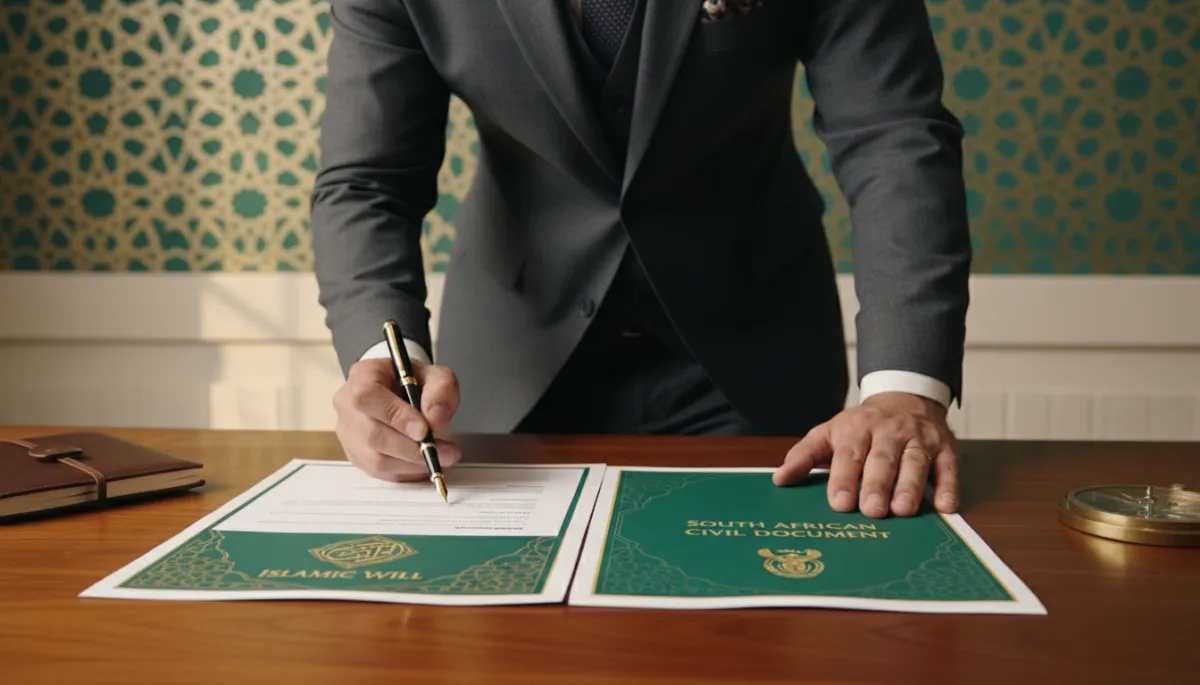
A Wasiyyah is an Islamic will — a formal declaration of a Muslim's wishes regarding the distribution of their estate after death. The word comes from the Arabic root meaning to enjoin or to counsel. In Islamic jurisprudence, it carries both a legal and spiritual dimension: it is the document through which a Muslim ensures their wealth reaches the right hands in the right proportions.
In South Africa, a Wasiyyah serves a dual function. It must comply with the formal requirements of the Wills Act 7 of 1953 to be valid in a South African court, AND it must direct the distribution of the estate according to Islamic inheritance principles (faraid). When both conditions are met, a South African executor is legally bound to distribute the estate as directed.
Why the Prophet (SAW) Made It Obligatory
The Prophet Muhammad (SAW) said: "It is the duty of a Muslim who has anything to bequest not to let two nights pass without writing a will about it." (Bukhari and Muslim)
This hadith is direct. Not two weeks, not two months — two nights. Islamic scholars have historically classified writing a Wasiyyah as wajib (obligatory) for anyone who has wealth and heirs. In South Africa, where civil law can fundamentally alter faraid distribution in the absence of a valid Islamic will, this obligation carries particular practical weight.
What a Wasiyyah Can and Cannot Do
What it can do
- Direct that the estate be distributed according to faraid
- Appoint an executor who understands both South African law and Islamic inheritance principles
- Make bequests of up to one-third of the net estate to non-heirs — charitable causes, a friend, a stepchild
- Establish a trust for minor children or a disabled heir
- Record the deceased's wishes regarding funeral arrangements and outstanding debts
- Appoint a guardian for minor children
What it cannot do
- Override faraid shares — the fixed Quranic fractions for wives, daughters, sons, parents cannot be changed
- Bequest more than one-third of the net estate to non-heirs
- Make a bequest to a faraid heir without the consent of all other heirs (scholars generally hold this position)
- Exclude a rightful heir from their faraid share
The Wills Act 7 of 1953 — South African Formalities
For a Wasiyyah to be legally enforceable in South Africa, it must meet the formal requirements of the Wills Act:
- Must be in writing
- The testator must sign at the end of the document
- Two competent witnesses must be present when the testator signs and must also sign in the testator's presence
- Witnesses cannot be beneficiaries of the will or married to beneficiaries
- The testator must be 16 years or older and of sound mind
A verbal Islamic will has no legal standing in a South African court. A correctly worded document that fails the Wills Act formalities can be declared invalid. The Master of the High Court will then treat the deceased as having died intestate — and the Intestate Succession Act applies, not faraid.
The Wasiyyah Bequest — Using the One-Third Wisely
Islam permits a Muslim to bequest up to one-third of their net estate (after debts) to non-heirs. This one-third is the space for personal discretion within faraid — the only portion of the estate the testator controls freely.
South African Muslims use this one-third for various purposes:
- Sadaqah jariyah — contributions to a mosque, school, or Islamic charity that generate ongoing reward
- A bequest to a stepchild who does not inherit under faraid
- A bequest to a non-Muslim family member
- Establishing a Waqf (Islamic endowment) for charitable purposes
Using this one-third strategically — whether for legacy, charity, or family equity — is where Islamic estate planning expertise adds the most value.
Who Needs a Wasiyyah in South Africa?
Every Muslim adult in South Africa who owns any asset — property, a bank account, shares, a vehicle, a retirement fund nomination — needs a Wasiyyah. The question is not whether you have enough wealth to justify it. The question is whether you want your estate distributed according to faraid or according to the Intestate Succession Act.
Without a Wasiyyah:
- Your estate is distributed under South African civil law, not faraid
- Your family has no legal basis to demand Shariah-compliant distribution
- Disputes about who gets what are resolved by the Master of the High Court, not an Islamic scholar
- Your intended charitable bequests are not made
- No guardian is formally appointed for your minor children
Keeping Your Wasiyyah Current
A Wasiyyah should be reviewed whenever your family circumstances change — marriage, the birth of a child, the death of a parent or sibling, divorce, or a significant change in assets. We recommend reviewing your Wasiyyah at least every three years, or immediately after any major life event.
The Connection Between Your Will and Your Full Estate Plan
A Wasiyyah is one part of a complete Islamic estate plan. It works alongside beneficiary nominations on retirement funds, life insurance policy nominations, asset ownership structures, and business succession plans.
Read the Complete Guide to Islamic Inheritance in South Africa for the full framework, and the Islamic Estate Planning guide for how a Wasiyyah fits into a broader estate plan.
Get Your Wasiyyah Drafted Correctly
An Islamic will that fails the Wills Act is as dangerous as no will at all. An Islamic will that lacks specific faraid direction leaves your executor without guidance. Both outcomes defeat the purpose.
MuslimFin Family Office works with qualified Shariah scholars and South African legal professionals to draft Wasiyyahs that are simultaneously legally valid and Islamically correct — giving your family certainty on both dimensions.
Book a confidential consultation: https://muslimfin.co.za/calendar-ali


