What is Diminishing Musharaka? Islamic Home Finance Explained in Plain English
If you have ever enquired about a halal home loan in South Africa, you have almost certainly encountered the term diminishing musharaka. It is the Shariah-compliant structure behind most Islamic home finance in South Africa — and understanding how it works will help you make a more confident, informed decision when buying property.
The Simple Explanation
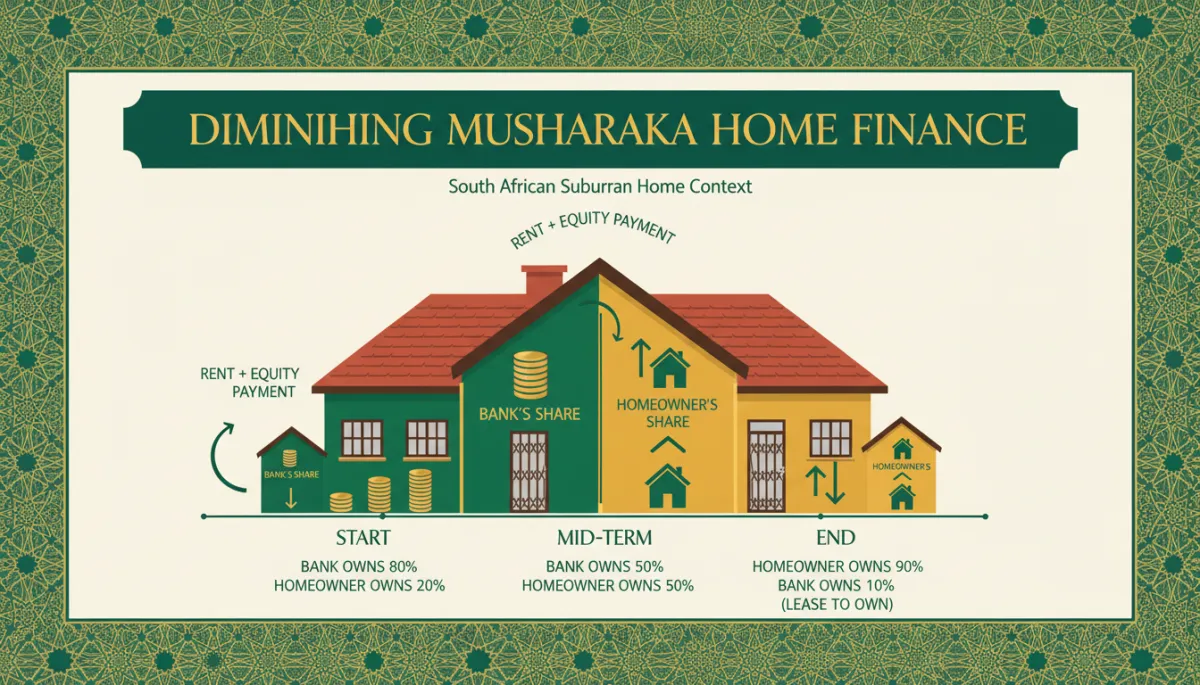
Diminishing musharaka literally means “declining partnership.” Instead of a bank lending you money to buy a house (a conventional bond, which is riba), the bank and you jointly purchase the property together. You then progressively buy the bank’s share — your ownership increases as the bank’s decreases — until you own it entirely. Throughout the process, you pay rent on the bank’s remaining share. No interest is ever charged.
How It Works: Step by Step
- Joint purchase — you and the bank purchase the property together. If the property costs R3 million and you have a R600,000 deposit (20%), you own 20% from day one and the bank owns 80%
- Monthly payment — your monthly payment has two components: (a) rent on the bank’s 80% share — your compensation to the bank for letting you live in its portion of the property; and (b) a purchase instalment — money used to buy a further slice of the bank’s share each month
- Declining rent — as you buy more of the bank’s share, its ownership percentage falls. Because you pay rent on the bank’s share, and that share is shrinking, the rental component of your payment decreases over time (while your purchase instalment remains relatively stable)
- Full ownership — after the full term (typically 20–30 years), you have bought the bank’s entire share. The property is 100% yours
Why This Is Shariah-Compliant
The rental income the bank earns is halal because it is compensation for providing you access to real property that the bank genuinely owns. This is ijarah (leasing) applied within a partnership structure. The bank is not lending you money and charging interest on the outstanding balance — it is renting you its share of a physical asset. As long as the bank genuinely holds ownership of its share (and bears the associated ownership risks), the structure is permissible.
Diminishing Musharaka vs a Conventional Bond: Side by Side
| Feature | Conventional Bond | Diminishing Musharaka |
|---|---|---|
| What the bank gives you | A loan (cash) | Co-ownership in the property |
| Your monthly payment | Interest + capital repayment | Rent on bank’s share + purchase instalment |
| Who owns the property? | You (mortgaged to the bank) | Both of you (proportionally) |
| Bank’s profit source | Interest on outstanding loan balance | Rental income on its share of the property |
| Early settlement? | Reduces future interest; penalty may apply | Reduces rental obligation; early settlement terms vary |
| Shariah status | Not permissible (riba) | Permissible (genuine partnership + rental) |
What Happens to the Rental Rate Over Time?
A common question: if the bank’s share decreases over time, does the rental amount decrease proportionally? In a genuine diminishing musharaka, yes — the rental payment should decrease as the bank’s share decreases, because you are paying rent on a smaller and smaller ownership stake. In practice, many South African Islamic home finance products link the rental rate to a benchmark (such as the prime rate), which means the rental rate can change over time. This is an area where scholars have different views on acceptability — ask your Islamic bank specifically how the rental rate is determined and whether the rental decreases as your ownership increases.
Which South African Banks Offer Diminishing Musharaka Home Finance?
Al Baraka Bank, Standard Bank Islamic Banking, Absa Islamic Banking, Nedbank Islamic Banking, and HBZ Bank all offer Islamic home finance products. The specific structure and terms vary. Read our complete guide on halal home loans in South Africa for a full comparison. For the underlying contract concept, read our guide on what musharaka is.
Joint Property and Islamic Inheritance
Because the bank co-owns the property during the diminishing musharaka term, your estate at the point of death includes your current ownership share — not the full property. Your Islamic will and faraid distribution must account for this. If you die mid-term, your ownership share forms part of your estate; the outstanding purchase obligation to the bank remains a liability of the estate. Coordinate your Islamic will with your home finance arrangement. Read our guides on joint property when a Muslim spouse dies and Islamic wills in South Africa.
Get the Right Islamic Home Finance
Diminishing musharaka is the most Shariah-aligned way to buy property in South Africa — when it is properly structured. Our team at MuslimFin helps South African Muslims navigate their home finance options, evaluate the Shariah compliance of specific products, and coordinate their home ownership with their broader Islamic estate plan. Book a consultation.
Book Your Home Finance Consultation →


