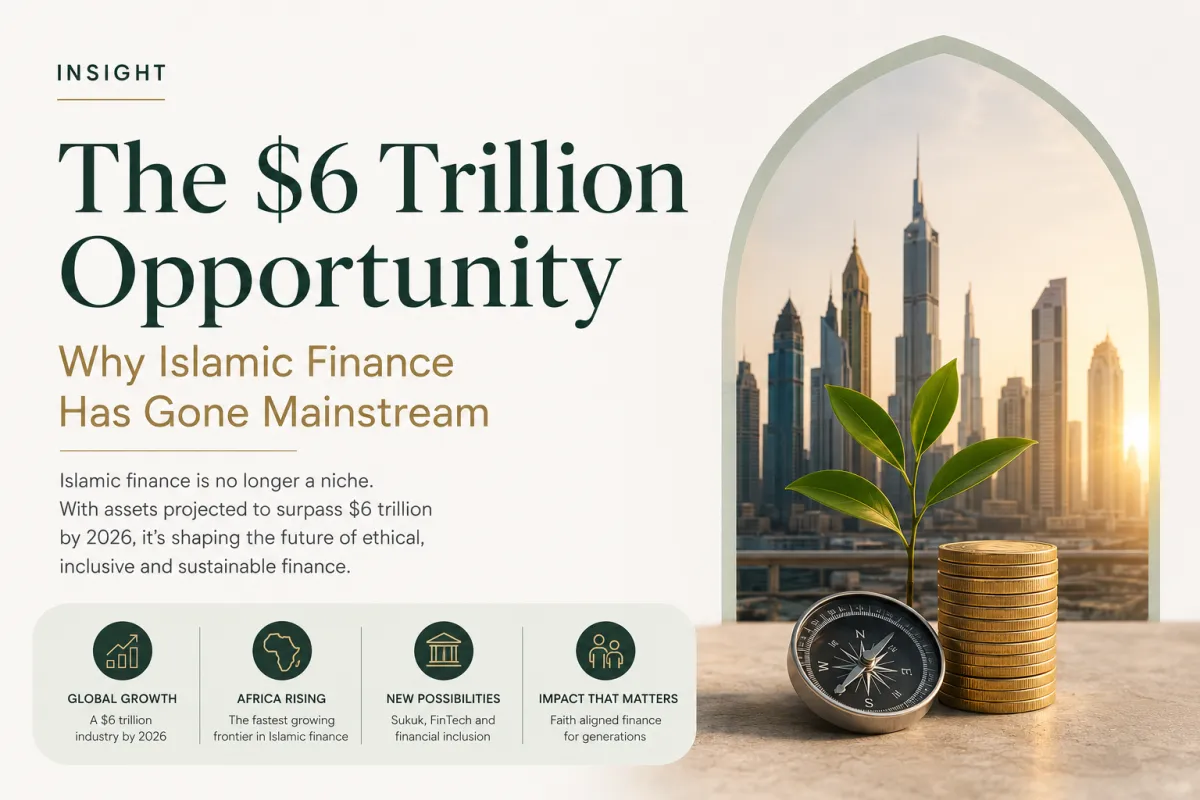
The $6 Trillion Shift: Why Islamic Finance Is Becoming a Global Financial Force
“The $6 Trillion Shift: Why Islamic Finance Is Becoming a Global Financial Force" by Mogamat Ali Salie
For decades, Islamic finance was often described as a niche industry, serving primarily Muslim-majority countries and a relatively small segment of the global financial market. That narrative no longer reflects reality.
A financial system approaching US$6 trillion in assets cannot reasonably be described as an alternative. It is increasingly becoming a recognised pillar of the global financial ecosystem.
This milestone represents more than impressive growth. It signals a broader shift in how investors, institutions and governments are thinking about capital, risk and long-term value creation.
A Structural Shift, Not a Temporary Trend
According to projections from the AlHuda Centre of Islamic Banking and Economics, global Islamic finance assets are expected to exceed US$6 trillion by the end of 2026, following strong double-digit annual growth.
While the numbers are impressive, they are only part of the story.
The industry's continued expansion reflects several long-term structural trends:
Increasing demand for ethical and values-based investing.
Greater financial inclusion across emerging markets.
Growing sovereign participation through Sukuk issuance.
Expansion of Islamic banking and wealth management.
Rapid innovation in Islamic FinTech.
These are not isolated developments. Together, they demonstrate that Islamic finance has evolved into a mature financial system capable of supporting governments, corporations, entrepreneurs and families alike.
Beyond Faith Based Finance
One of the most common misconceptions is that Islamic finance exists exclusively for Muslims.
In reality, many of its underlying principles have universal appeal.
The emphasis on transparency, asset backing, responsible risk sharing and avoiding excessive speculation closely aligns with many of the themes now shaping global investment conversations. Environmental, Social and Governance (ESG) investing, sustainable finance and impact investing all reflect a growing desire for financial systems that create long-term value rather than short-term gains.
Islamic finance has embodied many of these principles for centuries.
Rather than viewing Islamic finance as separate from mainstream finance, it is increasingly more accurate to see it as part of a broader movement towards responsible capital allocation.
Africa's Opportunity
Perhaps the most exciting developments are taking place closer to home.
Africa is emerging as one of the fastest-growing regions for Islamic finance. Markets across East and West Africa are expanding rapidly, supported by regulatory reforms, demographic growth and increasing investor demand.
Countries including Kenya, Tanzania, Nigeria and Senegal have already demonstrated how Sukuk can successfully finance infrastructure while attracting both domestic and international capital.
Several additional African jurisdictions are preparing to enter the market.
This matters because Africa faces one of the world's largest infrastructure funding gaps. Islamic finance offers another avenue through which governments and private investors can mobilise long-term capital while diversifying funding sources.
The continent has an opportunity not simply to adopt Islamic finance, but to help shape its next phase of development.
South Africa Is Better Positioned Than Many Realise
South Africa already possesses many of the building blocks required for a thriving Islamic finance ecosystem.
It has:
One of Africa's most sophisticated financial markets.
Strong legal and regulatory institutions.
Deep capital markets.
Established Islamic banking offerings.
Experienced investment professionals.
A well-developed asset management industry.
The country's return to the sovereign Sukuk market in 2023 demonstrated that Islamic capital markets remain relevant within South Africa's broader funding strategy.
Yet despite these strengths, public awareness remains relatively limited.
Many Muslim families continue to assume that Shariah compliant financial solutions are either unavailable or significantly more restrictive than conventional alternatives. Increasing financial literacy may be one of the industry's greatest opportunities over the coming decade.
The Next Frontier Is Digital
Technology is likely to become one of the industry's most significant catalysts.
Islamic FinTech is reducing barriers to entry by making Shariah compliant financial products more accessible, more affordable and easier to understand.
Digital onboarding, AI-powered financial education, robo-advice, inheritance calculators, digital wills and personalised wealth planning tools have the potential to transform how families engage with Islamic finance.
Technology should not replace trusted professional advice. Rather, it should make high-quality financial guidance available to many more people than has traditionally been possible.
A Conversation About Stewardship
Perhaps the most important implication of this industry's growth is philosophical rather than financial.
Islamic finance encourages us to view wealth not simply as something to accumulate, but as an Amanah entrusted to us with responsibility.
That perspective changes the conversation.
Instead of asking only how to maximise returns, we begin asking:
How should wealth be created?
How should risk be shared?
How should future generations be protected?
What responsibility accompanies financial success?
These are questions that extend well beyond balance sheets.
Looking Ahead
The rise of Islamic finance should not be viewed simply as the growth of another financial sector.
It represents a broader evolution in global finance towards systems that seek greater transparency, stronger governance, ethical stewardship and long-term resilience.
For South Africa, this presents an opportunity to strengthen its position as a regional financial centre while expanding access to innovative financial solutions for diverse communities.
For investors, it offers an expanding universe of opportunities.
For families, it provides an opportunity to align financial decisions with deeply held values while preserving wealth across generations.
The conversation has moved beyond whether Islamic finance belongs in the mainstream.
The market has already answered that question.
The more important question is how individuals, institutions and policymakers choose to participate in what comes next.
Editor's Note: This article was originally published in the Muslim Views digital newsletter and is republished here with permission to support broader financial literacy within the community.
This article is intended for educational purposes only and does not constitute financial, legal or tax advice. Readers should consult appropriately qualified professionals before making financial decisions.


