Zakah in South Africa: The Complete Guide for Muslim Families
Last reviewed: August 2026
Zakah is the third pillar of Islam — an obligation, not a recommendation. For South African Muslims, this means that every year, once a Muslim's wealth has been above the nisab threshold for a full lunar year, a precise portion of that wealth must be distributed to the categories of recipients prescribed in the Quran.
This guide covers everything a South African Muslim needs to know to calculate and discharge Zakah correctly — the rules, the assets included and excluded, the recipients, the South African-specific complexities, and how to approach Zakah as a family when wealth is held across multiple structures.
What Zakah Is — And What It Is Not
Zakah is a compulsory annual transfer of wealth from those who have accumulated wealth above a defined threshold to those who are entitled to receive it. It is not charity in the conventional sense — it is a right that the poor have over the wealth of the rich, established by divine obligation.
The Quran identifies eight categories of recipients (asnaf) in Surah At-Tawbah (9:60): the poor (fuqara), the needy (masakin), those appointed to collect and administer Zakah (amil), those whose hearts are to be reconciled (muallafatul quloob), those in bondage (riqab), the debt-burdened (gharimeen), those in the way of Allah (fi sabilillah), and the wayfarer (ibn as-sabil). Distribution among these categories follows the guidance of the madhab followed by the individual, and differs in some respects between schools of jurisprudence.
Zakah is distinct from Sadaqah (voluntary charity), Lillah (general charitable giving), and Waqf (Islamic endowment). These are all forms of giving, but only Zakah is obligatory and subject to the specific rules of nisab, hawl, and the prescribed categories of recipients.
The Nisab: The Threshold for Zakah Obligation
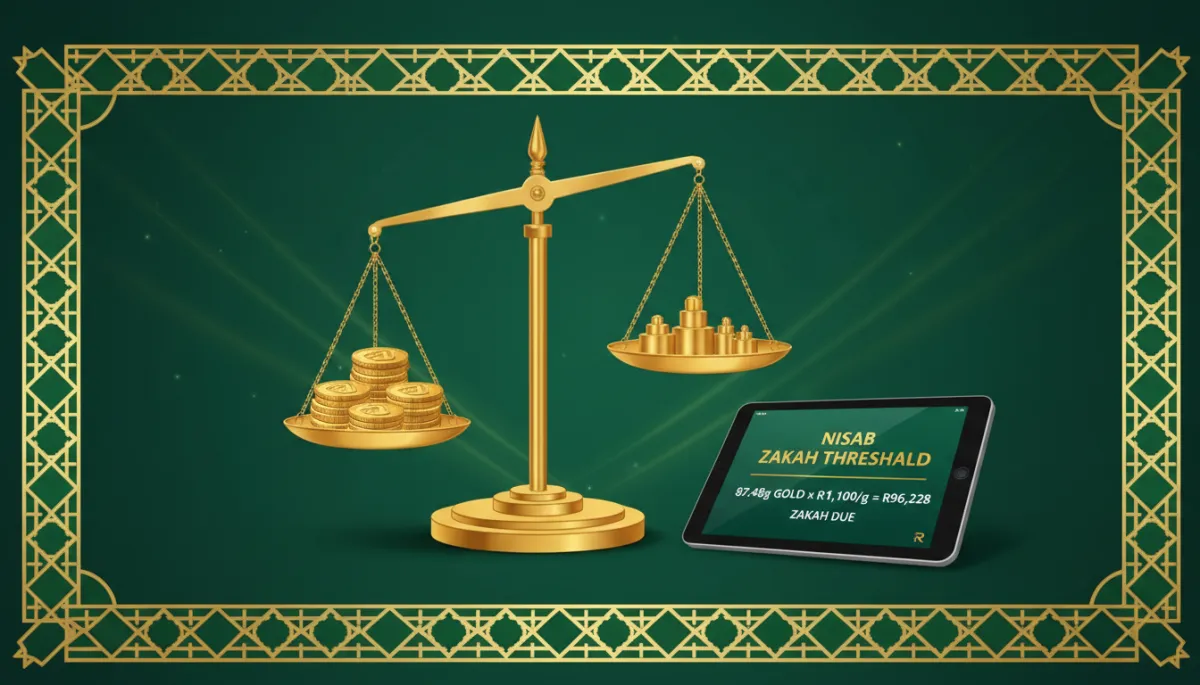
Zakah becomes obligatory when a Muslim's zakatable wealth reaches or exceeds the nisab — the minimum threshold — and has remained at or above that threshold for a full Islamic lunar year (hawl).
The nisab is defined in two ways in Islamic jurisprudence:
Gold nisab: 85 grams of gold. If the total zakatable wealth equals or exceeds the market value of 85 grams of gold, Zakah is due.
Silver nisab: 595 grams of silver. This is the lower of the two thresholds. Many contemporary scholars recommend using the silver nisab, particularly when calculating Zakah on cash and business assets, as it results in a higher obligation and benefits more recipients. The appropriate nisab to use is a matter of scholarly opinion — Muslims should follow the guidance of a qualified Islamic scholar.
The nisab value in South African Rand changes daily with the price of gold and silver and with the exchange rate. Reputable South African Islamic organisations and Zakah collection bodies publish updated nisab values annually or more frequently — verify the current nisab before calculating Zakah each year.
The Zakah Rate
The Zakah rate is 2.5% of total zakatable wealth above the nisab, payable after the hawl (one full lunar year at or above the nisab) has passed.
This rate applies to most categories of zakatable wealth for individuals. Different rates apply in some contexts (for example, agricultural produce and certain other categories), but for most South African Muslims calculating Zakah on financial assets, 2.5% is the applicable rate.
What Assets Are Subject to Zakah
Cash and Bank Deposits
All cash held in hand and in bank accounts is subject to Zakah — including current accounts, savings accounts, and fixed deposits. The full balance on the Zakah calculation date is included, regardless of whether it is in an Islamic or a conventional bank account.
For interest income accumulated in a conventional account: the interest itself should be disposed of to charity (not kept) and is not included in the Zakah base as it does not belong to the account holder under Islamic principles.
Trade Goods and Business Assets
Stock in trade — goods held for sale — is subject to Zakah at the market value on the calculation date. This is particularly relevant for business owners and traders.
Fixed assets used in a business (machinery, equipment, vehicles, property used for production) are generally not zakatable. It is the current assets — stock, receivables, cash — that are subject to Zakah.
For business owners, the Zakah calculation requires separating zakatable assets (cash, stock, receivables) from non-zakatable assets (equipment, property). This is a specific calculation that differs from a conventional financial statement analysis.
Gold and Silver
Physical gold and silver — jewellery, coins, bars — are zakatable in full (not just the portion above nisab). The Zakah due is 2.5% of the total value of gold and silver held.
There is a well-known scholarly debate about gold jewellery worn by women for personal use — some scholars exempt it from Zakah; others include it. Muslims should follow the ruling of their chosen madhab or the guidance of a qualified scholar.
Listed Investments and Unit Trusts
Shares and units in investment funds are subject to Zakah, but the calculation method depends on the nature of the investment. There are two primary approaches:
If the investment is for trading (short-term): the full market value is included in the Zakah base at 2.5%.
If the investment is long-term (held for dividends/growth): many scholars apply the Zakah to the zakatable underlying assets of the company proportional to the shareholder's interest — typically calculated as a percentage of the company's zakatable assets (cash, receivables, stock). Some scholars apply 2.5% of the market value directly — verify the applicable method with a scholar.
For Shariah-compliant unit trusts and ETFs, the fund manager or a Zakah calculator provided by the fund may publish the Zakah-relevant figures for each fund, based on an analysis of the underlying holdings.
Retirement Funds
Zakah on retirement savings is a more complex area where scholarly opinion differs.
The predominant view is that the Zakah obligation arises when the funds become accessible — at retirement or on withdrawal. Some scholars require Zakah to be paid annually on the accessible (savings component) portion. Under the South African two-pot system introduced from September 2024, the savings component is accessible once per year — this portion may be subject to annual Zakah under some scholarly interpretations.
This is an area where individual Muslims should seek specific guidance from a qualified Islamic scholar, as the ruling depends on factors including the nature of the fund, the degree of control the member has over the assets, and the applicable madhab.
Property
Property held for personal use — the family home — is not zakatable. Property held for rental income is not zakatable as an asset, but the rental income received is zakatable if it remains in the Zakah base at the calculation date. Property held as stock in trade (for a property development or trading business) is zakatable at market value.
Receivables (Money Owed to You)
Receivables — money owed to a Muslim by others — are generally zakatable if there is a reasonable expectation of recovery. Trade debtors in a business context are typically included in the Zakah base. Doubtful debts may be excluded based on scholarly guidance.
What Assets Are Excluded from Zakah
The following are generally excluded from the Zakah calculation: personal household goods and furniture; vehicles for personal use; property and equipment used in a business (not held for sale); personal clothing; and other personal-use assets that are not cash, gold, silver, or trade goods.
Deducting Liabilities
Current liabilities — debts that are due or payable within the lunar year — may be deducted from zakatable assets before calculating Zakah. Long-term debt where no instalment is due within the year is generally not deductible in the same way. The treatment of various liabilities differs between scholars and madhabs.
For business owners with significant debt structures, the correct treatment of liabilities in the Zakah calculation requires careful scholarly guidance.
The Zakah Year: Choosing a Calculation Date
Most Muslims choose a consistent annual date for their Zakah calculation — often Ramadan, as Zakah paid in Ramadan carries additional spiritual reward, or another meaningful date on the Islamic calendar. The date itself is less important than consistency: using the same date each year ensures that all wealth is captured over each lunar year.
It is important to calculate Zakah on actual wealth at the calculation date, not on an average or estimate. Use actual account balances, investment valuations, and stock counts as of the chosen date.
Who Is Entitled to Receive Zakah
The eight categories of Zakah recipients are prescribed in Surah At-Tawbah. In the South African context, the most commonly applicable categories are the poor and needy — South Africa has significant poverty and a substantial Muslim community in need. Zakah may be paid to individuals directly or through a reputable Zakah distribution organisation that ensures the funds reach qualifying recipients.
Zakah cannot be paid to the giver's direct dependants (spouse, minor children, parents), nor to non-Muslims in most scholarly opinions. It cannot be used for mosque construction or general charity — these require Lillah, not Zakah.
Zakah and Wealth Held in Trusts, Companies, and Family Structures
For South African Muslim families with wealth held in trusts, investment companies, or family office structures, the Zakah calculation requires careful analysis of each structure:
Trusts: Zakah may be due on the trust's zakatable assets if the trust is effectively controlled by the Muslim beneficiary, depending on scholarly analysis of the nature of the beneficial interest.
Companies: For a Muslim who owns a majority or significant stake in a company, Zakah may be due on their proportional share of the company's zakatable assets — not simply on the market value of their shares. A precise calculation requires the company's Zakah-relevant balance sheet.
Complex family structures: High-net-worth families with wealth distributed across multiple vehicles — direct holdings, trusts, companies, retirement funds, and offshore structures — require a consolidated Zakah analysis to ensure no zakatable assets are missed and no assets are counted twice.
Zakah in South Africa: Practical Distribution Channels
South Africa has well-established Zakah collection and distribution organisations, particularly in Cape Town, Johannesburg, and Durban. These organisations accept Zakah, verify the eligibility of recipients, and distribute to the appropriate asnaf.
Muslims may also distribute Zakah directly to eligible individuals if they are confident of the recipient's eligibility under the prescribed categories. Where there is doubt about eligibility or the correct distribution, using a reputable Zakah organisation is the more cautious approach.
The Relationship Between Zakah and Legacy Planning
Zakah is an annual obligation on living Muslims. It does not apply to the estate of a deceased person — the estate is subject to the debt settlement and inheritance rules of the Wills Act and faraid, not to Zakah.
However, unpaid Zakah from prior years is a debt of the estate. If a Muslim dies with uncalculated or unpaid Zakah outstanding, this represents a valid claim against the estate that should be satisfied before the inheritance shares are distributed. It is advisable for Muslims to document their annual Zakah calculations and ensure that any outstanding Zakah is discharged, or that their estate plan provides for its settlement.
The Connection to Broader Islamic Financial Planning
Zakah is not an isolated obligation — it is part of a coherent Islamic approach to wealth that also includes proper estate planning, Shariah-compliant investment, and the avoidance of interest. A Muslim family that calculates and pays Zakah carefully, structures its estate under faraid, invests in a Shariah-compliant portfolio, and avoids interest-based debt is operating within the complete framework of Islamic financial principles.
For South African Muslim families, MuslimFin's family office approach integrates Zakah planning with investment strategy, estate planning, and retirement planning — ensuring that the annual Zakah obligation is properly calculated and that the overall wealth structure is coherent under Shariah.
For an exclusive consultation: https://muslimfin.co.za/calendar-ali


