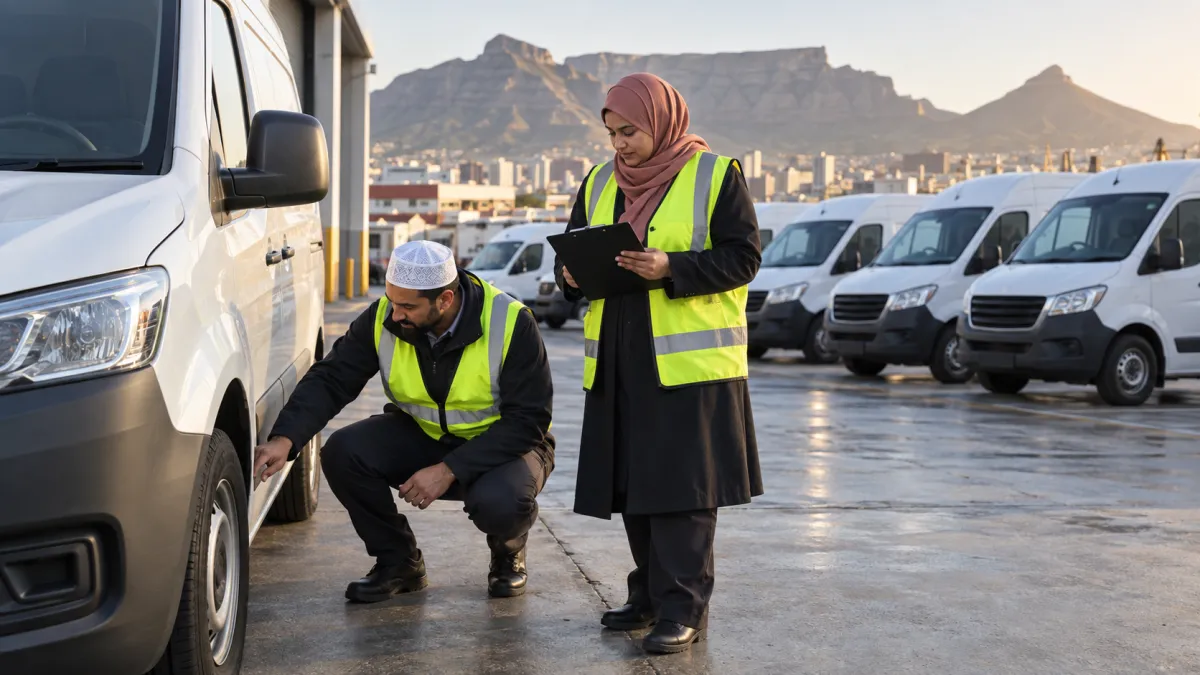
Commercial Vehicle and Fleet Takaful South Africa
Availability note: This is a fleet-risk planning guide, not confirmation that a commercial-fleet Takaful product is currently available for every South African vehicle class. Check the actual provider, permitted use, territories, capacity, wording and Shariah approval before relying on an arrangement.
Commercial vehicle and fleet Takaful in South Africa may protect company cars, bakkies, vans, trucks, trailers, buses or specialist vehicles against defined accidental loss, damage, theft and third-party liability, subject to the certificate or policy. The correct structure depends on what each vehicle does, who drives it, where it operates, what it carries, how it is financed and how quickly the business must recover after a loss.
A schedule containing registration numbers is not a complete fleet-risk plan. The business must align vehicle ownership, finance agreements, replacement values, permitted use, driver controls, cross-border journeys, tracking requirements, cargo protection, liability, special risks and claims evidence. A material change in the fleet or its operations should reach the intermediary or provider before it becomes a disputed fact after a claim.
Muslim-owned businesses should also complete product-specific Shariah due diligence. Review the participant risk fund, operator remuneration, investments, surplus and deficit treatment, retakaful or reinsurance, and current Shariah supervision. If suitable Takaful capacity is not available for a vehicle class or territory, document the search and obtain qualified guidance on necessity and proportionality.
This guide is general education. It is not insurance advice, road-transport advice, legal advice, tax advice, finance advice, claims advice or a fatwa. Obtain professional advice for the actual fleet, operation and wording.
The direct answer
What fleet Takaful can cover
Depending on the wording, it can cover comprehensive accidental loss or damage, theft, fire, specified perils, third-party liability, windscreen damage, towing, recovery and selected extensions. Every benefit has limits, exclusions and evidence requirements.
Who needs it
Businesses that own, lease, finance or are contractually responsible for vehicles need a structured review. Sole proprietors using personal vehicles for business should also disclose the real use.
What it does not replace
It does not replace lawful licensing, roadworthiness, maintenance, driver competence, fatigue management, route planning, tracking, incident response or a cash-flow reserve.
Why a fleet needs more than personal motor cover
A fleet introduces multiple drivers, changing vehicles, commercial use, cargo, higher mileage, overnight parking, subcontractors and accumulation risk. These facts must be reflected in the arrangement.
Build an accurate fleet inventory
Identify every vehicle
Record registration, VIN, make, model, year, body type, accessories, finance status, ownership entity, regular driver, garaging address and primary use. Include trailers, non-registered equipment and temporary replacements where relevant.
Separate vehicle classes
Company cars, light delivery vehicles, heavy commercial vehicles, buses, agricultural vehicles, motorcycles and mobile plant can attract different conditions. Do not assume one class definition captures them all.
Record modifications
Canopies, refrigeration units, cranes, hydraulic equipment, tracking systems, branding, shelving and specialist bodies can add significant value. Confirm whether each item forms part of the vehicle, an accessory or separate plant.
Map finance interests
Instalment-sale, lease and rental agreements can require comprehensive cover, noted financial interests and specific settlement handling. Record the outstanding balance separately from the insured value.
Control additions and disposals
Create a same-day process connecting procurement, finance, fleet management and the intermediary. The risk can begin before the monthly asset register is reconciled.
Declare the real business use
Ordinary business travel
Sales visits, staff travel and client calls differ from carrying goods, passengers or hazardous materials. Describe the actual operation rather than selecting the cheapest label.
Delivery and courier work
Frequent stops, time pressure, loading activity and theft exposure can change underwriting. The vehicle, the goods and delivery liability may require separate sections.
Carriage for reward
Transporting passengers or goods for payment can fall outside ordinary business use. Disclose the service, licences, routes and contracts.
Employee commuting
Take-home vehicles create after-hours and home-garaging exposures. State whether private use, spouse use or commuting is permitted.
Cross-border operation
Territorial limits, border documents, recovery arrangements, security conditions and emergency assistance must match the countries visited. South African cover should not be assumed to follow a vehicle everywhere.
Specialist operations
Construction, mining, agriculture, security, emergency response and mobile workshops can involve off-road work, hazardous sites and attachments. Compare motor, plant and liability definitions.
Choose the protection basis
Comprehensive protection
Comprehensive cover commonly combines own physical loss or damage with defined third-party liability. “Comprehensive” still remains subject to exclusions, excesses, conditions and limits.
Third party, fire and theft
This narrower option may address third-party liability plus specified fire and theft losses, while leaving collision damage to the business. Test whether the balance sheet can absorb that exposure.
Third party only
Third-party-only protection can leave the business responsible for replacing its own vehicle after a total loss. Finance contracts may not allow it.
Special risks
Riot, strike, public disorder and related special risks usually require the appropriate Sasria structure. Sasria's underwriting hub publishes current motor wordings and class material; the underlying motor schedule and Sasria documents should be aligned.
Sasria is discussed here as a separate conventional special-risks arrangement, not as a Takaful operator or a statement of Shariah approval. Ask a qualified Shariah adviser to assess its place in the specific risk programme; check the currently applicable wording and implementation date.
Optional extensions
Extensions can include windscreens, towing, vehicle hire, loss of use, credit shortfall, keys, emergency accommodation, cross-border assistance and accessories. Names and limits differ by provider.
Set defensible vehicle values
Retail, market and agreed value
The policy may use retail value, market value, an agreed amount or another basis. Identify which value applies at claim date and whether it includes VAT, accessories and modifications.
New-vehicle replacement
Replacement benefits often depend on age, mileage, first ownership, sum insured and time limits. Read the definition rather than treating “new for old” as unconditional.
Finance shortfall
The settlement on a written-off vehicle may be lower than the finance balance. Credit-shortfall protection can be subject to exclusions for arrears, balloon payments, early-settlement charges, extras and uninsured amounts.
Heavy and specialist vehicles
Trucks, trailers, refrigerated bodies, cranes and conversions can require professional valuation or separate amounts. Used-market volatility makes stale purchase prices unreliable.
VAT treatment
Confirm whether values and settlements are VAT inclusive or exclusive for the specific business. Align the schedule with the entity's tax position and obtain tax advice.
Review values during the year
Inflation, exchange rates, scarcity and new equipment can change replacement cost. Review after acquisitions, modifications and material market shifts—not only at annual renewal.
Control drivers and authorised use
Driver identity
State whether the wording permits any authorised driver, named drivers or defined employee classes. Keep an accurate link between driver, vehicle and journey.
Licence validity
Verify the correct licence class, professional driving permit where required, expiry date and restrictions. A photocopy collected years ago is not an active control.
Competence and training
Match training to vehicle type, load, route and equipment. Induction should include inspections, reversing, defensive driving, breakdowns, collisions and evidence preservation.
Age and experience
Young, inexperienced or newly licensed drivers may attract restrictions or additional excesses. Record and communicate changes.
Alcohol, drugs and medication
Adopt a lawful fitness-for-duty policy, escalation process and evidence standard. Claims decisions depend on wording and proven facts; do not substitute assumptions for investigation.
Unauthorised or personal use
Control keys, permissions, after-hours use and family access. Telematics can reveal use patterns but must be governed consistently and lawfully.
Meet legal and roadworthiness duties
Roadworthy vehicles
South Africa's National Road Traffic Act 93 of 1996 establishes the national road-traffic framework and includes roadworthiness and operator-fitness provisions. Insurance or Takaful does not authorise an unroadworthy vehicle to operate.
Registration and licensing
Keep vehicle registration and licensing current and aligned with the correct owner and operator. Record renewals and exceptions centrally.
Operator obligations
Prescribed vehicle classes can create operator responsibilities. Fleet owners should identify which vehicles and activities fall within the operator regime and obtain transport-law advice.
Maintenance evidence
Use scheduled maintenance, daily inspections, defect reporting, tyre records, brake checks, repair authorisation and closure evidence. A signed checklist with no follow-up is weak control.
Loads and equipment
Control load mass, dimensions, restraint, dangerous goods, refrigeration and specialist attachments. The safest vehicle can still be compromised by an unsafe load.
Understand liability boundaries
Damage to other property
Third-party motor liability may address legally liable damage caused to other vehicles, buildings, gates or infrastructure, subject to limits and exclusions.
Injury to people
The South African road-accident framework is distinct from ordinary property-damage liability. The Road Accident Fund Act 56 of 1996 establishes the Road Accident Fund and its statutory compensation framework. Obtain legal advice for an actual injury claim.
Goods carried
Motor cover does not automatically protect stock or customers' goods in the vehicle. The marine cargo Takaful guide explains goods-in-transit valuation, route and claims evidence.
Loading and unloading
Damage during loading, unloading or operation of attached equipment can fall between motor, public liability, product liability and plant sections. Map the activity rather than relying on the vehicle label.
Employees and passengers
Employee injury, passenger liability and carriage-for-reward exposures require specific legal and wording review. Do not assume one motor-liability limit answers every claim.
Contractual liability
Customer, lease or logistics contracts can impose indemnities beyond ordinary legal liability. Additional contractual promises are not automatically insured.
Manage major fleet hazards
Collision
Speed, following distance, reversing, fatigue, distraction and route design drive collision risk. Analyse near misses, not only claims.
Theft and hijacking
Vehicle type, commodity, route, parking, keys, tracking, recovery response and information security affect the exposure. Check tracking warranties and testing frequency.
Catastrophe accumulation
Fire, flood, hail, riot or theft can affect several vehicles at one depot. Record the maximum overnight and operational accumulation per location.
Mechanical breakdown
Ordinary mechanical or electrical failure is commonly treated differently from accidental damage. Maintenance plans, warranties and machinery-related cover remain important.
Cyber and telematics
Connected vehicles, routing platforms, mobile devices and tracking portals can expose credentials, locations and operations. Segment access and preserve logs after suspicious activity.
Environmental damage
Fuel, chemicals and contaminated loads can create cleanup and liability costs beyond vehicle repair. Confirm pollution and dangerous-goods treatment.
Understand exclusions and conditions
Unlicensed or disqualified drivers
The effect depends on the wording, the facts and applicable law. Prevent the dispute with current licence verification and controlled vehicle allocation.
Undisclosed use
Courier work, passenger transport, racing, testing, towing or cross-border use may be restricted. Update the declaration before the operation changes.
Wear and maintenance
Wear, depreciation, gradual deterioration and mechanical failure are commonly excluded from accidental-damage cover. Consequential collision damage can require separate causation analysis.
Security warranties
Tracking, immobilisers, alarms, safe parking, key custody and recovery subscriptions may be conditions. Assign evidence and renewal responsibility.
Leaving the scene or late notice
Drivers need an incident protocol covering safety, police or authority reporting, third-party details, photographs and prompt notification. Never admit liability or negotiate privately without authority.
Excess structures
Basic, young-driver, licence-duration, theft, night-driving and additional compulsory excesses can stack. Model the actual retained amount by vehicle and event.
Perform Shariah and regulatory due diligence
Confirm the participant fund
Ask how contributions enter the participant risk fund, how claims are paid and how the operator is remunerated. Product branding alone is not sufficient evidence.
Review fund investments
Request current information on how participant and shareholder funds are invested and screened.
Understand surplus and deficit treatment
Determine who is entitled to underwriting surplus and how a deficit is funded and repaid.
Examine retakaful
Ask when retakaful is used, when conventional reinsurance is used and what Shariah governance supports any exception. Large fleets and specialist vehicles can need wider capacity.
Verify current Shariah oversight
Identify the Shariah board or adviser, latest approval, scope of review and audit process. The IFSB-8 Takaful governance standard sets out governance principles for Takaful undertakings and participant funds.
Verify regulated providers
South Africa's Insurance Act 18 of 2017 provides the prudential framework for insurance business. Use the FSCA regulated-people-and-entities resources to verify relevant providers and intermediaries.
Build a claims-ready process
Protect people first
Call emergency services where required, secure the scene and prevent further harm. The claims process follows safety and lawful reporting.
Capture evidence
Record date, time, location, driver, passengers, other parties, witnesses, road conditions, photographs, dashcam or telematics data and authority reference numbers.
Notify promptly
Notify the provider or intermediary within the required period, even if quantum is uncertain. Report hijacking, theft, injury and regulatory events to the appropriate authorities.
Do not authorise repairs prematurely
Follow towing, storage, assessment and repair instructions. Unapproved work or excessive storage charges can create disputes.
Preserve third-party rights
Do not admit liability, promise payment or waive recovery rights. Forward demands, summonses and correspondence immediately.
Reconcile the settlement
Check valuation basis, excesses, VAT, finance settlement, salvage, accessories and outstanding contributions. Separate vehicle damage from cargo, interruption and liability loss.
Connect the fleet programme to related protection
Business Takaful
The business Takaful guide helps coordinate motor, property, liability, crime and interruption sections.
Marine cargo Takaful
Vehicles and goods require separate values and triggers. The marine cargo Takaful guide covers transit boundaries, Incoterms, cargo declarations and evidence.
Business interruption Takaful
A damaged delivery vehicle can stop revenue without creating automatic income cover. Use the business interruption Takaful guide to assess fleet dependencies and recovery periods.
Public liability Takaful
Non-driving incidents at depots, customer premises or loading areas can fall outside motor liability. The public liability Takaful guide maps those exposures.
A worked South African example
The facts
A Johannesburg distributor operates twelve delivery vehicles, two refrigerated trucks and four company cars. Vehicles are financed across two entities, drivers rotate, and deliveries run through Gauteng and neighbouring provinces.
The hidden gaps
The schedule omits three fitted refrigeration units, one truck is registered in a sister company, two drivers' licence copies are expired, tracking subscriptions are not centrally tested, and the declared use does not mention temperature-controlled deliveries. The busiest depot holds eight vehicles overnight.
The loss
A truck is hijacked with customer stock. The recovery team discovers a lapsed tracking subscription. The business also loses delivery income and must hire a replacement vehicle.
The better structure
Before loss, the group aligns ownership and finance interests, separately values bodies and refrigeration units, declares delivery use, assigns monthly tracking tests, verifies driver credentials, sets depot accumulation limits, protects goods under cargo cover and models vehicle-hire and interruption needs. The incident protocol preserves telematics, stock and police evidence.
The lesson
Fleet protection succeeds when the schedule, operations and controls describe the same business. A mismatch is most expensive after a serious event.
A 12-step implementation process
Inventory every vehicle, trailer, accessory and specialist body.
Confirm ownership, finance interest and correct insured entity.
Classify each vehicle by actual use, load, territory and driver group.
Select comprehensive or narrower protection deliberately.
Set defensible values and per-location accumulation limits.
Review driver licences, permits, age, experience and authorisation.
Map roadworthiness, maintenance and defect-escalation controls.
Test theft, tracking, key, parking and recovery requirements.
Align motor, cargo, liability, interruption and Sasria sections.
Complete regulatory and Shariah due diligence.
Install additions, disposal, incident and claims-evidence workflows.
Review claims, telematics, values and operational changes quarterly.
Questions to ask before accepting terms
Vehicles and use
Which vehicle classes, accessories and trailers are included?
Are delivery, courier, passenger, cross-border and off-road uses declared?
How are temporary, hired and newly acquired vehicles treated?
Which territories and emergency services apply?
Drivers and conditions
Who is authorised to drive and what licence or permit is required?
Which age, experience and additional-excess rules apply?
What tracking, parking, security and key controls are mandatory?
Which maintenance or roadworthiness evidence is required?
Values and settlement
Is settlement based on retail, market, agreed or another value?
How are accessories, VAT, finance shortfall and salvage handled?
What excesses can apply to the same event?
What is the maximum cover at one depot or in one catastrophe?
Liability and governance
What third-party property-damage limit applies?
How are passengers, employees, loading and contractual liability treated?
How do Sasria, cargo and business interruption sections interact?
How does the Takaful fund and Shariah oversight operate?
Frequently asked questions
Is commercial fleet Takaful the same as personal motor insurance?
No. Commercial fleets involve business use, multiple drivers, cargo, higher mileage, finance interests, depots and operational controls that need specific disclosure.
Can one certificate cover all company vehicles?
It may, but each vehicle, class, value and use must fall within the wording and schedule. Fleet declarations and automatic-addition rules require active administration.
Are goods inside the vehicle covered?
Not automatically. Cargo or goods-in-transit protection normally requires a separate valuation, trigger and set of conditions.
Does comprehensive cover include every accident?
No. It is still subject to exclusions, driver requirements, permitted use, excesses, security conditions and proof.
Does the Road Accident Fund replace third-party motor liability?
No blanket conclusion should be drawn. The RAF has a statutory personal-injury compensation framework, while vehicle and property damage and other liabilities require separate legal and policy analysis.
What if an employee takes a company vehicle home?
Disclose and govern the arrangement. Private use, home garaging, household drivers, keys and after-hours trips can affect risk and terms.
Are modifications automatically included?
No. Specialist bodies, refrigeration, cranes, shelving and accessories should be described and valued.
Can a business claim vehicle hire after an accident?
Only if the applicable benefit or extension responds, within its duration, daily limit and conditions. Hire costs are not automatically paid.
What happens when a vehicle is financed?
The financier's interest and settlement requirements must be recorded. The claim value can still be lower than the outstanding balance unless suitable shortfall protection applies.
How often should a fleet be reviewed?
Review operational changes immediately, reconcile vehicles and drivers regularly, examine claims and telematics quarterly, and complete a full annual renewal review.
Final checklist
Every vehicle, trailer and accessory is inventoried.
Ownership and finance interests match the schedule.
Actual business use and territories are declared.
Vehicle values and VAT treatment are defensible.
Drivers have current licences and required permits.
Roadworthiness and maintenance evidence is current.
Tracking, keys and parking controls are assigned.
Depot and catastrophe accumulations are measured.
Excesses and retained cash exposure are understood.
Cargo and customer-goods exposure is separately addressed.
Liability and Road Accident Fund boundaries are reviewed.
Sasria and ordinary motor documents align.
Takaful structure and Shariah oversight are documented.
Incident and claims procedures are issued to drivers.
Additions, disposals and modifications are reported promptly.
Fleet, cargo, liability and interruption covers are coordinated.
How MuslimFin Family Office helps
MuslimFin Family Office can help a South African business build a complete fleet inventory, map ownership and finance interests, review valuation and operational controls, compare available Takaful or insurance structures, document Shariah and regulatory due diligence, and coordinate appropriate insurance, transport, legal, tax and Shariah specialists.
The goal is not merely to place vehicles on a schedule. It is to align the entities, drivers, vehicles, journeys, duties, protection wording, cash exposure and claims evidence in one governed fleet-risk plan.


