Public Liability Takaful in South Africa
Product availability: This is a risk and policy-wording guide, not confirmation that a South African insurer currently offers every Takaful section or extension described. Obtain a current written quotation, identify the legal insurer and check the exact product’s Shariah evidence before relying on cover.
Public liability Takaful in South Africa may respond when an insured business becomes legally liable for defined accidental bodily injury or property damage suffered by a third party during the period of cover. The exact insured entity, business activity, event, territory, legal basis, defence process, limit, excess and exclusion determine whether a claim is covered.
A certificate does not make unsafe premises safe or transfer every operational obligation to an insurer. Businesses should map visitors, customers, tenants, contractors, events, deliveries, products and off-site work; maintain practical controls; preserve incident evidence; and report potential claims promptly without making unauthorised admissions.
Muslim businesses also need product-specific Shariah evidence. Review the participant risk fund, operator remuneration, investments, surplus and deficit rules, retakaful, conventional reinsurance and current Shariah supervision. If appropriate Takaful capacity is unavailable, document the market search and obtain qualified guidance on necessity and proportionality for the actual exposure.
This guide is general education. It is not legal advice, insurance advice, health-and-safety advice, engineering advice, claims advice, tax advice or a fatwa. Obtain professional advice for the relevant site, activity, incident, contract and wording.
The direct answer
What public liability cover generally addresses
Public liability commonly addresses defined damages and defence costs arising from accidental third-party injury or property damage connected with the insured business. It is liability cover, not a maintenance fund or automatic payment for every incident.
Who counts as a third party
Customers, visitors, neighbouring owners, landlords, tenants, members of the public and contractors may qualify, subject to definitions and exclusions. Employees, directors and related entities may be treated differently.
What must usually be established
The claimant generally needs a legal basis for liability. The insured must also satisfy the policy's insured, business, occurrence, timing, territory, notification and cooperation requirements.
Why controls still matter
Inspection, maintenance, supervision, signage, training, contractor management and accurate records reduce harm. They also help establish what occurred and whether the response was reasonable.
Map every third-party interface
Customers and visitors
Record how people enter, queue, move, use facilities, receive services and leave. Consider children, older people, people with disabilities and unfamiliar visitors.
Landlords and tenants
Leases allocate maintenance, common-area, security and indemnity duties, but contractual wording does not automatically bind an insurer. Align lease duties with the cover.
Contractors
Identify who controls the work area, method, equipment and public interface. Obtain competence, insurance and safety evidence before work begins.
Neighbours
Water escape, fire, vibration, smoke, excavation, noise and falling objects can affect adjacent property or businesses. Record boundaries and pre-work condition evidence.
Events and temporary locations
Markets, exhibitions, conferences, community events and pop-up stores create crowd, food, equipment, temporary-structure and venue-contract exposures.
Deliveries and collections
Loading areas, reversing vehicles, drivers, couriers, pallets and public foot traffic need defined routes and supervision. Motor exclusions may change which policy responds.
Online and remote services
Remote work reduces some premises risks but does not remove off-site visits, delivered goods, advice, data or employee-home exposures. Map the actual activity.
Identify the main loss scenarios
Slips, trips and falls
Wet floors, uneven paving, loose mats, poor lighting, cables and blocked routes are common allegations. Inspection and response logs should be contemporaneous.
Falling or moving objects
Shelving, signs, displays, stock, tools, doors and equipment require secure installation, load control and inspection.
Fire, smoke and water damage
A fire or water escape may damage neighbouring or leased property. Property insurance and liability insurance answer different questions.
Construction and maintenance work
Excavation, hot work, drilling, scaffolding, roof work and temporary barriers can create severe injury and property exposure. Specialist cover or endorsements may be required.
Food and beverage incidents
Contamination, allergens, temperature control, foreign objects and cleaning chemicals may involve public, product and statutory issues. Preserve batch and supplier records.
Security incidents
Assault, theft or crowd-control allegations may include negligent security, intentional-act, employee, contractor and criminal-event issues. Do not assume universal cover.
Pollution and environmental harm
Gradual pollution is commonly restricted; sudden accidental events may have limited cover. Waste, fuel, chemicals and water run-off need separate analysis.
Understand the legal and regulatory context
Civil liability is fact-specific
An incident does not prove negligence or legal liability by itself. Duty, conduct, causation, harm, defences and quantum require evidence and legal analysis.
Health and safety duties
The Occupational Health and Safety Act 85 of 1993 addresses workplace health and safety and protection of people other than workers from hazards connected with workplace activities. Verify current regulations and sector duties for the actual operation.
Consumer-facing obligations
The Consumer Protection Act 68 of 2008 establishes a South African consumer-protection framework for goods, services, information and market conduct. Its application and exclusions require legal advice.
Contracts do not eliminate public duties
Waivers, disclaimers, venue rules and indemnities may affect risk but are not automatically enforceable or covered. Review wording, prominence, fairness and applicable law.
Regulatory action differs from civil liability
An authority may investigate or impose a requirement even when no insured third-party damages claim succeeds. Fines, penalties and compliance costs can be excluded.
Read the policy trigger carefully
Occurrence or event
The wording may require an accident or occurrence during the policy period. Gradual, repeated or expected harm can be treated differently.
Bodily injury
Definitions may include death, illness, disease or mental injury only in specified circumstances. Employee injuries and statutory compensation require separate review.
Property damage
Physical loss, damage and loss of use can have different treatment. Damage to property in the insured's custody or control is often restricted.
Legal liability
The policy normally responds to liability the insured would have under applicable law, not every payment promised under a contract.
Claim and circumstance notice
A demand, attorney letter, incident, regulatory enquiry or serious complaint can trigger notice duties before proceedings begin. Follow the actual clause.
Defence control
The insurer may appoint lawyers, approve costs, control defence and require consent before settlement. Emergency action should be documented and notified immediately.
Examine common exclusions
Employees and workers
Injury to employees can fall under statutory occupational-injury arrangements, employer liability or another section. Contractors and labour-broker workers need careful classification.
Motor vehicles
Liability arising from licensed vehicles may be excluded or allocated to motor cover. Loading, unloading, mobile machinery and vehicles used as tools create boundary issues.
Products and completed work
Public liability may exclude or limit injury or damage caused after goods leave the premises or work is completed. Product and completed-operations cover should be tested.
Professional services
Pure financial loss or injury arising from professional advice, design or specification may belong under professional indemnity rather than public liability.
Property in custody or control
Customer property being repaired, stored, transported or worked on can be excluded. Bailee, goods-in-custody or specialist cover may be needed.
Pollution
Gradual contamination, clean-up and environmental liability are commonly restricted. The definition of sudden and accidental should be checked.
Intentional and expected harm
Deliberate injury and harm expected by the insured may be excluded, with separate treatment for innocent insureds. Security and self-defence situations require legal review.
Contractual liability
Liability assumed only by contract may be excluded. Review leases, venue agreements, tenders, supplier terms and indemnities before signature.
Integrate public liability with related protection
Business Takaful
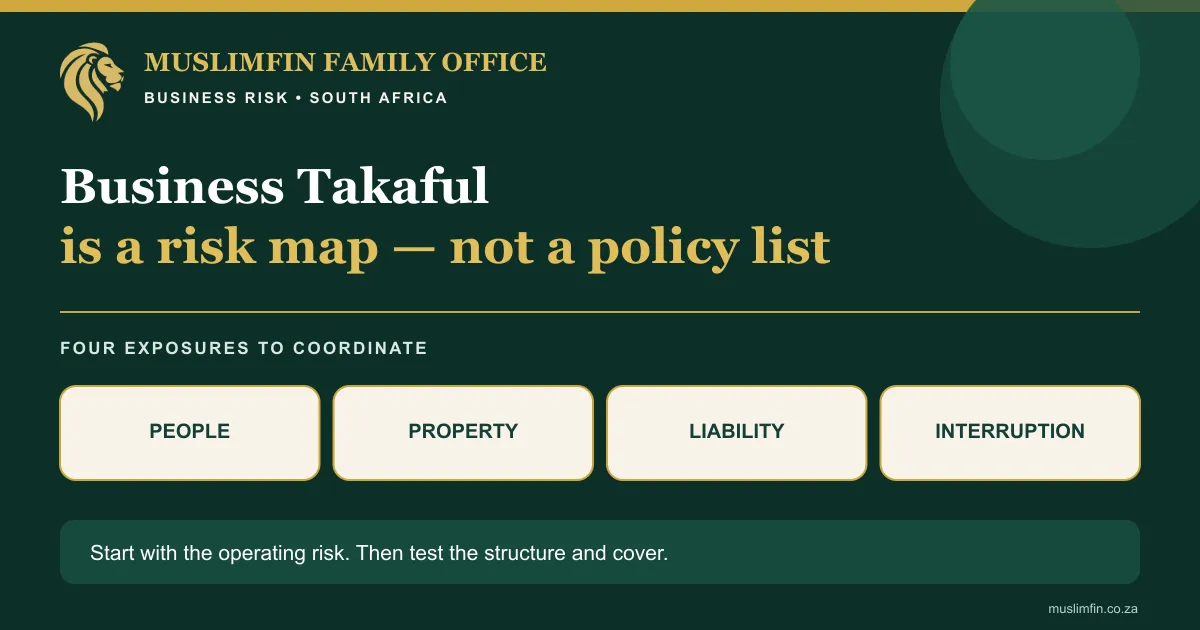
The business Takaful guide maps property, interruption, motor, crime and liability sections across the enterprise.
Professional indemnity
The professional indemnity Takaful guide explains claims arising from professional services, errors, omissions and financial loss.
Cyber Takaful
The cyber Takaful guide addresses privacy, network, incident-response and cyber-interruption risks rather than ordinary premises injury.
Product liability
Manufacturers, importers, distributors, retailers and food businesses should examine product injury, recall and completed-operations exposure separately.
Motor and fleet cover
Road accidents, owned vehicles and some mobile equipment may fall under motor wording. Do not rely on public liability as a substitute.
Property cover
Property cover protects the insured's own defined assets; liability cover addresses defined legal liability to others. One event can trigger both.
Build practical risk controls
Inspect systematically
Use a site-specific checklist for floors, stairs, rails, lighting, fire equipment, exits, shelving, doors, parking and public routes. Record defects and closure actions.
Maintain and repair
Assign owners, priorities and completion dates. Warning signs are temporary controls, not permanent substitutes for repair.
Manage contractors
Verify competence, scope, method, insurance and supervision. Use permits for high-risk work and control public access.
Prepare for emergencies
Maintain evacuation, first-aid, fire, spill, severe-weather and communication procedures. Conduct drills proportionate to the site.
Preserve CCTV and records
Set lawful retention and incident-hold processes. Preserve original footage, access logs, maintenance records, witness details and photographs promptly.
Control events
Document capacity, layout, emergency access, structures, vendors, food, security, weather and venue responsibilities before the event.
Train frontline staff
Employees should know how to make an area safe, provide reasonable assistance, avoid admissions, capture facts and escalate an incident.
South African insurance due diligence
Verify regulated parties
Use the FSCA entity and person search to check the intermediary’s FSP authorisation and permitted activities. Separately check the legal insurer against the Prudential Authority’s insurer list. A registration entry does not establish that a particular product is suitable or Shariah compliant. Keep dated evidence of each check.
Identify the legal contract
The Insurance Act 18 of 2017 supplies South Africa's prudential framework for insurance business. A Takaful label does not replace the licensed issuer or wording.
Confirm insured entities and activities
Match every company, branch, trading name, property, service and territory. New operations or acquisitions should not wait until renewal.
Compare limits and excesses
Distinguish per-occurrence, annual aggregate, sublimit and costs-inside-limit structures. Test more than one serious scenario.
Check contract requirements
Landlords, clients, event venues and tenders may demand specific limits, indemnities or noting of interests. Confirm what the policy can validly provide.
Record complaint routes
Identify internal insurer escalation and any applicable ombud, tribunal or court route for the actual dispute rather than assuming jurisdiction.
Apply Takaful and Shariah due diligence
Participant risk fund
Request contractual evidence showing how contributions support valid participant claims through mutual assistance and how relevant funds are separated.
Operator model
Identify Wakala fees, Mudarabah shares, incentives, expenses, conflicts, surplus distribution and deficit support.
Investments
Review prohibited sectors, financial screens, purification, breach management and reporting for participant and shareholder funds.
Retakaful
Severe liability losses may exceed local capacity. Confirm retakaful, conventional reinsurance, why it is used and the Shariah authority's position.
Shariah governance
The IFSB explanation of Takaful is a starting point for understanding the model, not approval of a South African insurance product. Record the approving authority, method, product scope, exceptions and review date.
Capacity shortfall
If suitable Takaful cannot supply the activity, territory or limit, keep the market evidence and obtain qualified case-specific guidance before considering an alternative.
A worked public-liability example
Simplified facts
Assume a customer suffers a serious injury at a business premises. Model third-party damages at R2.2 million, approved legal and expert costs at R650,000 and incident investigation at R150,000.
Gross modelled exposure
The simplified total is R3 million before the excess, policy exclusions, liability findings, recoveries and cost allocation.
Limit erosion
If the policy limit is R2.5 million and defence and investigation costs sit inside it, the modelled gap is R500,000 before the excess. If costs are additional, the outcome differs.
What the example does not prove
It does not prove negligence, causation, quantum or coverage. The insured entity, activity, event date, claimant, evidence, consent, exclusions and wording determine the result.
Respond to an incident
Make the area safe
Provide reasonable emergency assistance and prevent further harm. Record necessary changes before disturbing evidence where possible.
Capture facts
Record time, location, conditions, witnesses, staff, photographs, CCTV, maintenance and the claimant's stated account without pressuring anyone.
Avoid unauthorised admissions
Show care and provide practical assistance without accepting legal liability or promising payment before authorised review.
Notify promptly
Use the policy's incident, claim and circumstance provisions. A severe incident can require notice before a formal demand.
Preserve evidence
Place CCTV, inspection logs, contracts, training and communications under a controlled hold. Maintain originals and a chain of custody.
Coordinate processes
Insurer, lawyer, regulator, health-and-safety specialist, property owner and investigator may have different duties. One notification does not satisfy every process.
A twelve-step implementation process
1. Map sites and activities
List premises, branches, events, off-site work, deliveries and temporary locations.
2. Map third parties
Identify customers, visitors, tenants, landlords, contractors, neighbours and vulnerable users.
3. Map credible incidents
Model injury, fire, water, security, food, construction, vehicle and property-damage scenarios.
4. Test controls
Review inspection, maintenance, contractor, event, emergency, training and evidence procedures.
5. Quantify exposure
Estimate damages, legal costs, experts, aggregation and balance-sheet tolerance.
6. Search Takaful capacity
Compare activities, territories, occurrence definitions, limits, excesses and exclusions.
7. Obtain Shariah review
Assess the exact product and any capacity-based necessity case.
8. Verify regulated roles
Confirm insurer, intermediary, authority, claims handler and remuneration.
9. Correct proposal facts
Reconcile turnover, payroll, visitor volumes, activities, claims, sites and contracts.
10. Align related covers
Map property, motor, product, professional, cyber, employer and event protection.
11. Build the evidence vault
Store wordings, inspections, maintenance, training, contracts, photographs and incident files securely.
12. Review after change
Reassess after relocation, renovation, acquisition, new products, new events, incidents or policy changes.
Frequently asked questions
Is public liability cover compulsory in South Africa?
There is no single universal requirement for every business. A lease, client, venue, tender, professional rule or sector law may impose requirements.
Does it cover any customer injury?
No. Legal liability and every policy condition must be established. Some injuries may occur without negligence or within an exclusion.
Does it cover employees?
Employee injuries are commonly handled under separate statutory or employer-liability arrangements. Check the definitions and applicable law.
Does it cover products?
Products and completed work may be excluded, included or separately endorsed. Product liability requires its own review.
Does it cover rented premises?
Potentially, but leases, property-in-custody exclusions, tenant-liability extensions and the cause of damage matter.
Does it cover events away from the main premises?
Only if the business activity, territory, event and contract fit the wording. Notify the insurer before material events.
Are legal costs included?
They may be inside the limit, additional or subject to consent and sublimits. Confirm before appointing advisers.
Can the business settle directly?
Direct settlement can prejudice cover when consent is required. Notify the insurer and obtain advice first.
What if appropriate Takaful is unavailable?
Document the search and obtain qualified Shariah guidance on necessity and proportionality before considering an alternative.
What does MuslimFin do?
MuslimFin coordinates the public-liability inventory, Takaful evidence, wording questions, family-office workstreams and specialist referrals. The insurer, authorised intermediary, lawyer, safety professional, engineer, investigator and Shariah authority retain their formal roles.
Final checklist
Before treating the public-liability plan as ready, confirm that:
every entity, site, activity and territory is declared;
customers, visitors, contractors, tenants, landlords and neighbours are mapped;
injury and property-damage scenarios have been modelled;
inspections, maintenance and contractor controls operate in practice;
event and emergency plans match the actual exposure;
bodily-injury, property-damage and legal-liability definitions are understood;
employee, motor, product, professional, pollution and custody exclusions are tested;
contractual indemnities and insurance requirements are reviewed before signature;
occurrence, notification, defence and settlement clauses are diarised;
limits, aggregates, costs and excesses match credible scenarios;
property, product, motor, professional and cyber overlaps are mapped;
insurer and intermediary authority is verified;
the Takaful structure and current Shariah governance are evidenced;
incident records and CCTV can be preserved promptly; and
annual and event-driven reviews are scheduled.
Public liability Takaful is strongest when it sits behind a safe, documented operation. Accurate disclosure, suitable limits, sound contracts, disciplined incident response and product-specific Shariah evidence provide more durable protection than a certificate alone.
Discuss your business protection needs
Contact MuslimFin about a business-risk and protection review. Start with your business type and the service you need. Do not attach identity documents, medical details, incident evidence or confidential claim files to a general enquiry; arrange an appropriate secure channel first. An enquiry does not put cover in force or notify your insurer of a claim. Follow the insurer’s own notification requirements and deadlines.


