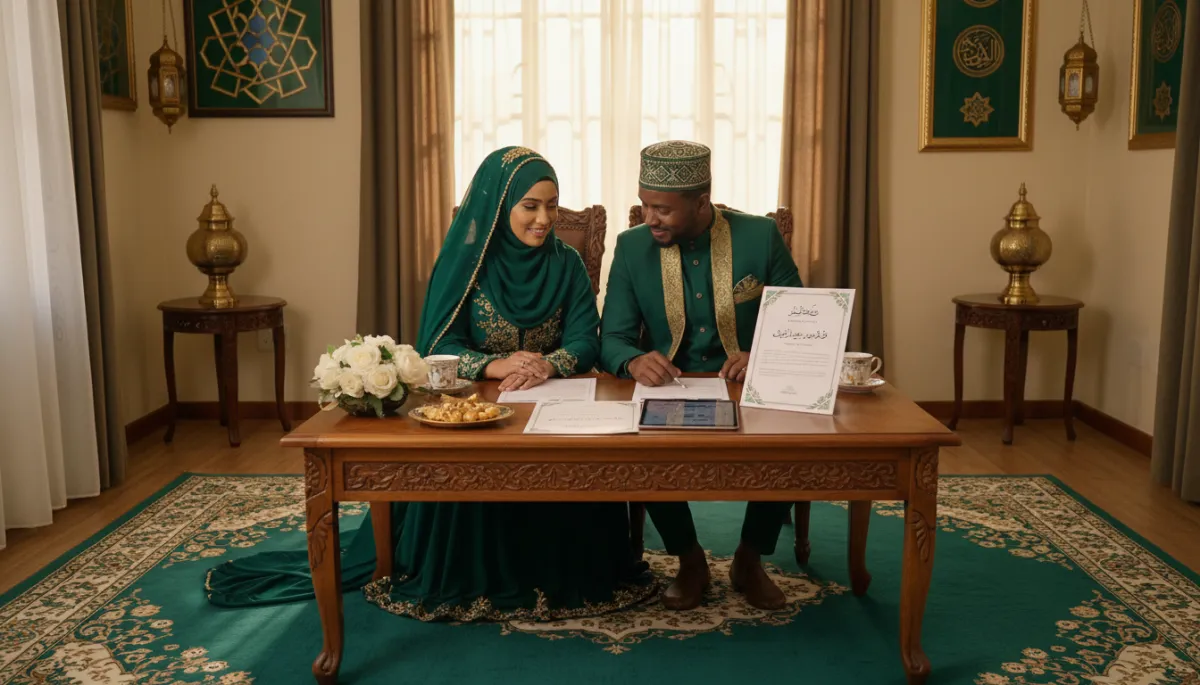
Muslim Marriage and Financial Planning in South Africa
The financial decisions you make when you get married — specifically which marital property regime you choose — will shape your Islamic estate plan, your spouse's rights, and the distribution of your assets under mīrāth for the rest of your life.
Most South African Muslims make this decision without advice. Many discover the consequences only when it is too late to change anything easily.
This guide explains how South African marital property law interacts with Islamic inheritance law, what your options are before marriage, and what you can do if you are already married and your current structure needs attention.
South Africa's Three Marital Property Regimes
When you get legally married in South Africa, you must choose a marital property regime. There are three options:
1. In Community of Property (the default)
This is the automatic outcome if no antenuptial contract is signed before marriage. All assets and debts of both spouses are pooled into a single joint estate from the moment of marriage. Each spouse owns exactly half the joint estate at all times — including debts.
2. Out of Community of Property — Without Accrual
An antenuptial contract (ANC) establishes this. Each spouse keeps a completely separate estate throughout the marriage. What you bring in, you keep. What your spouse earns, they keep. At death or divorce, there is no sharing.
3. Out of Community of Property — With Accrual
Also established by an ANC. Each spouse keeps a separate estate during the marriage. But at divorce or death, the spouse whose estate grew less during the marriage has a claim on a share of the growth of the other spouse's estate. This is the most widely used ANC structure in South Africa.
The Community of Property Problem for Islamic Inheritance
Community of property marriages create a specific complication for mīrāth.
When a spouse dies in community of property, the joint estate is immediately split in half. The surviving spouse takes their 50% first — not as an heir, but as a co-owner. That is their existing ownership right. Only the deceased's 50% forms the estate to be distributed under Islamic inheritance law.
This means:
- The surviving spouse has already secured 50% of all joint assets before mīrāth is applied
- The Islamic inheritance calculation then applies to the remaining 50% only
- The effective distribution can differ significantly from what was intended
Example: Husband and wife are married in community of property. Joint estate: R2,000,000. They have two children. Husband dies:
- Wife takes her 50% co-ownership share first: R1,000,000 (this is not inheritance)
- Deceased husband's estate: R1,000,000
- Wife's mīrāth share: 1/8 = R125,000
- Children share the remaining R875,000 according to mīrāth
- Total received by wife: R1,000,000 + R125,000 = R1,125,000
This may or may not align with what the husband intended — but it is the automatic legal and Shariah outcome of a COP marriage. Planning for it requires an Islamic family office approach.
The Debt Risk in Community of Property
In a COP marriage, debt is also joint. If your spouse carries a business loan, credit card balances, or personal loans — those are equally your debts. If your spouse dies or becomes insolvent while carrying significant debt, the joint estate must first satisfy creditors. What remains after debts is what heirs inherit.
Many South African Muslims in COP marriages have not considered this risk. For those in business, it is particularly acute.
The Antenuptial Contract
An antenuptial contract (ANC) must be signed before marriage — it cannot typically be entered into after marriage without a High Court application. It must be signed before a notary public and registered at the Deeds Office.
If you are already married in community of property and want to change your regime, it is legally possible but complex — it requires a joint High Court application and the consent of all creditors. Prevention is far better than correction.
Muslim Marriage Registration
A further concern for many South African Muslims: some Muslim marriages are contracted under Islamic law only, without formal registration under the Marriage Act. The legal recognition of unregistered Muslim marriages in South Africa has been an evolving area — court decisions have progressively extended protections to Muslim spouses, but the legal position remains complex.
If your Muslim marriage is not formally registered under South African law, your surviving spouse may face significant challenges in the estate administration process, even if they are named in an Islamic will. Urgent legal advice about registration and spousal protection is warranted in these cases.
Joint Financial Planning for Muslim Couples
Regardless of the marital regime, Muslim couples benefit from coordinated financial planning across:
- Individual Zakah: Each spouse has their own zakatable wealth — Zakah is an individual obligation, though a holistic household assessment is helpful
- Retirement fund nominations: Both spouses' nominations should reflect the Islamic estate plan — not just the breadwinner's
- Islamic wills for both spouses: Not just one — both need valid, current Islamic wills
- Takaful for both: A non-earning spouse has an economic value (childcare, household management) that should be insured under Takaful. Life risk is not only present when you are the breadwinner.
- Debt management: In a COP marriage especially, eliminating interest-bearing debt is both a Shariah obligation and a family protection measure
The Estate Administration Process When a Spouse Dies
When a spouse dies in South Africa, the estate administration process begins through the Master of the High Court. An executor is appointed, assets are collected, debts settled, and the estate is distributed according to the will — or under intestate succession law if there is no valid will.
In a COP marriage, the joint estate is split first. The Islamic will then governs distribution of the deceased's half.
An executor who understands both Islamic inheritance law and South African estate administration is essential — they must apply the mīrāth formula, not simply default to the civil law's distribution.
Related: Community of Property and Islamic Inheritance
Related: How to Write an Islamic Will in South Africa
Plan Your Marriage Finances Together
At MuslimFin Family Office, we work with South African Muslim couples to align their full financial structure — marital regime, estate plan, retirement fund nominations, Takaful, and investments — with Islamic principles and South African law. A free initial consultation will show you exactly how your current structure affects your family's future under Islamic law.
Book a free consultation with Ali →
Related reading:


