How to Calculate Zakah in South Africa: A Step-by-Step Guide
Zakah is one of the five pillars of Islam — an obligation that falls on every Muslim who meets the conditions. But many South African Muslims are uncertain about how to calculate it correctly, especially when their wealth includes modern financial instruments like shares, retirement annuities, and unit trusts.
This guide walks through Zakah calculation step by step, covering the major asset types a South African Muslim is likely to hold.
Who Must Pay Zakah?
Zakah is obligatory on a Muslim who:
- Is a free adult of sound mind
- Owns wealth that exceeds the nisab threshold
- Has held that level of wealth for a complete lunar year (hawl)
If all three conditions are met, Zakah is due at 2.5% of net zakatable assets.
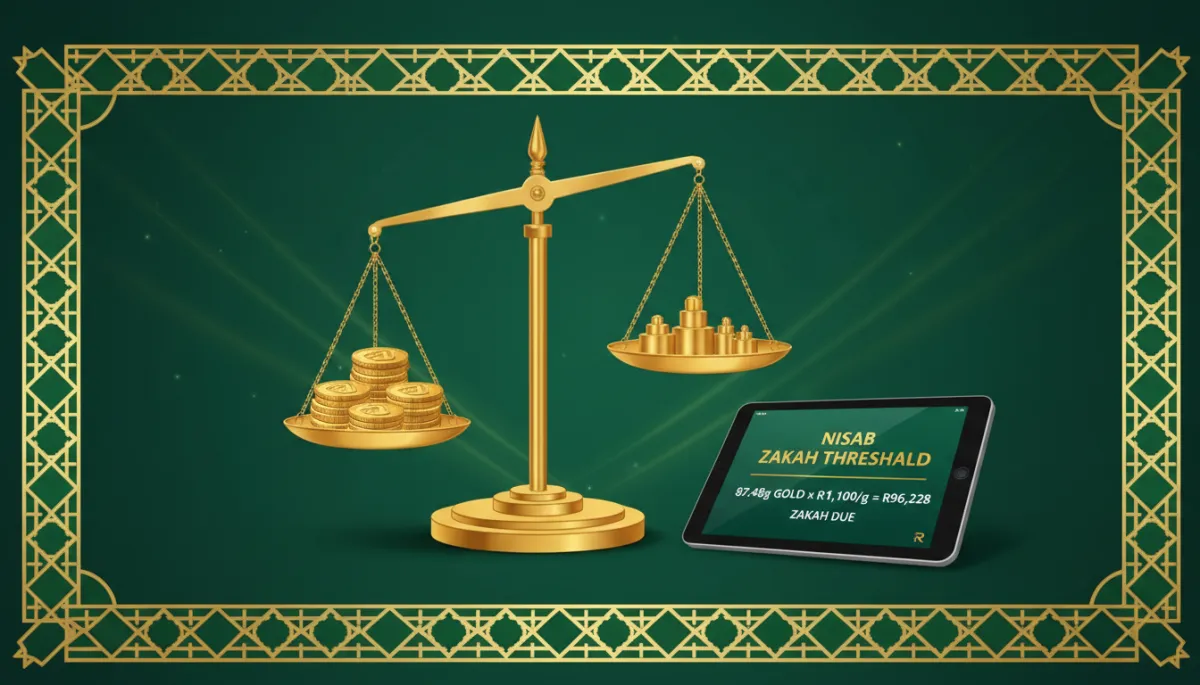
What Is the Nisab?
The nisab is the minimum threshold of wealth that makes a person liable for Zakah. It is based on either:
- Gold nisab: 85 grams of gold
- Silver nisab: 612 grams of silver
Because gold and silver prices fluctuate, the rand value of the nisab changes regularly. South African Zakah organisations — notably SANZAF (the South African National Zakah Fund) — update the nisab value based on current market prices. Check the current figure before calculating each year.
The gold nisab is more commonly used, though scholars differ. The silver nisab is lower, which means more people qualify to pay Zakah — an approach some scholars consider more socially beneficial.
The Lunar Year Condition (Hawl)
Your Zakah anniversary is the date on which your wealth first exceeded the nisab. One lunar year later, you assess your total zakatable wealth and pay 2.5% of the net amount — provided your wealth still exceeds the nisab on that date.
Many South African Muslims fix their Zakah date to Ramadan for ease of calculation and the additional spiritual reward of giving during that month. This is permissible provided you are not deliberately delaying payment past the actual hawl date.
What Assets Are Zakatable?
Zakah applies to wealth that is in excess of personal needs and capable of growth (namā). The major zakatable asset categories for a South African Muslim are:
1. Cash and Bank Balances
All cash — in a current account, savings account, or held at home — is zakatable at 100% of its value. If the account earns interest, discard the interest amount (donate it without intention of reward); Zakah is calculated on the principal only.
2. Gold and Silver
Gold and silver in any form — jewellery, bullion, coins, or Krugerrands — are zakatable at 2.5% of their current market value.
Note: there is a well-known scholarly difference regarding jewellery worn regularly. The Shafi'i and Maliki schools hold that jewellery for personal use is exempt; the Hanafi school holds that all gold and silver — including personal jewellery — is zakatable. Follow the ruling of your madhab or consult your local scholar.
3. Business Stock and Trade Goods
If you run a business, goods held for sale (inventory) are zakatable at their current market value. Goods purchased for personal use and fixed assets (equipment, vehicles used in the business, property) are not zakatable.
4. Shares and Equity Investments
Shares in listed companies — JSE and international — are zakatable. Two approaches are used:
- Investor approach: Pay Zakah on the full market value of the shares at your hawl date. This is the conservative, most widely followed position for passive investors.
- Business approach: Assess the underlying zakatable assets of the company (cash, receivables, inventory) proportionate to your shareholding and pay Zakah on that figure only.
For most individual investors holding JSE shares or index funds, the full market value approach is simpler and is recommended by most South African Islamic scholars and Zakah organisations.
Related: Are ETFs Halal? A South African Guide
5. Unit Trusts and Managed Funds
Unit trust holdings are treated similarly to shares — Zakah is payable on the current value of your units at the hawl date. For Shariah-compliant funds, the fund manager may publish a Zakah rate based on the underlying asset composition, which simplifies the calculation.
Related: Are Unit Trusts Halal? A South African Guide
6. Retirement Funds (Pension, Provident, and RA)
This is one of the most contested areas in contemporary Islamic finance. Scholars differ on whether Zakah is payable on retirement fund balances — and if so, at what stage.
The main scholarly positions are:
- Zakah is due annually on the current fund value, since the participant has effective ownership of the asset even if access is restricted
- Zakah is due only when funds are received — on retirement or resignation — because the participant cannot freely access or dispose of the funds before that point
In South Africa, where retirement fund access is heavily restricted by the Pension Funds Act, the second position is adopted by many scholars. However, some South African Muslims follow the conservative approach of paying annually on the full value. Consult your local Islamic scholar or a Shariah-compliant financial planner for guidance specific to your situation.
7. Receivables and Money Owed to You
Money that others owe you is zakatable if you expect to recover it. Strong debts (likely to be paid) are zakatable in full. Doubtful debts may be deferred or discounted based on the realistic likelihood of recovery.
8. Property
Your primary residence is not zakatable. Investment property generates Zakah in two ways:
- Rental income — treated as cash; zakatable at your hawl date if it has not yet been spent
- The property itself — not zakatable unless you are a property trader, in which case properties held for resale are trade stock and are zakatable at market value
What Is Deductible?
Before calculating Zakah, you may deduct debts that are currently due and payable. Long-term debts like a home loan are not deducted in full — only the instalments immediately payable may be deducted (though this is a point of scholarly discussion; some scholars permit deducting the full outstanding balance).
A Simple Zakah Calculation Illustration
Here is a hypothetical example to illustrate how the calculation works (using illustrative figures only — your actual values, nisab, and madhab will differ):
| Asset | Illustrative Value | Zakatable? |
|---|---|---|
| Cash (all accounts) | R 50,000 | Yes |
| Gold jewellery (100g at market value) | R 140,000 | Yes (Hanafi position) |
| JSE shares (market value) | R 200,000 | Yes |
| Unit trust holding | R 80,000 | Yes |
| Retirement annuity | R 500,000 | Depends on madhab |
| Primary residence | R 2,000,000 | No |
| Investment property | R 1,500,000 | No (rental income: yes) |
| Rental income (at hawl date) | R 20,000 | Yes |
| Total zakatable (excl. RA) | R 490,000 | |
| Less: debts due | R 15,000 | |
| Net zakatable wealth | R 475,000 | |
| Zakah due (2.5%) | R 11,875 |
These are illustrative figures only. Your actual Zakah calculation will depend on your specific asset values, your madhab, and the nisab value at your hawl date.
Where to Pay Your Zakah in South Africa
Zakah can be paid directly to eligible recipients — the eight categories mentioned in Surah At-Tawbah (9:60). It can also be paid through established Zakah organisations that distribute to eligible recipients on your behalf:
- SANZAF (South African National Zakah Fund) — the largest and most established Zakah organisation in South Africa
- Muslim Hands South Africa
- Gift of the Givers
- Your local masjid or Islamic welfare organisation
Zakah paid through a registered Public Benefit Organisation (PBO) in South Africa may qualify for an income tax deduction — ask the organisation for their PBO number and a Section 18A certificate if applicable.
Need Help Calculating Your Zakah?
If your financial situation is complex — multiple asset types, retirement funds, business interests, or cross-border assets — a qualified Islamic financial planner can help you calculate your Zakah correctly and ensure your full financial structure is Shariah-compliant.
At MuslimFin Family Office, we offer holistic Islamic financial planning for South African Muslim families, including Zakah calculation, estate planning, Shariah-compliant investment advice, and Takaful structuring.
Book a free consultation with Ali →
Related reading:


