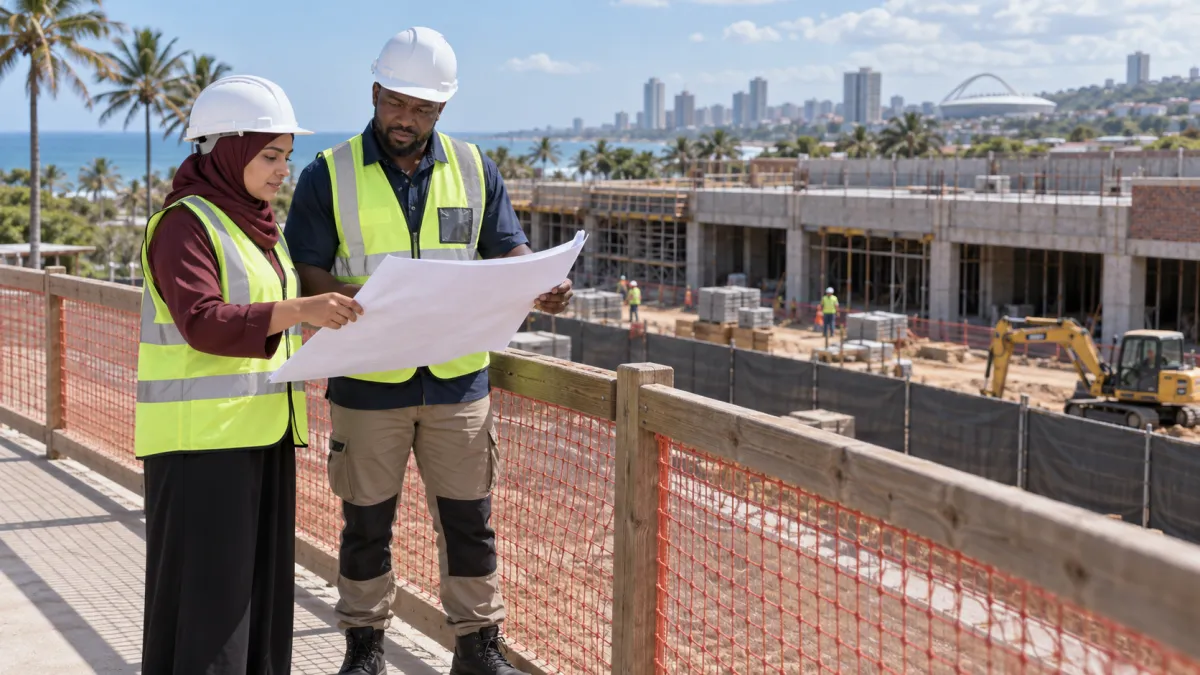
Contractors All Risks Takaful South Africa Guide
Availability note: This is a construction-risk guide, not confirmation that contractors all risks Takaful is currently available in South Africa. Verify the actual provider, project capacity, insured works, wording and product-specific Shariah approval before treating a proposed arrangement as cover.
Contractors all risks Takaful in South Africa may protect construction works, materials, temporary works and selected plant against defined accidental physical loss or damage during a project, with a separate section for third-party liability, subject to the certificate or policy. It is often called contract works, construction all risks or CAR cover. “All risks” is not unlimited: design, defective workmanship, wear, delay, penalties, existing property and testing can be restricted or excluded.
The arrangement should mirror the construction contract. The employer, main contractor, subcontractors, professional team, financiers and other parties may have different interests. The project value, scope, site, duration, maintenance period, plant, free-issue materials, surrounding property, public exposure and special risks must be declared consistently.
Muslim-owned developers and contractors should also complete product-specific Shariah review. Examine the participant risk fund, operator remuneration, investments, surplus and deficit arrangements, retakaful or reinsurance, and current Shariah supervision. Where suitable Takaful capacity is unavailable for a material project risk, document the search and obtain qualified guidance on necessity and proportionality.
This guide is general education. It is not insurance advice, legal advice, engineering advice, quantity-surveying advice, health-and-safety advice, tax advice, claims advice or a fatwa. Obtain professional advice for the actual contract, design, site and wording.
The direct answer
What contractors all risks Takaful can protect
It can protect the physical works and declared materials during construction against covered accidental events. A liability section can respond to qualifying third-party injury or property damage arising from the works.
Who arranges it
The employer, contractor or another party may arrange it according to the building contract. Responsibility should be explicit, and every party requiring protection should be correctly named or included.
When protection starts and ends
It can attach when work or insured materials begin at the declared site and terminate on practical completion, handover, occupation, expiry or another wording trigger. Sections of a project may finish earlier than the project as a whole.
What it does not replace
It does not replace sound design, competent contractors, contract administration, safety management, quality control, security, programme governance or adequate contingency.
Align the construction contract and Takaful wording
Identify the insurance clause
Read the signed contract, tender requirements, amendments and employer specifications. Record who must arrange contract works, liability, plant, existing structures, professional indemnity, workers' compensation and Sasria protection.
Name the parties correctly
The employer, contractor, subcontractors, joint venture, financiers and consultants can have distinct interests. A generic “principal contractor” label may not protect every entity or role.
Respect contractual risk allocation
Indemnities, care-of-works clauses, possession, access, defects, liquidated damages and termination provisions shape the exposure. Takaful does not automatically fund every promise made in the contract.
Coordinate multiple projects
An annual contract-works arrangement can cover declared projects within limits, values, territories and categories. A large or unusual development may require project-specific terms.
Avoid duplicate assumptions
The employer and contractor may each hold policies, but they can cover different interests or contain “other insurance” provisions. Reconcile them before work begins.
Define the insured project
Permanent works
Describe the buildings, civil works, services, infrastructure and other assets that will remain after completion. Use drawings, bills of quantities and the signed scope.
Temporary works
Scaffolding, formwork, hoarding, temporary roads, shoring and site facilities can be essential but may require explicit inclusion and values.
Materials for incorporation
Confirm protection for materials on site, in off-site storage and in transit. Attachment points, storage security and geographic limits differ.
Existing property
Extensions, renovations and tenant installations can damage the existing building. The contract-works section may not automatically protect property that existed before the project.
Plant and equipment
Owned or hired plant, cranes, generators, excavators and tools may require separate items. Distinguish stationary construction plant, licensed vehicles and consumable equipment.
Free-issue materials
Materials supplied by the employer or another contractor must be valued and allocated. They can be absent from the main contractor's price but still exposed.
Set the sum insured correctly
Use the full completed value
The works value should generally reflect the completed contract value or replacement basis required by the wording, not only work certified to date. Include declared materials, labour, preliminaries and relevant professional fees.
Allow for escalation
Inflation, imported inputs, variations, delays and scope changes can increase reinstatement cost. Apply the wording's escalation and declaration provisions rather than assuming an automatic uplift.
Include debris and professional fees
Demolition, debris removal, architects, engineers, quantity surveyors and other reinstatement costs may have sublimits. Confirm whether they sit within or above the works amount.
Measure maximum accumulation
One fire, flood, storm, collapse or riot can affect works, plant, materials and adjacent property. Test the largest exposure at one site and in off-site storage.
Reconcile valuations regularly
Compare contract price, approved variations, cost reports, material orders and programme changes monthly. Late notification can leave a growing underinsurance gap.
Understand physical-damage triggers
Fire and explosion
Hot work, temporary electricity, fuel, gas and incomplete fire separation increase exposure. Permits, fire watches, extinguishers and housekeeping should be auditable.
Storm, flood and water damage
Excavations, roofs under construction, drainage and stored materials are vulnerable. Review seasonal weather, stormwater paths, dewatering and emergency pumping.
Collapse
Temporary support, excavation, formwork, sequencing, ground conditions and overloading can cause sudden loss. Engineering control remains essential even where physical damage is insured.
Theft and malicious damage
Copper, tools, plant, fuel and materials attract theft. Perimeter security, guards, lighting, stock controls, tracking and key management can be conditions.
Accidental damage
Impact, dropped loads, plant operation and installation mistakes may cause physical damage. The defective element and resulting damage can be treated differently.
Testing and commissioning
Electrical, mechanical and pressure testing can introduce severe loss. Confirm testing periods, procedures, limits and whether specialist machinery requires separate terms.
Examine design and defect exclusions
Defective design
The cost of improving or correcting an inadequate design can be excluded. Some wordings cover resulting damage but not the defective component; others are narrower.
Defective materials
A batch of unsuitable material can affect both the material itself and completed work. Preserve batch, supplier and laboratory evidence.
Defective workmanship
The cost to redo poor work may differ from unforeseen resulting damage to sound property. Read the defect exclusion and any applicable clause level.
Betterment
A claim is not normally intended to fund an upgraded design beyond reinstatement, except where law, safety or loss mitigation requires agreed changes.
Professional responsibility
Design and supervision allegations require a professional-indemnity analysis separate from contract-works damage. Check the insured professional services, claims-made trigger, retroactive date, contractual duty, design exclusions and responsibility of each consultant before assuming either section responds.
Protect construction plant
Owned plant
Inventory serial numbers, values, attachments, finance interests and operating sites. Maintenance and operator competency must be documented.
Hired-in plant
The hire contract can impose responsibility beyond ordinary legal liability. Confirm replacement value, continuing hire charges, recovery costs and waiver provisions.
Mobile plant and road use
Plant may move between construction sites or travel on public roads. Align plant, motor and transit protection rather than assuming one section follows every movement.
Breakdown versus accidental damage
Internal mechanical or electrical breakdown can be excluded from contract works. Specialist machinery breakdown terms may be needed.
Cranes and lifting
Lifting plans, ground bearing, certification, operators, rigging and wind controls are critical. Damage to the lifted item, crane and surrounding property can fall under different sections.
Structure third-party liability
Injury to the public
Open excavations, falling objects, vehicles, dust and site access can injure visitors or neighbours. Liability depends on law, facts and wording.
Damage to neighbouring property
Vibration, excavation, dewatering, piling and collapse can damage adjoining buildings and services. Condition surveys and monitoring create essential baseline evidence.
Underground services
Damage to water, electricity, fibre, gas and sewer infrastructure can cause repair and interruption claims. Obtain drawings, scan, expose and permit before excavation.
Contractor and employee injuries
Employee and contractor injury interacts with occupational-injury law, contract allocation and exclusions. It is not automatically solved by public-liability cover.
Contractual liability
Indemnities that extend beyond liability imposed by law may be excluded. Submit contract wording for review before accepting the obligation.
Limits and deductibles
Set limits for the credible event, not the smallest tender requirement. Consider multiple claimants, legal defence, neighbouring property and municipal infrastructure.
Address delay and financial consequences
Delay is not physical damage
Contract works protection does not automatically pay liquidated damages, lost rent, finance costs or lost profit. Physical reinstatement and financial delay are different losses.
Advance loss of profits
Developers can consider specialist delay-in-start-up or advance-loss-of-profits protection triggered by insured physical damage, subject to programme, critical-path and indemnity-period evidence.
Contractor business interruption
A contractor's office, depot, plant or supplier loss can interrupt revenue. Use the business interruption Takaful guide for those dependencies.
Penalties and guarantees
Performance guarantees, retention, penalties and contractual default are not automatically covered. Separate the surety, credit and performance risks.
Programme evidence
Maintain a baseline programme, updates, critical path, progress records, delays, mitigation decisions and revised completion forecasts. A reconstructed timeline is weaker than contemporaneous evidence.
Meet South African project duties
Construction health and safety
The Department of Employment and Labour's Construction Regulations 2014 operate within the Occupational Health and Safety framework. Identify the client's, designer's, principal contractor's and contractor's duties with competent legal and safety advice, checking current amendments, notices and project-specific requirements.
CIDB requirements
The Construction Industry Development Board Act 38 of 2000 establishes the CIDB framework. For public-sector procurement, the CIDB Register of Contractors guidance explains grading and client verification duties.
Competent appointments
Document designers, engineers, project managers, safety professionals, supervisors and specialists. Insurance cannot cure an invalid or incompetent appointment.
Permits and approvals
Planning, building, environmental, heritage, water, road and utility approvals may apply. A permit delay is not automatically insured physical damage.
Records
Keep contracts, drawings, specifications, approvals, appointments, inspection records, photographs, meeting minutes, certificates, cost reports and correspondence.
Manage special risks and related covers
Sasria contract works
Riot, strike, public disorder and related perils require a separate special-risk review. Consult Sasria’s underwriting hub and current contract-works wording, together with the actual underlying policy, schedule and endorsements. Sasria is conventional special-risk insurance; it should not be described as Takaful or assumed to have Shariah approval. Obtain qualified case-specific guidance on the proposed arrangement.
Transit protection
Materials can be damaged before reaching site. The marine cargo Takaful guide covers route, storage, valuation and claims evidence.
Fleet protection
Licensed site and delivery vehicles require motor analysis. The commercial vehicle and fleet Takaful guide maps drivers, roadworthiness, use and liability.
Public liability
Ongoing operations outside the insured project may need annual liability protection. The public liability Takaful guide addresses premises, operations and third-party exposures.
Environmental liability
Pollution, contaminated soil, fuel spills, asbestos and waste can require specialist assessment and cover. Sudden events and gradual pollution are often treated differently.
Perform Shariah and regulatory due diligence
Confirm the participant fund
Ask how contributions enter the participant risk fund, how claims are paid and how the operator is remunerated.
Review investments
Request current information on the screening and investment of participant and shareholder funds.
Understand surplus and deficits
Determine who is entitled to underwriting surplus and how a fund deficit is financed and repaid.
Examine retakaful
Large construction values may require layered international capacity. Ask when retakaful or conventional reinsurance is used and what Shariah governance supports the structure.
Verify current oversight
Identify the Shariah board or adviser, latest approval, scope and audit process. The IFSB-8 Takaful governance standard provides governance principles for Takaful undertakings.
Verify providers
South Africa's Insurance Act 18 of 2017 provides the prudential framework for insurance business. Verify insurers and intermediaries through current official registers.
Build a claims-ready project file
Stabilise the site
Protect people, prevent further damage, preserve evidence and follow emergency and authority instructions. Do not disturb the loss scene beyond safety and mitigation requirements without recording it.
Notify immediately
Notify the provider, intermediary, employer, contractor and other required parties. A project may have short contractual and policy notice periods.
Capture the loss
Photograph and map damage, weather, site condition, security, temporary works, plant, materials and unaffected property. Preserve CCTV, access logs and monitoring data.
Separate cause and defect
Engage appropriate engineers and specialists to distinguish defective work from resulting damage and pre-existing conditions.
Prove quantum
Reconcile measured work, materials, variations, invoices, labour, plant, professional fees, debris, acceleration, salvage and betterment. Separate covered reinstatement from redesign and delay.
Preserve recoveries
Do not release designers, suppliers, subcontractors or other responsible parties without approval. Protect warranties and recovery rights.
A worked South African example
The facts
A developer appoints a main contractor for a R48 million mixed-use renovation. The project includes an existing building, a basement excavation, imported equipment, hired cranes and phased tenant occupation.
The hidden gaps
The contract-works schedule states only the original R48 million. It omits R6 million of variations, existing property, off-site imported equipment and the crane hire responsibility. The neighbour condition survey is incomplete, and the maintenance period is misunderstood.
The loss
Heavy rain floods the excavation, undermines temporary support and damages existing services. The neighbour alleges cracking, equipment is delayed, and the completion date moves.
The better structure
Before works, the team maps each insured interest, values works and existing property, includes variations and professional fees, coordinates transit and hired plant, documents ground and neighbour conditions, sets water controls, and assesses delay-in-start-up. Monthly cost and programme reports trigger declared-value updates.
The lesson
The most serious gap is often not absence of a certificate. It is a project that has changed while its contract, values, scope and risk controls have not been reconciled.
A 12-step implementation process
Read the signed construction contract and insurance schedule.
Identify every party, interest and contractual responsibility.
Define permanent works, temporary works, materials and existing property.
Inventory owned and hired plant, vehicles and off-site assets.
Set completed value, escalation, fees and catastrophe limits.
Review design, defect, testing, maintenance and handover provisions.
Assess third-party, neighbour, service and environmental exposure.
Map health, safety, security, quality and weather controls.
Coordinate Sasria, transit, fleet, liability and professional indemnity.
Complete regulatory and Shariah due diligence.
Establish monthly value, programme and scope reconciliation.
Issue an incident, notification and claims-evidence protocol.
Frequently asked questions
Is contractors all risks Takaful genuinely all risks?
No. It can be broad accidental-damage protection, but exclusions, defects clauses, conditions, deductibles, limits and proof still govern.
Does it cover defective workmanship?
The cost of correcting the defective work and resulting damage may be treated differently. The exact defects exclusion must be reviewed.
Are existing buildings automatically covered?
No. Existing property normally requires explicit attention, a value and appropriate condition evidence.
Does it cover tools and construction plant?
Only where included under the relevant item or separate section. Owned and hired plant can require distinct declarations.
Is delay covered?
Not automatically. Physical damage cover does not itself pay contractual penalties, finance costs, lost rent or lost profit.
Does it cover subcontractors?
It may include defined subcontractors, but their entity, interest, scope and separate liabilities must be checked.
What happens at practical completion?
Cover may terminate or narrow at completion, handover, occupation or expiry. A maintenance period does not necessarily continue full construction protection.
Is public liability included?
A separate liability section may be included, with its own trigger, exclusions, limit and deductible. It should be tested against the project and contract.
Must project values be updated?
Yes. Variations, escalation, imported costs and programme changes can make the original declared value obsolete.
How often should the arrangement be reviewed?
Review before commencement, monthly during significant works, after every material change, before testing and handover, and at the start of maintenance.
Final checklist
The signed contract and insurance obligations were reviewed.
Every employer, contractor and stakeholder interest is mapped.
Permanent and temporary works are defined.
Existing property and free-issue materials are addressed.
Owned and hired plant is inventoried and valued.
Completed value includes approved variations and relevant fees.
Design, defect and testing clauses are understood.
Liability limits reflect neighbours, public and services.
Health, safety, quality and weather controls are documented.
Transit, fleet and professional risks are coordinated.
Sasria contract-works protection is aligned.
Shariah structure and oversight are documented.
Monthly cost and programme reconciliation is active.
Incident, notice and claims records are pre-planned.
Completion, occupation and maintenance triggers are understood.
How MuslimFin Family Office helps
MuslimFin Family Office can help a South African developer, owner or contractor map project risks and contractual responsibilities, build a defensible value schedule, compare available Takaful or insurance structures, document Shariah and regulatory due diligence, and coordinate appropriate insurance, legal, engineering, quantity-surveying, safety and Shariah specialists.
The objective is not merely to satisfy a tender checkbox. It is to align the contract, parties, project scope, values, controls, protection wording and claims evidence in one governed construction-risk plan.


