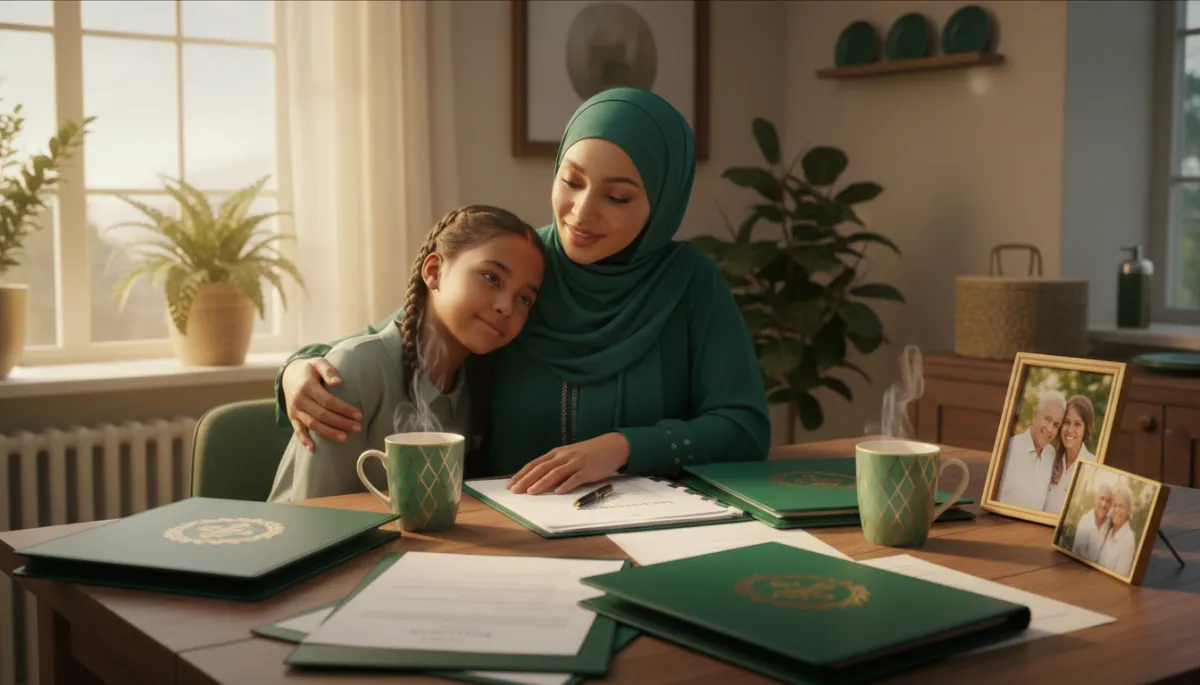
Islamic Inheritance for Single Parents and Unmarried Muslims in South Africa
Most Islamic inheritance guidance assumes a married person with a spouse and children. But a significant and growing number of South African Muslims are single parents, divorced, widowed, or unmarried — and their inheritance situation is different, often more complex, and almost never addressed directly.
This guide covers the specific Islamic inheritance scenarios for single parents and unmarried Muslims in South Africa.
The Key Difference: No Spouse Means a Different Faraid Picture
In Islamic inheritance law, the spouse is a fixed-share heir. When there is no spouse — because you are single, divorced, or widowed — the distribution changes significantly. The shares that would have gone to a spouse are reallocated among the remaining heirs, and in many cases the children’s shares increase.
Scenario 1: Single Parent with Children (No Spouse)
If you are a single parent with children and no spouse, your children are your primary heirs. The fara distribution works as follows:
- If you have one child (son or daughter): that child inherits the entire estate
- If you have two or more children: they share the entire estate, with a son receiving double the share of a daughter
- Your parents (the children’s grandparents) may also inherit if they are alive, but their share is reduced or eliminated depending on the number of children
The practical implication: for a single parent with children, the children inherit the vast majority (often all) of the estate. This is actually a simpler and more protective outcome than the married scenario — but it makes planning for minors critical.
Scenario 2: Single Parent with Minor Children
If you are a single parent with minor children, the inheritance question becomes a guardianship question. Your children inherit your estate, but they cannot manage it themselves until they reach the age of majority. This creates two critical planning needs:
- Guardianship appointment — who will care for your minor children if you die? This must be specified in your will. Without it, the court decides — and the outcome may not reflect your wishes or your family’s values.
- Asset management — who will manage your children’s inherited assets until they are adults? A testamentary trust is the standard solution, with trustees appointed to manage the assets for your children’s benefit (education, housing, maintenance) until they reach a specified age.
Read our guides on how to write an Islamic will and trusts and Islamic inheritance for the guardianship and trust framework.
Scenario 3: Unmarried Muslim with No Children
If you are an unmarried Muslim with no children, your fara distribution follows a different order of priority:
- Your parents are your primary heirs — if both are alive, they share the estate (mother receives one-third, father receives two-thirds)
- If only one parent is alive, that parent inherits the entire estate
- If your parents are deceased, your siblings inherit (with the specific shares depending on whether they are full or half siblings)
- If no siblings, more distant relatives inherit in a defined order
- If no relatives at all can be identified, the estate goes to the bayt al-mal (Islamic treasury)
The practical implication: for an unmarried Muslim with no children, your parents (and then your siblings) are your heirs. If you want to provide for anyone outside this group — a partner, a close friend, a charitable cause — you must use the wasiyyah (up to one-third of your estate).
Scenario 4: Divorced Muslim with Children
If you are divorced, your ex-spouse is not your heir under Islamic law. Your children remain your heirs. The distribution follows the same pattern as Scenario 1 (children inherit, with a son receiving double a daughter’s share). Your ex-spouse receives nothing from your estate unless you provide for them through the wasiyyah — which is generally not recommended given the marital relationship has ended.
Read our guide on Islamic divorce and financial rights for the broader financial framework around divorce.
Scenario 5: Widowed Muslim with Children
If your spouse has predeceased you and you have children, your children inherit your estate. The distribution follows the standard children’s shares. Your late spouse’s parents (your children’s grandparents) may have a claim in certain circumstances, but the children’s shares generally take priority.
The Wasiyyah for Single and Unmarried Muslims
The wasiyyah (bequest of up to one-third of your estate to non-heirs) is especially important for single and unmarried Muslims, because it is the primary mechanism to provide for people outside the faraid system:
- A single parent can bequeath up to one-third to a step-child, an adopted child, or a charitable cause
- An unmarried Muslim can bequeath up to one-third to a close friend, a mentor, a sibling’s child, or a cause they care about
- A divorced Muslim can bequeath to a child from a previous relationship or to a charitable cause
Read our guide on what a wasiyyah is and how it works.
Why Single Parents and Unmarried Muslims Need a Will More Than Anyone
There is a common misconception that estate planning is only for the wealthy or the married. In reality, single parents and unmarried Muslims have some of the most urgent planning needs:
- Without a will, the court decides guardianship for minor children — a risk no single parent can afford
- Without a will, your estate is distributed under South African intestate succession, which does not follow Islamic fara rules at all
- Without a will, there is no mechanism to provide for non-heirs through the wasiyyah
- Without a will, your burial wishes and executor appointments are unenforceable
Use the Calculator
Use our Islamic Inheritance Calculator to see exactly how your estate would be distributed under fara based on your specific family structure — whether you are single, divorced, widowed, or unmarried. And read our complete guide on Islamic inheritance in South Africa for the full framework.
Book Your Estate Planning Consultation
If you are a single parent, divorced, widowed, or unmarried, your estate plan is not optional — it is one of the most important documents you will ever sign. It determines who cares for your children, who inherits your wealth, and whether your wishes are honoured. Our team at MuslimFin works with South African Muslims in every family situation to build estate plans that protect the people they love and fulfil their Islamic obligations.
Book Your Estate Planning Consultation →


