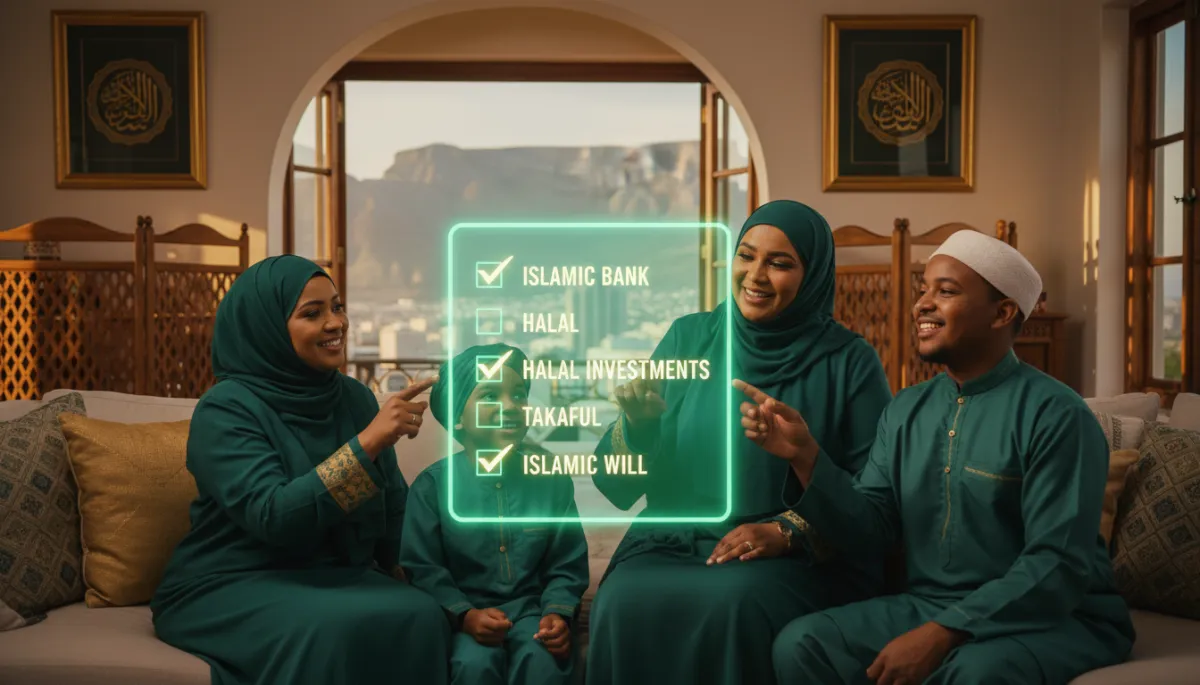
The South African Muslim Financial Planning Checklist
Most South African Muslims have financial lives that span multiple domains — investments, property, a business, retirement savings, Takaful, and religious obligations like Zakah. But rarely are all of these reviewed together, from a Shariah perspective, in one comprehensive assessment.
This checklist is designed for a South African Muslim who wants to take stock of their financial life and identify where Shariah compliance gaps exist — and where planning work still needs to be done.
Work through each section honestly. Every "no" or "not sure" is a planning priority.
Section 1: Halal Investments
- ☐ Are your shares and unit trusts Shariah-screened? (No investments in alcohol, tobacco, conventional banking, gambling, or other prohibited industries)
- ☐ If you hold index trackers or ETFs, are they Shariah-compliant?
- ☐ Are you receiving interest income from savings accounts or money market funds? (If yes, this income must be purified — donated without intention of reward)
- ☐ Have you reviewed your portfolio for halal compliance in the last 12 months? (Companies can drift into non-compliance as their revenue mix changes)
- ☐ Is your emergency fund held in a Shariah-compliant savings account or money market vehicle?
Related: How Shariah Screening Works for Investments
Section 2: Zakah
- ☐ Do you know your Zakah anniversary (hawl date)?
- ☐ Have you calculated Zakah on all zakatable assets — cash, gold, shares, business stock, receivables?
- ☐ Have you addressed the Zakah question on your retirement fund (pension, provident, RA) — either paying annually or deferring to receipt, consistently?
- ☐ Have you paid your Zakah for the current hawl year?
- ☐ If you are a business owner, have you calculated Zakah on trade stock and business receivables separately from personal assets?
Related: How to Calculate Zakah in South Africa
Section 3: Islamic Estate Planning
- ☐ Do you have a valid Islamic will (wasiyyah) that is also legally compliant with the Wills Act?
- ☐ Does your will reference the Islamic inheritance formula (mīrāth) rather than distributing the estate at your own discretion?
- ☐ Have you appointed an executor who understands both Islamic inheritance law and South African estate administration?
- ☐ Have you appointed a guardian for your minor children?
- ☐ Does your will include funeral instructions (Islamic rites, burial preference)?
- ☐ Does your will address how debts — including home loan and other finance — are to be settled before distribution?
- ☐ If you are married in community of property, do you understand how this affects the mīrāth distribution?
Related: How to Write an Islamic Will in South Africa
Related: Islamic Estate Planning in South Africa
Section 4: Retirement Funds and Beneficiary Nominations
- ☐ Are your retirement fund investments (pension, provident, RA) in a Shariah-compliant portfolio?
- ☐ Have you filed a detailed beneficiary nomination form with your retirement fund?
- ☐ Does your nomination reflect your Islamic inheritance intentions as closely as possible?
- ☐ Do your intended beneficiaries know what to do with the proceeds under Islamic law?
- ☐ Is your living annuity drawdown invested in a Shariah-compliant portfolio?
Related: Shariah-Compliant Retirement Planning in South Africa
Related: Retirement Funds and Islamic Inheritance
Section 5: Family Takaful (Protection)
- ☐ Do you have life cover — and if so, is it structured as Family Takaful rather than conventional life insurance?
- ☐ Do you have disability and critical illness cover structured as Takaful?
- ☐ Is your motor vehicle insurance through a Shariah-compliant Takaful provider?
- ☐ Is your home and contents cover through a Takaful provider?
- ☐ Have you coordinated Takaful beneficiary nominations with your Islamic estate plan?
Related: Takaful in South Africa: The Complete Guide
Section 6: Property and Debt
- ☐ Is your home loan structured as Islamic property finance (diminishing musharakah or murabahah) rather than a conventional bond?
- ☐ Is your vehicle finance structured as murabahah or ijarah rather than a conventional hire-purchase?
- ☐ Do you have any interest-bearing credit card debt? (This is riba — settle it and convert to a Shariah-compliant facility)
- ☐ Do you have any personal loans carrying interest?
- ☐ Is investment property financed through a halal structure?
Related: Halal Home Loans in South Africa
Related: Halal Car Finance in South Africa
Section 7: Business Finance (If Applicable)
- ☐ Is your core business activity halal — free of prohibited industries?
- ☐ Are your business bank accounts and facilities interest-free?
- ☐ Is business asset finance (vehicles, equipment, premises) structured as murabahah or ijarah?
- ☐ Is your business succession plan aligned with Islamic inheritance law?
- ☐ Have you considered key-person Takaful for the business?
- ☐ Is Zakah on business stock and receivables calculated annually?
Related: Halal Business Finance in South Africa
Section 8: Islamic Philanthropy
- ☐ Beyond Zakah, do you have a regular sadaqah practice?
- ☐ Have you considered whether a Waqf (Islamic endowment) fits your legacy goals?
- ☐ Do you have outstanding kaffarah obligations that need to be settled?
- ☐ If you hold interest income that needs to be purified, have you donated it correctly?
Related: What Is Waqf? The Islamic Endowment Explained
Section 9: Family and Inter-Generational Planning
- ☐ Does your spouse understand the broad outline of your Islamic financial plan?
- ☐ Are your adult children building Shariah-compliant financial habits?
- ☐ Have you had a conversation with your family about your Islamic will and your wishes?
- ☐ Do your beneficiaries know where to find your will and other critical documents?
How to Read Your Results
All boxes checked: You have an unusually well-structured Islamic financial life. Review annually and as circumstances change.
5–10 unchecked: Common — and fixable. Prioritise estate planning and Zakah first; these carry the most direct religious obligation and have the greatest family impact if neglected.
More than 10 unchecked: A comprehensive Islamic financial review is overdue. The good news: most gaps can be structured correctly with the right guidance, and the process is less complex than it seems from the outside.
Get Your Islamic Financial Review
At MuslimFin Family Office, we offer a comprehensive Islamic financial review for South African Muslim families — working through every section of this checklist and building a plan to close the gaps. The initial consultation is free.
Book your free review with Ali →
Deep-dive guides:
- Islamic Inheritance in South Africa
- Islamic Estate Planning in South Africa
- How to Write an Islamic Will in South Africa
- How to Calculate Zakah in South Africa
- Takaful in South Africa: The Complete Guide
- Shariah-Compliant Retirement Planning in South Africa
- Halal Home Loans in South Africa
- Halal Business Finance in South Africa
- What Is an Islamic Family Office?


