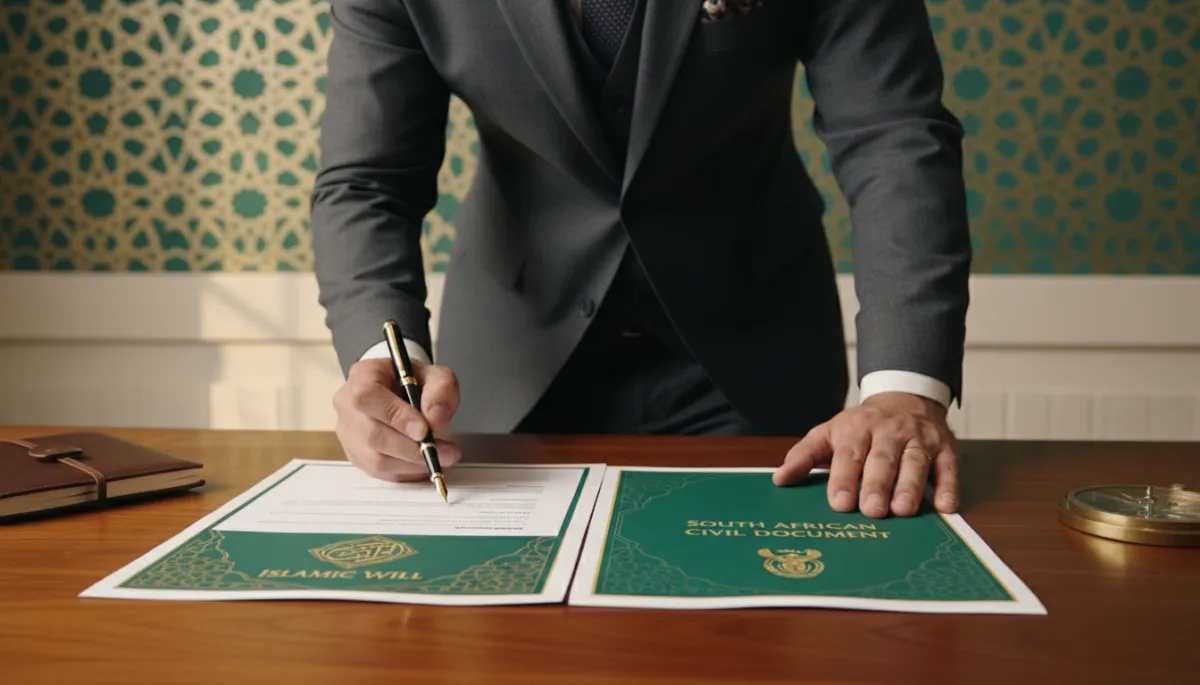
Muslim Will vs South African Will: What Every Muslim Family Needs to Know
Every South African Muslim needs to know this: a South African civil will and an Islamic will (wasiyyah) are two different documents serving two different legal frameworks. Having one does not mean you have the other. And having neither means your estate will be distributed by a court applying laws that were not designed for your faith.
This guide breaks down exactly how these two documents differ, why you need both, and what happens when Muslim families rely on one but not the other.
What Is a South African Civil Will?
A civil will is a legal document governed by the Wills Act 7 of 1953. To be legally valid in South Africa, it must be in writing, signed by the testator at the end of every page, signed in the presence of two competent witnesses who sign simultaneously, and made by someone who is at least 16 years old and mentally competent.
A valid civil will determines who inherits your assets and in what proportions, who is appointed as executor, who is appointed as guardian of minor children, and whether any testamentary trusts are created.
What a civil will does NOT do on its own: it does not ensure your estate is distributed according to Islamic inheritance law (faraid), it does not capture burial instructions accessibly (wills are often only read after burial), and it does not limit your dispositions to the wasiyyah ceiling of one-third for non-heirs.
If you die without a valid civil will in South Africa, the Intestate Succession Act applies. This Act distributes your estate among your spouse and children in proportions that bear no relation to Islamic inheritance shares. Your parents, siblings, and other heirs entitled under Islamic law may receive nothing.
What Is an Islamic Will (Wasiyyah)?
A wasiyyah is a testamentary instruction rooted in Islamic law. It specifies that your estate should be distributed according to faraid (the divinely ordained inheritance shares). It can bequeath up to one-third of your net estate to non-heirs — step-children, adopted children, charitable causes. It can include burial instructions your family can access immediately. And it expresses your intention to fulfil your obligations as a Muslim in death as in life.
What a wasiyyah alone does NOT achieve in South Africa: without being formalised as a legally valid civil will, a wasiyyah is not enforceable in a South African court. A verbal wasiyyah, or a written one that does not meet the Wills Act requirements, cannot be executed by the Master of the High Court. A standalone Islamic document that does not comply with South African legal formalities can be ignored entirely by the courts.
The Critical Difference: Two Frameworks, One Estate
South African law determines whether your will is legally valid and whether the courts will execute it. Islamic law determines whether your distribution is spiritually correct and fulfils your obligations before Allah. These are not the same thing. A will can be legally valid but Islamically deficient. A wasiyyah can be Islamically correct but legally unenforceable.
The solution is not to choose one over the other. It is to have a single document — or coordinated set of documents — that is simultaneously compliant with the Wills Act and compliant with Islamic law. This is known as an integrated Islamic will, and it is what every South African Muslim should have.
5 Common Mistakes Muslim Families Make
1. Having a Civil Will That Ignores Faraid
Many Muslim families have a civil will prepared by a mainstream attorney that distributes the estate “equally between the children” or leaves everything to a surviving spouse. This satisfies South African law but violates Islamic inheritance shares. The will is legally enforceable — and Islamically incorrect.
2. Having a Wasiyyah That Is Not Legally Formalised
A handwritten wasiyyah passed between family members, or a document prepared by a religious scholar without legal formalities, may be spiritually sincere but practically unenforceable. When assets are held by banks or investment companies, the executor needs a document the Master of the High Court will accept.
3. Bequeathing More Than One-Third to Non-Heirs
A civil will that tries to provide generously for a step-child or an adopted child may inadvertently give them more than the wasiyyah ceiling of one-third. This creates a distribution that is Islamically impermissible — regardless of what the civil law says.
4. Forgetting That Retirement Funds and Life Assurance Fall Outside the Will
These assets bypass your will entirely in South Africa. Your retirement fund death benefit is distributed by trustees at their discretion. Your life assurance pays to the nominated beneficiary. Neither automatically follows your civil will or your wasiyyah. They must be planned for separately. Read our guide on retirement funds and Islamic inheritance.
5. Never Updating Either Document After Life Changes
Marriage, divorce, the birth of children, or significant changes in wealth all affect your inheritance distribution. A will or wasiyyah that was accurate ten years ago may be completely misaligned with your current family structure and obligations.
What an Integrated Islamic Will Looks Like
An integrated Islamic will is a single legally valid document (compliant with the Wills Act) that states your intention to have your estate distributed according to Islamic law (faraid), appoints an executor who understands both South African estate administration and Islamic inheritance, includes a wasiyyah provision (up to one-third) for any non-heirs you wish to provide for, appoints guardians for minor children, references and coordinates with your takaful and retirement fund nominations, and includes burial instructions in a separate annexed document your family can access immediately.
Read our guides on how to write an Islamic will in South Africa, what a wasiyyah is, and Islamic wills in South Africa for more detail on each component.
How This Connects to Your Full Estate Plan
Your will is just one part of a complete estate plan. The full picture includes your retirement fund death benefit nominations, your life assurance and takaful beneficiary nominations, any testamentary trusts, a letter of wishes, and your burial instructions. Read our complete guide to Islamic estate planning and use our Islamic Inheritance Calculator to understand how your estate would be distributed under faraid with your current family structure.
Get Your Integrated Islamic Will in Place
If you do not currently have a document that is simultaneously Wills Act-compliant and Islamically correct — you need one. Every day without a valid integrated Islamic will is a day where your estate would be distributed in a way that serves neither South African law nor your Islamic obligations properly. Book a consultation with MuslimFin. We work with estate attorneys who understand both frameworks to ensure your family receives exactly what you intended, distributed correctly according to your faith.


